Event submissions
Published
 10.3390/ecsoc-28-20198 (registering DOI)
 This submission belongs to the session S4. Polymer and Supramolecular Chemistry of the event The 28th International Electronic Conference on Synthetic Organic Chemistry
Published date
14 Nov, 2024
Academic Editor
'%3e%3cpath%20d='M12.6657%2010.9104C12.4185%2010.325%2012.0599%209.79327%2011.6097%209.34482C11.1609%208.89508%2010.6293%208.5365%2010.0442%208.28888C10.0389%208.28626%2010.0337%208.28495%2010.0285%208.28233C10.8446%207.69279%2011.3752%206.73249%2011.3752%205.64904C11.3752%203.8542%209.92103%202.39999%208.1262%202.39999C6.33136%202.39999%204.87715%203.8542%204.87715%205.64904C4.87715%206.73249%205.40774%207.69279%206.22393%208.28364C6.21869%208.28626%206.21345%208.28757%206.20821%208.29019C5.62129%208.5378%205.09463%208.89284%204.64265%209.34613C4.1929%209.79493%203.83432%2010.3266%203.58671%2010.9117C3.34345%2011.4845%203.21226%2012.0987%203.20023%2012.7209C3.19988%2012.7349%203.20233%2012.7488%203.20744%2012.7619C3.21255%2012.7749%203.22022%2012.7867%203.22998%2012.7968C3.23975%2012.8068%203.25142%2012.8147%203.26431%2012.8202C3.2772%2012.8256%203.29105%2012.8284%203.30504%2012.8284H4.09109C4.14874%2012.8284%204.19459%2012.7825%204.1959%2012.7262C4.2221%2011.7148%204.62823%2010.7676%205.34617%2010.0497C6.08899%209.30683%207.0755%208.89808%208.1262%208.89808C9.17689%208.89808%2010.1634%209.30683%2010.9062%2010.0497C11.6242%2010.7676%2012.0303%2011.7148%2012.0565%2012.7262C12.0578%2012.7838%2012.1037%2012.8284%2012.1613%2012.8284H12.9474C12.9613%2012.8284%2012.9752%2012.8256%2012.9881%2012.8202C13.001%2012.8147%2013.0126%2012.8068%2013.0224%2012.7968C13.0322%2012.7867%2013.0398%2012.7749%2013.0449%2012.7619C13.0501%2012.7488%2013.0525%2012.7349%2013.0522%2012.7209C13.0391%2012.0947%2012.9094%2011.4855%2012.6657%2010.9104ZM8.1262%207.9024C7.52486%207.9024%206.9589%207.6679%206.53312%207.24211C6.10733%206.81633%205.87283%206.25037%205.87283%205.64904C5.87283%205.0477%206.10733%204.48174%206.53312%204.05596C6.9589%203.63018%207.52486%203.39567%208.1262%203.39567C8.72753%203.39567%209.29349%203.63018%209.71927%204.05596C10.1451%204.48174%2010.3796%205.0477%2010.3796%205.64904C10.3796%206.25037%2010.1451%206.81633%209.71927%207.24211C9.29349%207.6679%208.72753%207.9024%208.1262%207.9024Z'%20fill='%235D1EE1'/%3e%3c/g%3e%3c/svg%3e) Julio A. Seijas
Julio A. SeijasCitation
Anca-Dana Bendrea, Demet Göen-Colak, Luminita Cianga, Elena-Gabriela Hitruc, Ioan Cianga, Mariana Pinteala, Synthesis, Self-Assembling and Photophysical Properties Exploration of Water Self-Dispersible, Grafted Poly(p-Phenylene Vinylene)s with Nonionic, Hydrophylic and Biocompatible Side Chains, in Proceedings of The 28th International Electronic Conference on Synthetic Organic Chemistry, 15 November–30 November 2024, MDPI: Basel, Switzerland, doi: 10.3390/ecsoc-28-20198
Share
Email
Facebook
Twitter
LinkedIn
Synthesis, Self-Assembling and Photophysical Properties Exploration of Water Self-Dispersible, Grafted Poly(p-Phenylene Vinylene)s with Nonionic, Hydrophylic and Biocompatible Side Chains
'%3e%3cpath%20d='M12.6647%2010.9104C12.4176%2010.325%2012.0589%209.7933%2011.6088%209.34485C11.16%208.89511%2010.6283%208.53653%2010.0432%208.28891C10.038%208.28629%2010.0327%208.28498%2010.0275%208.28236C10.8437%207.69282%2011.3743%206.73252%2011.3743%205.64907C11.3743%203.85423%209.92005%202.40002%208.12522%202.40002C6.33038%202.40002%204.87618%203.85423%204.87618%205.64907C4.87618%206.73252%205.40677%207.69282%206.22296%208.28367C6.21772%208.28629%206.21248%208.2876%206.20724%208.29022C5.62031%208.53783%205.09365%208.89287%204.64167%209.34616C4.19192%209.79496%203.83334%2010.3266%203.58573%2010.9117C3.34247%2011.4846%203.21128%2012.0987%203.19925%2012.721C3.1989%2012.735%203.20135%2012.7489%203.20646%2012.7619C3.21157%2012.7749%203.21924%2012.7868%203.22901%2012.7968C3.23877%2012.8068%203.25045%2012.8148%203.26334%2012.8202C3.27623%2012.8256%203.29007%2012.8284%203.30406%2012.8284H4.09012C4.14776%2012.8284%204.19362%2012.7825%204.19493%2012.7262C4.22113%2011.7148%204.62726%2010.7676%205.34519%2010.0497C6.08802%209.30686%207.07452%208.89811%208.12522%208.89811C9.17592%208.89811%2010.1624%209.30686%2010.9052%2010.0497C11.6232%2010.7676%2012.0293%2011.7148%2012.0555%2012.7262C12.0568%2012.7839%2012.1027%2012.8284%2012.1603%2012.8284H12.9464C12.9604%2012.8284%2012.9742%2012.8256%2012.9871%2012.8202C13%2012.8148%2013.0117%2012.8068%2013.0214%2012.7968C13.0312%2012.7868%2013.0389%2012.7749%2013.044%2012.7619C13.0491%2012.7489%2013.0515%2012.735%2013.0512%2012.721C13.0381%2012.0947%2012.9084%2011.4856%2012.6647%2010.9104ZM8.12522%207.90243C7.52388%207.90243%206.95792%207.66793%206.53214%207.24215C6.10636%206.81636%205.87185%206.2504%205.87185%205.64907C5.87185%205.04773%206.10636%204.48177%206.53214%204.05599C6.95792%203.63021%207.52388%203.3957%208.12522%203.3957C8.72655%203.3957%209.29252%203.63021%209.7183%204.05599C10.1441%204.48177%2010.3786%205.04773%2010.3786%205.64907C10.3786%206.2504%2010.1441%206.81636%209.7183%207.24215C9.29252%207.66793%208.72655%207.90243%208.12522%207.90243Z'%20fill='%235D1EE1'/%3e%3c/g%3e%3c/svg%3e)
Anca-Dana Bendrea 1
Demet Göen-Colak 2
Luminita Cianga 1
Elena-Gabriela Hitruc 3
Ioan Cianga 1

Mariana Pinteala 1
1. Centre of Advanced Research in Bionanoconjugates and Biopolymers “Petru Poni” Institute of Macromolecular Chemistry 41 A, Grigore-GhicaVoda Alley, 700487 Iasi, Romania
2. Department of Chemistry, Faculty of Science and Letters, Istanbul Technical University Maslak, 34469 Istanbul, Turkey
3. Department of Physics of Polymers and Polymeric Materials, “Petru Poni” Institute of Macromolecular Chemistry, 41 A, Grigore-GhicaVoda Alley, 700487 Iasi, Romania
Abstract
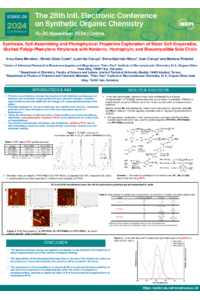
Biophotonics as a highly interdisciplinary paradigm, which studies biological processes activated by light at the molecular, cellular or tissue level, is increasingly important in modern medicine for diagnosis and therapy. Originally designed for the use in electronic and optoelectronic devices, conjugated polymers (CPs) have emerged as one of the most appropriate agents for biophotonics.
For a better interaction with biological entities, attaching hydrophilic side chains to the conjugated backbone, resulting in a grafted topology with enhanced properties in terms of physiological stability and optical properties, can be a better alternative to CPs nanoparticles encapsulation in amphiphilic biocompatible matrix by nanoprecipitation.
Following this strategy, the present communication reports on synthesis and basic characterization of amphiphilic grafted poly(p-phenylene vinylene)s (g-PPVs), having hydrophilic side chains differing in length, chemical nature and attaching way.
g-PPVs were synthesized by the Suzuki-Heck cascade polycondensation of macromonomers derived from PEG or poly(2-alkyl-oxazolines) (POXA). Spectral methods (1H-NMR, IR) were applied for polymers’ structural characterization, whereas DLS and AFM microscopy were complementary used to characterize the size and shape of the micellar nanoparticles formed by spontaneous self-assembling in aqueous media.
The photophysical properties of the formed micelles were followed by UV-vis and fluorescence spectroscopy and the results were discussed in relation with their size, the nature and the attaching way of the side chains. Interestingly, while for the PEG side chains the emission maximum appeared in the yellow-green region, for the both types of POXA a blue shift was noticed besides a clusteroluminescence phenomenon.
Keywords
biophotonics
amphiphilic grafted poly(p-phenylene vinylene)s
polyethylene glycol
poly(2-alkyl-oxazolines)
clusteroluminescence
Manuscript
chemproc-sciforum_102171_S4_original_I_Cianga_Main_manuscript-done.pdf
Poster
ICianga-Poster ECSOC-2024.pdf
Study of the stability, solubility and geometry of the complex of inclusion β-CD with the nimesulide by computer chemistry methods
Silica-polymer ionogel for energy storage applications