Event submissions
Published

This submission belongs to the session S5. Computational Chemistry of the event The 28th International Electronic Conference on Synthetic Organic Chemistry
Published date
14 Nov, 2024
Academic Editor
'%3e%3cpath%20d='M12.6657%2010.9104C12.4185%2010.325%2012.0599%209.79327%2011.6097%209.34482C11.1609%208.89508%2010.6293%208.5365%2010.0442%208.28888C10.0389%208.28626%2010.0337%208.28495%2010.0285%208.28233C10.8446%207.69279%2011.3752%206.73249%2011.3752%205.64904C11.3752%203.8542%209.92103%202.39999%208.1262%202.39999C6.33136%202.39999%204.87715%203.8542%204.87715%205.64904C4.87715%206.73249%205.40774%207.69279%206.22393%208.28364C6.21869%208.28626%206.21345%208.28757%206.20821%208.29019C5.62129%208.5378%205.09463%208.89284%204.64265%209.34613C4.1929%209.79493%203.83432%2010.3266%203.58671%2010.9117C3.34345%2011.4845%203.21226%2012.0987%203.20023%2012.7209C3.19988%2012.7349%203.20233%2012.7488%203.20744%2012.7619C3.21255%2012.7749%203.22022%2012.7867%203.22998%2012.7968C3.23975%2012.8068%203.25142%2012.8147%203.26431%2012.8202C3.2772%2012.8256%203.29105%2012.8284%203.30504%2012.8284H4.09109C4.14874%2012.8284%204.19459%2012.7825%204.1959%2012.7262C4.2221%2011.7148%204.62823%2010.7676%205.34617%2010.0497C6.08899%209.30683%207.0755%208.89808%208.1262%208.89808C9.17689%208.89808%2010.1634%209.30683%2010.9062%2010.0497C11.6242%2010.7676%2012.0303%2011.7148%2012.0565%2012.7262C12.0578%2012.7838%2012.1037%2012.8284%2012.1613%2012.8284H12.9474C12.9613%2012.8284%2012.9752%2012.8256%2012.9881%2012.8202C13.001%2012.8147%2013.0126%2012.8068%2013.0224%2012.7968C13.0322%2012.7867%2013.0398%2012.7749%2013.0449%2012.7619C13.0501%2012.7488%2013.0525%2012.7349%2013.0522%2012.7209C13.0391%2012.0947%2012.9094%2011.4855%2012.6657%2010.9104ZM8.1262%207.9024C7.52486%207.9024%206.9589%207.6679%206.53312%207.24211C6.10733%206.81633%205.87283%206.25037%205.87283%205.64904C5.87283%205.0477%206.10733%204.48174%206.53312%204.05596C6.9589%203.63018%207.52486%203.39567%208.1262%203.39567C8.72753%203.39567%209.29349%203.63018%209.71927%204.05596C10.1451%204.48174%2010.3796%205.0477%2010.3796%205.64904C10.3796%206.25037%2010.1451%206.81633%209.71927%207.24211C9.29349%207.6679%208.72753%207.9024%208.1262%207.9024Z'%20fill='%235D1EE1'/%3e%3c/g%3e%3c/svg%3e) Julio A. Seijas
Julio A. SeijasCitation
Mehdi HAMMAR, Nasséra BENBRAHIM, Amina NEGADI, Investigating the Molecular Interactions of Thymol and Menthol as Green Solvents Using DFT Calculations, in Proceedings of The 28th International Electronic Conference on Synthetic Organic Chemistry, 15 November–30 November 2024, MDPI: Basel, Switzerland, doi: 10.3390/ecsoc-28-20213
Share
Email
Facebook
Twitter
LinkedIn
Investigating the Molecular Interactions of Thymol and Menthol as Green Solvents Using DFT Calculations
'%3e%3cpath%20d='M12.6647%2010.9104C12.4176%2010.325%2012.0589%209.7933%2011.6088%209.34485C11.16%208.89511%2010.6283%208.53653%2010.0432%208.28891C10.038%208.28629%2010.0327%208.28498%2010.0275%208.28236C10.8437%207.69282%2011.3743%206.73252%2011.3743%205.64907C11.3743%203.85423%209.92005%202.40002%208.12522%202.40002C6.33038%202.40002%204.87618%203.85423%204.87618%205.64907C4.87618%206.73252%205.40677%207.69282%206.22296%208.28367C6.21772%208.28629%206.21248%208.2876%206.20724%208.29022C5.62031%208.53783%205.09365%208.89287%204.64167%209.34616C4.19192%209.79496%203.83334%2010.3266%203.58573%2010.9117C3.34247%2011.4846%203.21128%2012.0987%203.19925%2012.721C3.1989%2012.735%203.20135%2012.7489%203.20646%2012.7619C3.21157%2012.7749%203.21924%2012.7868%203.22901%2012.7968C3.23877%2012.8068%203.25045%2012.8148%203.26334%2012.8202C3.27623%2012.8256%203.29007%2012.8284%203.30406%2012.8284H4.09012C4.14776%2012.8284%204.19362%2012.7825%204.19493%2012.7262C4.22113%2011.7148%204.62726%2010.7676%205.34519%2010.0497C6.08802%209.30686%207.07452%208.89811%208.12522%208.89811C9.17592%208.89811%2010.1624%209.30686%2010.9052%2010.0497C11.6232%2010.7676%2012.0293%2011.7148%2012.0555%2012.7262C12.0568%2012.7839%2012.1027%2012.8284%2012.1603%2012.8284H12.9464C12.9604%2012.8284%2012.9742%2012.8256%2012.9871%2012.8202C13%2012.8148%2013.0117%2012.8068%2013.0214%2012.7968C13.0312%2012.7868%2013.0389%2012.7749%2013.044%2012.7619C13.0491%2012.7489%2013.0515%2012.735%2013.0512%2012.721C13.0381%2012.0947%2012.9084%2011.4856%2012.6647%2010.9104ZM8.12522%207.90243C7.52388%207.90243%206.95792%207.66793%206.53214%207.24215C6.10636%206.81636%205.87185%206.2504%205.87185%205.64907C5.87185%205.04773%206.10636%204.48177%206.53214%204.05599C6.95792%203.63021%207.52388%203.3957%208.12522%203.3957C8.72655%203.3957%209.29252%203.63021%209.7183%204.05599C10.1441%204.48177%2010.3786%205.04773%2010.3786%205.64907C10.3786%206.2504%2010.1441%206.81636%209.7183%207.24215C9.29252%207.66793%208.72655%207.90243%208.12522%207.90243Z'%20fill='%235D1EE1'/%3e%3c/g%3e%3c/svg%3e)
Mehdi HAMMAR 1,2
Nasséra BENBRAHIM 3
Amina NEGADI 2
1. 1 Laboratory of Advanced Materials and Physicochemistry for Environment and Health, Djillali Liabes University, Sidi Bel Abbes, Algeria.
2. Laboratory of Thermodynamics and Molecular Modeling, Abou Bekr Belkaid University, Tlemcen, Algeria.
3. Laboratory of Advanced Materials and Physicochemistry for Environment and Health, Djillali Liabes University, Sidi Bel Abbes, Algeria.
Abstract
Introduction:
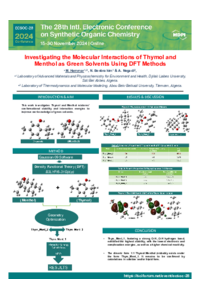
In the search for sustainable and environmentally friendly solutions, green solvents have attracted significant attention for their potential applications in pollution mitigation. They pave the way for the development of more efficient and sustainable methods for cleaning the environment, taking advantage of the unique properties of these green solvents [1,2].
Our research explores the molecular interactions between two naturally occurring green solvents, thymol and L-menthol. The first is found in many natural products. It is widely used for such purposes as medical disinfection. The second has various biological properties. It is used in a wide range of applications, including cosmetics, medicines and other consumer products.
Computational details:
To understand the behavior of one to the other, our work focuses on the study of the two separate systems and interactions due to their combination. This investigation helps to understand how this combination can improve their collective extraction capabilities. Structures, interaction stabilities and chemical descriptors are obtained with DFT.
Results and discussion:
GAPs increase considerably from monomers to dimers of thymol:L-menthol. Hence the increase in chemical reactivity. The values obtained for the chemical descriptors can contribute to the rational planning of experimental works. They confirm that thymol plays the role of nucleophile while L-menthol is the electrophile. Dimers, on the other hand, tend to be nucleophilic.
References:
[1] C. D’Hondt, D. Morineau, Journal of Molecular Liquids 365, 120145, (2022).
[2] P. A. Cablé, Y. Le Brech & F. Mutelet, Struct Chem 35, 321–339, (2024).
Keywords
Thymol
L-Menthol
Density Functional Theory (DFT)
Molecular Interactions
Reactivity
Toxicity.
Manuscript
chemproc-sciforum_099029_S5_original_ECSOC_28_Hammar_paper-done.pdf
Poster
ECSOC_28_Hammar_poster.pdf
In silico investigation of two benzoxanthone-flavonoids: ADMET analysis and xanthine oxidase binding
DFT studies on physicochemical properties and spectral data of 2-thiophene carboxylic acid thiourea derivatives