Event submissions
Published

This submission belongs to the session S5. Computational Chemistry of the event The 28th International Electronic Conference on Synthetic Organic Chemistry
Published date
14 Nov, 2024
Academic Editor
'%3e%3cpath%20d='M12.6657%2010.9104C12.4185%2010.325%2012.0599%209.79327%2011.6097%209.34482C11.1609%208.89508%2010.6293%208.5365%2010.0442%208.28888C10.0389%208.28626%2010.0337%208.28495%2010.0285%208.28233C10.8446%207.69279%2011.3752%206.73249%2011.3752%205.64904C11.3752%203.8542%209.92103%202.39999%208.1262%202.39999C6.33136%202.39999%204.87715%203.8542%204.87715%205.64904C4.87715%206.73249%205.40774%207.69279%206.22393%208.28364C6.21869%208.28626%206.21345%208.28757%206.20821%208.29019C5.62129%208.5378%205.09463%208.89284%204.64265%209.34613C4.1929%209.79493%203.83432%2010.3266%203.58671%2010.9117C3.34345%2011.4845%203.21226%2012.0987%203.20023%2012.7209C3.19988%2012.7349%203.20233%2012.7488%203.20744%2012.7619C3.21255%2012.7749%203.22022%2012.7867%203.22998%2012.7968C3.23975%2012.8068%203.25142%2012.8147%203.26431%2012.8202C3.2772%2012.8256%203.29105%2012.8284%203.30504%2012.8284H4.09109C4.14874%2012.8284%204.19459%2012.7825%204.1959%2012.7262C4.2221%2011.7148%204.62823%2010.7676%205.34617%2010.0497C6.08899%209.30683%207.0755%208.89808%208.1262%208.89808C9.17689%208.89808%2010.1634%209.30683%2010.9062%2010.0497C11.6242%2010.7676%2012.0303%2011.7148%2012.0565%2012.7262C12.0578%2012.7838%2012.1037%2012.8284%2012.1613%2012.8284H12.9474C12.9613%2012.8284%2012.9752%2012.8256%2012.9881%2012.8202C13.001%2012.8147%2013.0126%2012.8068%2013.0224%2012.7968C13.0322%2012.7867%2013.0398%2012.7749%2013.0449%2012.7619C13.0501%2012.7488%2013.0525%2012.7349%2013.0522%2012.7209C13.0391%2012.0947%2012.9094%2011.4855%2012.6657%2010.9104ZM8.1262%207.9024C7.52486%207.9024%206.9589%207.6679%206.53312%207.24211C6.10733%206.81633%205.87283%206.25037%205.87283%205.64904C5.87283%205.0477%206.10733%204.48174%206.53312%204.05596C6.9589%203.63018%207.52486%203.39567%208.1262%203.39567C8.72753%203.39567%209.29349%203.63018%209.71927%204.05596C10.1451%204.48174%2010.3796%205.0477%2010.3796%205.64904C10.3796%206.25037%2010.1451%206.81633%209.71927%207.24211C9.29349%207.6679%208.72753%207.9024%208.1262%207.9024Z'%20fill='%235D1EE1'/%3e%3c/g%3e%3c/svg%3e) Julio A. Seijas
Julio A. SeijasCitation
Milena Ivkovic, Milan Ilic, Natasa Nastic, Sladjana Krivosija, Senka Vidovic, Mire Zloh, In silico evaluation of the potential for the rational use of garlic and onion crop residue extracts in cosmetics, in Proceedings of The 28th International Electronic Conference on Synthetic Organic Chemistry, 15 November–30 November 2024, MDPI: Basel, Switzerland, doi: 10.3390/ecsoc-28-20217
Share
Email
Facebook
Twitter
LinkedIn
In silico evaluation of the potential for the rational use of garlic and onion crop residue extracts in cosmetics
'%3e%3cpath%20d='M12.6647%2010.9104C12.4176%2010.325%2012.0589%209.7933%2011.6088%209.34485C11.16%208.89511%2010.6283%208.53653%2010.0432%208.28891C10.038%208.28629%2010.0327%208.28498%2010.0275%208.28236C10.8437%207.69282%2011.3743%206.73252%2011.3743%205.64907C11.3743%203.85423%209.92005%202.40002%208.12522%202.40002C6.33038%202.40002%204.87618%203.85423%204.87618%205.64907C4.87618%206.73252%205.40677%207.69282%206.22296%208.28367C6.21772%208.28629%206.21248%208.2876%206.20724%208.29022C5.62031%208.53783%205.09365%208.89287%204.64167%209.34616C4.19192%209.79496%203.83334%2010.3266%203.58573%2010.9117C3.34247%2011.4846%203.21128%2012.0987%203.19925%2012.721C3.1989%2012.735%203.20135%2012.7489%203.20646%2012.7619C3.21157%2012.7749%203.21924%2012.7868%203.22901%2012.7968C3.23877%2012.8068%203.25045%2012.8148%203.26334%2012.8202C3.27623%2012.8256%203.29007%2012.8284%203.30406%2012.8284H4.09012C4.14776%2012.8284%204.19362%2012.7825%204.19493%2012.7262C4.22113%2011.7148%204.62726%2010.7676%205.34519%2010.0497C6.08802%209.30686%207.07452%208.89811%208.12522%208.89811C9.17592%208.89811%2010.1624%209.30686%2010.9052%2010.0497C11.6232%2010.7676%2012.0293%2011.7148%2012.0555%2012.7262C12.0568%2012.7839%2012.1027%2012.8284%2012.1603%2012.8284H12.9464C12.9604%2012.8284%2012.9742%2012.8256%2012.9871%2012.8202C13%2012.8148%2013.0117%2012.8068%2013.0214%2012.7968C13.0312%2012.7868%2013.0389%2012.7749%2013.044%2012.7619C13.0491%2012.7489%2013.0515%2012.735%2013.0512%2012.721C13.0381%2012.0947%2012.9084%2011.4856%2012.6647%2010.9104ZM8.12522%207.90243C7.52388%207.90243%206.95792%207.66793%206.53214%207.24215C6.10636%206.81636%205.87185%206.2504%205.87185%205.64907C5.87185%205.04773%206.10636%204.48177%206.53214%204.05599C6.95792%203.63021%207.52388%203.3957%208.12522%203.3957C8.72655%203.3957%209.29252%203.63021%209.7183%204.05599C10.1441%204.48177%2010.3786%205.04773%2010.3786%205.64907C10.3786%206.2504%2010.1441%206.81636%209.7183%207.24215C9.29252%207.66793%208.72655%207.90243%208.12522%207.90243Z'%20fill='%235D1EE1'/%3e%3c/g%3e%3c/svg%3e)
Milena Ivkovic 1
Milan Ilic 1

Natasa Nastic 2
Sladjana Krivosija 2
Senka Vidovic 2

Mire Zloh 1,3
1. Faculty of Pharmacy, Novi Sad, University Business Academy, Heroja Pinkija 4, Novi Sad, Serbia
2. Faculty of Technology, University of Novi Sad, Boulevard cara Lazara 1, Novi Sad, Serbia
3. University College London, UCL School of Pharmacy, London, UK
Abstract
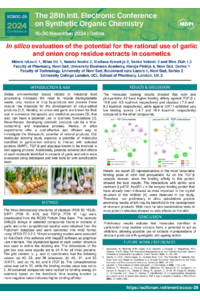
The crop residue after harvesting onion (Allium cepa) and garlic (Allium sativum) is significant and it has a great potential for use in developing value-added products due to presence of a range of bioactive compounds. A potential of compounds found in the crop residue extracts to be used in cosmetics was evaluated using a range of in silico approaches, including evaluation of their interactions with selected skin target proteins (SIRT1, TGF-beta and elastase). Molecular docking results obtained using AutoDockVina revealed that the strongest interaction between small molecules in garlic/onion extracts was observed with TGF-beta protein (-10.8 Kcal/mol – rutin; -9.5 Kcal/mol - procyanidin A2; -9.2 Kcal/mol – quercetin, kaempferol, epigallocatechin, epicatechin and catechin). SIRT1 protein showed the best interaction with quercetin (-8.9 Kcal/mol) and kaempferol (-8.8 Kcal/mol), while the elastase interacted favorably only with procyanidin A2 (-8.3 Kcal/mol) and rutin (-7.9 Kcal/mol). Potential side effects on the skin of an individual molecules in extracts of garlic and onion were predicted using regulated databases for skin sensitization tests (Ambit, SkinSensDB, Danish QSAR Database, SkinDoctorCP). By screening the most active molecules through the mentioned skin sensitization tests, it was confirmed that rutin and procyanidin A2 are not irritating or corrosive to the skin, while SkinSensDB and SkinDoctorCP test reported quercetin, epicatechin and catechin as non-sensitizer. The obtained results indicate a significant potential for the use of crop residue extracts in the development of skincare products from the sustainable resources while addressing the issues of waste.
Keywords
molecular docking
crop residues
skin sensitization
cosmetics
Manuscript
chemproc-sciforum_099332_S5_original_Manuscript_word_Milena_Ivkovic-done.pdf
Poster
Poster, Milena Ivkovic.pdf
Studies on Anti-Cancer Agents from Natural Resources with Special Reference to Cannabis sativa & Datura metel L.
Computational investigations of Arylnaphthalene Lignan Lactones as anticancer agents