Event submissions
Published

This submission belongs to the session S5. Computational Chemistry of the event The 28th International Electronic Conference on Synthetic Organic Chemistry
Published date
14 Nov, 2024
Academic Editor
'%3e%3cpath%20d='M12.6657%2010.9104C12.4185%2010.325%2012.0599%209.79327%2011.6097%209.34482C11.1609%208.89508%2010.6293%208.5365%2010.0442%208.28888C10.0389%208.28626%2010.0337%208.28495%2010.0285%208.28233C10.8446%207.69279%2011.3752%206.73249%2011.3752%205.64904C11.3752%203.8542%209.92103%202.39999%208.1262%202.39999C6.33136%202.39999%204.87715%203.8542%204.87715%205.64904C4.87715%206.73249%205.40774%207.69279%206.22393%208.28364C6.21869%208.28626%206.21345%208.28757%206.20821%208.29019C5.62129%208.5378%205.09463%208.89284%204.64265%209.34613C4.1929%209.79493%203.83432%2010.3266%203.58671%2010.9117C3.34345%2011.4845%203.21226%2012.0987%203.20023%2012.7209C3.19988%2012.7349%203.20233%2012.7488%203.20744%2012.7619C3.21255%2012.7749%203.22022%2012.7867%203.22998%2012.7968C3.23975%2012.8068%203.25142%2012.8147%203.26431%2012.8202C3.2772%2012.8256%203.29105%2012.8284%203.30504%2012.8284H4.09109C4.14874%2012.8284%204.19459%2012.7825%204.1959%2012.7262C4.2221%2011.7148%204.62823%2010.7676%205.34617%2010.0497C6.08899%209.30683%207.0755%208.89808%208.1262%208.89808C9.17689%208.89808%2010.1634%209.30683%2010.9062%2010.0497C11.6242%2010.7676%2012.0303%2011.7148%2012.0565%2012.7262C12.0578%2012.7838%2012.1037%2012.8284%2012.1613%2012.8284H12.9474C12.9613%2012.8284%2012.9752%2012.8256%2012.9881%2012.8202C13.001%2012.8147%2013.0126%2012.8068%2013.0224%2012.7968C13.0322%2012.7867%2013.0398%2012.7749%2013.0449%2012.7619C13.0501%2012.7488%2013.0525%2012.7349%2013.0522%2012.7209C13.0391%2012.0947%2012.9094%2011.4855%2012.6657%2010.9104ZM8.1262%207.9024C7.52486%207.9024%206.9589%207.6679%206.53312%207.24211C6.10733%206.81633%205.87283%206.25037%205.87283%205.64904C5.87283%205.0477%206.10733%204.48174%206.53312%204.05596C6.9589%203.63018%207.52486%203.39567%208.1262%203.39567C8.72753%203.39567%209.29349%203.63018%209.71927%204.05596C10.1451%204.48174%2010.3796%205.0477%2010.3796%205.64904C10.3796%206.25037%2010.1451%206.81633%209.71927%207.24211C9.29349%207.6679%208.72753%207.9024%208.1262%207.9024Z'%20fill='%235D1EE1'/%3e%3c/g%3e%3c/svg%3e) Julio A. Seijas
Julio A. SeijasCitation
Andrea Defant, Thamere Cheriet, Ines Mancini, Acetylcholinesterase as Target for Heliotridine-Type Alkaloids Isolated from Plants: A Computational Study
, in Proceedings of The 28th International Electronic Conference on Synthetic Organic Chemistry, 15 November–30 November 2024, MDPI: Basel, Switzerland, doi: 10.3390/ecsoc-28-20223
Share
Email
Facebook
Twitter
LinkedIn
Acetylcholinesterase as Target for Heliotridine-Type Alkaloids Isolated from Plants: A Computational Study
'%3e%3cpath%20d='M12.6647%2010.9104C12.4176%2010.325%2012.0589%209.7933%2011.6088%209.34485C11.16%208.89511%2010.6283%208.53653%2010.0432%208.28891C10.038%208.28629%2010.0327%208.28498%2010.0275%208.28236C10.8437%207.69282%2011.3743%206.73252%2011.3743%205.64907C11.3743%203.85423%209.92005%202.40002%208.12522%202.40002C6.33038%202.40002%204.87618%203.85423%204.87618%205.64907C4.87618%206.73252%205.40677%207.69282%206.22296%208.28367C6.21772%208.28629%206.21248%208.2876%206.20724%208.29022C5.62031%208.53783%205.09365%208.89287%204.64167%209.34616C4.19192%209.79496%203.83334%2010.3266%203.58573%2010.9117C3.34247%2011.4846%203.21128%2012.0987%203.19925%2012.721C3.1989%2012.735%203.20135%2012.7489%203.20646%2012.7619C3.21157%2012.7749%203.21924%2012.7868%203.22901%2012.7968C3.23877%2012.8068%203.25045%2012.8148%203.26334%2012.8202C3.27623%2012.8256%203.29007%2012.8284%203.30406%2012.8284H4.09012C4.14776%2012.8284%204.19362%2012.7825%204.19493%2012.7262C4.22113%2011.7148%204.62726%2010.7676%205.34519%2010.0497C6.08802%209.30686%207.07452%208.89811%208.12522%208.89811C9.17592%208.89811%2010.1624%209.30686%2010.9052%2010.0497C11.6232%2010.7676%2012.0293%2011.7148%2012.0555%2012.7262C12.0568%2012.7839%2012.1027%2012.8284%2012.1603%2012.8284H12.9464C12.9604%2012.8284%2012.9742%2012.8256%2012.9871%2012.8202C13%2012.8148%2013.0117%2012.8068%2013.0214%2012.7968C13.0312%2012.7868%2013.0389%2012.7749%2013.044%2012.7619C13.0491%2012.7489%2013.0515%2012.735%2013.0512%2012.721C13.0381%2012.0947%2012.9084%2011.4856%2012.6647%2010.9104ZM8.12522%207.90243C7.52388%207.90243%206.95792%207.66793%206.53214%207.24215C6.10636%206.81636%205.87185%206.2504%205.87185%205.64907C5.87185%205.04773%206.10636%204.48177%206.53214%204.05599C6.95792%203.63021%207.52388%203.3957%208.12522%203.3957C8.72655%203.3957%209.29252%203.63021%209.7183%204.05599C10.1441%204.48177%2010.3786%205.04773%2010.3786%205.64907C10.3786%206.2504%2010.1441%206.81636%209.7183%207.24215C9.29252%207.66793%208.72655%207.90243%208.12522%207.90243Z'%20fill='%235D1EE1'/%3e%3c/g%3e%3c/svg%3e)
Andrea Defant 1
Thamere Cheriet 2,3

Ines Mancini 1
1. Laboratory of Bioorganic Chemistry, Department of Physics, University of Trento, Via Sommarive 14, 38123 Trento, Italy
2. Valorization of Natural Resources, Bioactive Molecules, and Physicochemical and Biological Analysis (VARENBIOMOL); University of the Mentouri Brothers, Constantine, Algeria
3. Department of Material Science, Faculty of Exact Sciences, and Natural and Life Sciences, Larbi Ben M’hidi-Oum El-Bouaghi University, Algeria
Abstract
Acetylcholinesterase (AChE) is a key enzyme of cholinergic neurotransmission, acting in mammalians and insects. Depending on the type of mechanism, its inhibitors are relevant for the action of drugs in the treatment of human diseases, including Alzheimer’s disorder, and for the development of insecticides.
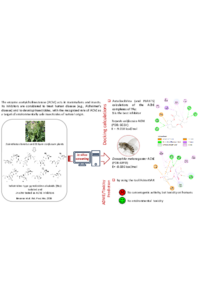
We report here on the results of molecular docking calculations performed on the Torpedo californica AChE (PDB ID: 6G1V) complexes of eight natural pyrrolizidine alkaloids (PAs) isolated from Solenthatus lanatus and Echium confusum plants. The data were correlated with the results previously reported by in vitro screening of 7-O-angeloylechinatine N-oxide 3’-O-acetylheliosupine N-oxide, heliosupine N-oxide, heliosupine, 7-O-angeloyllycopsamine N-oxide, echimidine N-oxide, and echimidine 7-O-angeloylretronecine as inhibitors of electric eel AChE.
Due to the known hepatoxicity of these alkaloids that prevents any potential application in human therapy, we focused on inhibiting fruit fly Drosophila melanogaster AChE (PDB ID: 6XYU). This choice is related to the role of AChE as a target of environmentally safe and selective insecticides and to the ethnobotanical interest in extracts from local plants to protect against insects and treat parasites. The data obtained by AutoDock Vina and Protein-Ligand-ANTSystem (PLANTS) indicated the presence of the hydroxylated chain as a crucial feature for the inhibitory activity of these PA structures.
ADME/Toxicity parameters were also predicted for human and eco-toxicities of all metabolites using the admetSAR tool.
The results of this in silico screening may serve as a further indication in investigating these natural molecules as scaffolds for the potential development of insecticides.
Keywords
Acetylcholinesterase
molecular docking
natural products
alkaloids
plants
insecticides
Manuscript
chemproc-sciforum_101885_Defant_Proccedings-done.pdf
Poster
26Nov_Defant_slide.pdf
In silico pharmacological prediction of capitavine, buchenavianine and related flavonoid alkaloids
In Silico Evaluation of Novel 2-Pyrazoline Carboxamide Derivatives as Potential Protease Inhibitors Against Plasmodium Parasites