Event submissions
Published
This submission belongs to the session Posters. Poster Session of the event 2nd Canadian Peptide and Protein Community Virtual Meeting
Published date
15 Nov, 2024
Academic Editor
'%3e%3cpath%20d='M12.6657%2010.9104C12.4185%2010.325%2012.0599%209.79327%2011.6097%209.34482C11.1609%208.89508%2010.6293%208.5365%2010.0442%208.28888C10.0389%208.28626%2010.0337%208.28495%2010.0285%208.28233C10.8446%207.69279%2011.3752%206.73249%2011.3752%205.64904C11.3752%203.8542%209.92103%202.39999%208.1262%202.39999C6.33136%202.39999%204.87715%203.8542%204.87715%205.64904C4.87715%206.73249%205.40774%207.69279%206.22393%208.28364C6.21869%208.28626%206.21345%208.28757%206.20821%208.29019C5.62129%208.5378%205.09463%208.89284%204.64265%209.34613C4.1929%209.79493%203.83432%2010.3266%203.58671%2010.9117C3.34345%2011.4845%203.21226%2012.0987%203.20023%2012.7209C3.19988%2012.7349%203.20233%2012.7488%203.20744%2012.7619C3.21255%2012.7749%203.22022%2012.7867%203.22998%2012.7968C3.23975%2012.8068%203.25142%2012.8147%203.26431%2012.8202C3.2772%2012.8256%203.29105%2012.8284%203.30504%2012.8284H4.09109C4.14874%2012.8284%204.19459%2012.7825%204.1959%2012.7262C4.2221%2011.7148%204.62823%2010.7676%205.34617%2010.0497C6.08899%209.30683%207.0755%208.89808%208.1262%208.89808C9.17689%208.89808%2010.1634%209.30683%2010.9062%2010.0497C11.6242%2010.7676%2012.0303%2011.7148%2012.0565%2012.7262C12.0578%2012.7838%2012.1037%2012.8284%2012.1613%2012.8284H12.9474C12.9613%2012.8284%2012.9752%2012.8256%2012.9881%2012.8202C13.001%2012.8147%2013.0126%2012.8068%2013.0224%2012.7968C13.0322%2012.7867%2013.0398%2012.7749%2013.0449%2012.7619C13.0501%2012.7488%2013.0525%2012.7349%2013.0522%2012.7209C13.0391%2012.0947%2012.9094%2011.4855%2012.6657%2010.9104ZM8.1262%207.9024C7.52486%207.9024%206.9589%207.6679%206.53312%207.24211C6.10733%206.81633%205.87283%206.25037%205.87283%205.64904C5.87283%205.0477%206.10733%204.48174%206.53312%204.05596C6.9589%203.63018%207.52486%203.39567%208.1262%203.39567C8.72753%203.39567%209.29349%203.63018%209.71927%204.05596C10.1451%204.48174%2010.3796%205.0477%2010.3796%205.64904C10.3796%206.25037%2010.1451%206.81633%209.71927%207.24211C9.29349%207.6679%208.72753%207.9024%208.1262%207.9024Z'%20fill='%235D1EE1'/%3e%3c/g%3e%3c/svg%3e) William D. Lubell
William D. LubellCitation
Larissa Cunico, Eduarda Heck Sumny, Aniela Pinto Kempka, Immune Modulation and Reduction of Inflammatory Biomarkers by Bioactive Peptides from Whey Fermented with Saccharomyces boulardii in an Animal Model, in Proceedings of 2nd Canadian Peptide and Protein Community Virtual Meeting, 16 December 2024, MDPI: Basel, Switzerland
Share
Email
Facebook
Twitter
LinkedIn
Immune Modulation and Reduction of Inflammatory Biomarkers by Bioactive Peptides from Whey Fermented with Saccharomyces boulardii in an Animal Model
'%3e%3cpath%20d='M12.6647%2010.9104C12.4176%2010.325%2012.0589%209.7933%2011.6088%209.34485C11.16%208.89511%2010.6283%208.53653%2010.0432%208.28891C10.038%208.28629%2010.0327%208.28498%2010.0275%208.28236C10.8437%207.69282%2011.3743%206.73252%2011.3743%205.64907C11.3743%203.85423%209.92005%202.40002%208.12522%202.40002C6.33038%202.40002%204.87618%203.85423%204.87618%205.64907C4.87618%206.73252%205.40677%207.69282%206.22296%208.28367C6.21772%208.28629%206.21248%208.2876%206.20724%208.29022C5.62031%208.53783%205.09365%208.89287%204.64167%209.34616C4.19192%209.79496%203.83334%2010.3266%203.58573%2010.9117C3.34247%2011.4846%203.21128%2012.0987%203.19925%2012.721C3.1989%2012.735%203.20135%2012.7489%203.20646%2012.7619C3.21157%2012.7749%203.21924%2012.7868%203.22901%2012.7968C3.23877%2012.8068%203.25045%2012.8148%203.26334%2012.8202C3.27623%2012.8256%203.29007%2012.8284%203.30406%2012.8284H4.09012C4.14776%2012.8284%204.19362%2012.7825%204.19493%2012.7262C4.22113%2011.7148%204.62726%2010.7676%205.34519%2010.0497C6.08802%209.30686%207.07452%208.89811%208.12522%208.89811C9.17592%208.89811%2010.1624%209.30686%2010.9052%2010.0497C11.6232%2010.7676%2012.0293%2011.7148%2012.0555%2012.7262C12.0568%2012.7839%2012.1027%2012.8284%2012.1603%2012.8284H12.9464C12.9604%2012.8284%2012.9742%2012.8256%2012.9871%2012.8202C13%2012.8148%2013.0117%2012.8068%2013.0214%2012.7968C13.0312%2012.7868%2013.0389%2012.7749%2013.044%2012.7619C13.0491%2012.7489%2013.0515%2012.735%2013.0512%2012.721C13.0381%2012.0947%2012.9084%2011.4856%2012.6647%2010.9104ZM8.12522%207.90243C7.52388%207.90243%206.95792%207.66793%206.53214%207.24215C6.10636%206.81636%205.87185%206.2504%205.87185%205.64907C5.87185%205.04773%206.10636%204.48177%206.53214%204.05599C6.95792%203.63021%207.52388%203.3957%208.12522%203.3957C8.72655%203.3957%209.29252%203.63021%209.7183%204.05599C10.1441%204.48177%2010.3786%205.04773%2010.3786%205.64907C10.3786%206.2504%2010.1441%206.81636%209.7183%207.24215C9.29252%207.66793%208.72655%207.90243%208.12522%207.90243Z'%20fill='%235D1EE1'/%3e%3c/g%3e%3c/svg%3e)
Larissa Cunico 1
Eduarda Heck Sumny 2

Aniela Pinto Kempka 3
1. Department of Zootechnics, Santa Catarina State University – UDESC. Chapecó, SC, Brazil.
2. Postgraduate Program in Food Science and Technology. Department of Food Engineering and Chemical Engineering, Santa Catarina State University – UDESC. Pinhalzinho, SC, Brazil.
3. Department of Food Engineering and Chemical Engineering, Santa Catarina State University – UDESC. Pinhalzinho, SC, Brazil
Abstract
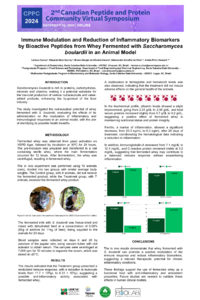
The study investigated the nutraceutical potential of whey fermented with Saccharomyces boulardii, emphasizing its effects on inflammatory and immunological responses in an animal model. Fermented whey was obtained through yeast activation and incubation at 30°C for 24 hours, followed by a 12-hour fermentation process, with subsequent centrifugation to remove microorganisms. In vivo experiments (CEUA/UDESC no. 3728250923) involved 15 female cats, divided into a Control group (8 animals) and a Treatment group (7 animals) that received fermented whey mixed with feed at a concentration of 0.59% for 20 days. Peptidomic analysis identified 715 peptides in digested fermented whey, with 15.21% exhibiting antioxidant potential. Anti-inflammatory predictions revealed a higher prevalence of high-confidence peptides. Blood analysis demonstrated a reduction in leukocytes (from 11.7 × 10³/µL to 6.31 × 10³/µL), an increase in lymphocytes (from 3.73 × 10³/µL to 7.6 × 10³/µL), and a decrease in ferritin (from 23.3 ng/mL to 6.3 ng/mL), indicating reduced inflammation. Albumin showed a slight improvement (from 2.34 to 2.50 g/dL), while C-reactive protein levels remained stable. The results indicate that peptides from fermented whey can modulate immune responses and decrease inflammatory markers, suggesting therapeutic potential for chronic inflammation and supporting its use as a functional food.
Keywords
Peptides
Probiotic
anti-inflammatory
Immunology
Poster
CPPC 2024 - Immune Modulation and Reduction of Inflammatory Biomarkers by Bioactive Peptides from Whey Fermented with Saccharomyces boulardii in an Animal Model.pdf
Artificial Hydrolase based on Self-assembled Peptide and Their Potential Applications
Molecular characterization of the interaction between the Hsp70 chaperone Binding immunoglobulin protein (BiP) and the islet amyloid polypeptide for the inhibition of amyloid formation