Event submissions
Published
This submission belongs to the session Posters. Poster Session of the event 2nd Canadian Peptide and Protein Community Virtual Meeting
Published date
15 Nov, 2024
Academic Editor
'%3e%3cpath%20d='M12.6657%2010.9104C12.4185%2010.325%2012.0599%209.79327%2011.6097%209.34482C11.1609%208.89508%2010.6293%208.5365%2010.0442%208.28888C10.0389%208.28626%2010.0337%208.28495%2010.0285%208.28233C10.8446%207.69279%2011.3752%206.73249%2011.3752%205.64904C11.3752%203.8542%209.92103%202.39999%208.1262%202.39999C6.33136%202.39999%204.87715%203.8542%204.87715%205.64904C4.87715%206.73249%205.40774%207.69279%206.22393%208.28364C6.21869%208.28626%206.21345%208.28757%206.20821%208.29019C5.62129%208.5378%205.09463%208.89284%204.64265%209.34613C4.1929%209.79493%203.83432%2010.3266%203.58671%2010.9117C3.34345%2011.4845%203.21226%2012.0987%203.20023%2012.7209C3.19988%2012.7349%203.20233%2012.7488%203.20744%2012.7619C3.21255%2012.7749%203.22022%2012.7867%203.22998%2012.7968C3.23975%2012.8068%203.25142%2012.8147%203.26431%2012.8202C3.2772%2012.8256%203.29105%2012.8284%203.30504%2012.8284H4.09109C4.14874%2012.8284%204.19459%2012.7825%204.1959%2012.7262C4.2221%2011.7148%204.62823%2010.7676%205.34617%2010.0497C6.08899%209.30683%207.0755%208.89808%208.1262%208.89808C9.17689%208.89808%2010.1634%209.30683%2010.9062%2010.0497C11.6242%2010.7676%2012.0303%2011.7148%2012.0565%2012.7262C12.0578%2012.7838%2012.1037%2012.8284%2012.1613%2012.8284H12.9474C12.9613%2012.8284%2012.9752%2012.8256%2012.9881%2012.8202C13.001%2012.8147%2013.0126%2012.8068%2013.0224%2012.7968C13.0322%2012.7867%2013.0398%2012.7749%2013.0449%2012.7619C13.0501%2012.7488%2013.0525%2012.7349%2013.0522%2012.7209C13.0391%2012.0947%2012.9094%2011.4855%2012.6657%2010.9104ZM8.1262%207.9024C7.52486%207.9024%206.9589%207.6679%206.53312%207.24211C6.10733%206.81633%205.87283%206.25037%205.87283%205.64904C5.87283%205.0477%206.10733%204.48174%206.53312%204.05596C6.9589%203.63018%207.52486%203.39567%208.1262%203.39567C8.72753%203.39567%209.29349%203.63018%209.71927%204.05596C10.1451%204.48174%2010.3796%205.0477%2010.3796%205.64904C10.3796%206.25037%2010.1451%206.81633%209.71927%207.24211C9.29349%207.6679%208.72753%207.9024%208.1262%207.9024Z'%20fill='%235D1EE1'/%3e%3c/g%3e%3c/svg%3e) William D. Lubell
William D. LubellCitation
Emilia Oueis, Walaa K. Mousa, Ashif Y. Shaikh, Rose Ghemrawi, Mohammed Aldulaimi, Aya Alali, Nour Sammani, Mostafa Khair, Mohamed I. Helal, Farah Al-Marzooq, Human microbiome-derived synthetic peptides with antibacterial activity, in Proceedings of 2nd Canadian Peptide and Protein Community Virtual Meeting, 16 December 2024, MDPI: Basel, Switzerland
Share
Email
Facebook
Twitter
LinkedIn
Human microbiome-derived synthetic peptides with antibacterial activity
'%3e%3cpath%20d='M12.6647%2010.9104C12.4176%2010.325%2012.0589%209.7933%2011.6088%209.34485C11.16%208.89511%2010.6283%208.53653%2010.0432%208.28891C10.038%208.28629%2010.0327%208.28498%2010.0275%208.28236C10.8437%207.69282%2011.3743%206.73252%2011.3743%205.64907C11.3743%203.85423%209.92005%202.40002%208.12522%202.40002C6.33038%202.40002%204.87618%203.85423%204.87618%205.64907C4.87618%206.73252%205.40677%207.69282%206.22296%208.28367C6.21772%208.28629%206.21248%208.2876%206.20724%208.29022C5.62031%208.53783%205.09365%208.89287%204.64167%209.34616C4.19192%209.79496%203.83334%2010.3266%203.58573%2010.9117C3.34247%2011.4846%203.21128%2012.0987%203.19925%2012.721C3.1989%2012.735%203.20135%2012.7489%203.20646%2012.7619C3.21157%2012.7749%203.21924%2012.7868%203.22901%2012.7968C3.23877%2012.8068%203.25045%2012.8148%203.26334%2012.8202C3.27623%2012.8256%203.29007%2012.8284%203.30406%2012.8284H4.09012C4.14776%2012.8284%204.19362%2012.7825%204.19493%2012.7262C4.22113%2011.7148%204.62726%2010.7676%205.34519%2010.0497C6.08802%209.30686%207.07452%208.89811%208.12522%208.89811C9.17592%208.89811%2010.1624%209.30686%2010.9052%2010.0497C11.6232%2010.7676%2012.0293%2011.7148%2012.0555%2012.7262C12.0568%2012.7839%2012.1027%2012.8284%2012.1603%2012.8284H12.9464C12.9604%2012.8284%2012.9742%2012.8256%2012.9871%2012.8202C13%2012.8148%2013.0117%2012.8068%2013.0214%2012.7968C13.0312%2012.7868%2013.0389%2012.7749%2013.044%2012.7619C13.0491%2012.7489%2013.0515%2012.735%2013.0512%2012.721C13.0381%2012.0947%2012.9084%2011.4856%2012.6647%2010.9104ZM8.12522%207.90243C7.52388%207.90243%206.95792%207.66793%206.53214%207.24215C6.10636%206.81636%205.87185%206.2504%205.87185%205.64907C5.87185%205.04773%206.10636%204.48177%206.53214%204.05599C6.95792%203.63021%207.52388%203.3957%208.12522%203.3957C8.72655%203.3957%209.29252%203.63021%209.7183%204.05599C10.1441%204.48177%2010.3786%205.04773%2010.3786%205.64907C10.3786%206.2504%2010.1441%206.81636%209.7183%207.24215C9.29252%207.66793%208.72655%207.90243%208.12522%207.90243Z'%20fill='%235D1EE1'/%3e%3c/g%3e%3c/svg%3e)
Emilia Oueis 1,2
Walaa K. Mousa 3,4,5
Ashif Y. Shaikh 1
Rose Ghemrawi 3,4
Mohammed Aldulaimi 1
Aya Alali 3
Nour Sammani 3
Mostafa Khair 6
Mohamed I. Helal 7
Farah Al-Marzooq 8
1. Chemistry department, Khalifa University of Science and Technology
2. Healthcare engineering innovation group, Khalifa University of Science and Technology
3. College of Pharmacy, Al Ain University, Abu Dhabi
4. AAU Health and Biomedical Research Center, Al Ain University, United Arab Emirates
5. College of Pharmacy, Mansoura University, Mansoura 35516, Egypt
6. Core Technology Platforms, New York University Abu Dhabi
7. Electron Microscopy Core Labs, Khalifa University of Science and Technology
8. Department of Medical Microbiology and Immunology, College of Medicine and Health Sciences, UAE University
Abstract
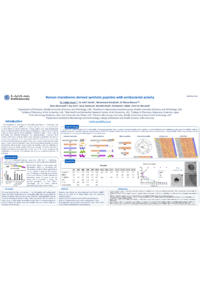
Antimicrobial resistance (AMR) has become one of the biggest health challenges of this era, causing yearly millions of deaths worldwide. However, there has been a sharp decline in antibiotic development despite the critical need for novel therapies. In our work, we propose multiple methodologies for the discovery and design of peptidic compounds with antibacterial activities, ranging from natural products to inhibitor design. In this talk, we focus on the progress we have made in the development of nature-derived antimicrobial peptides (AMP). Lactomodulin, a 53-amino acid long microbiome-derived AMP, has both antibiotic and anti-inflammatory activity. We have analyzed the composition and structure of the parent peptide and generated shorter truncated versions analyzed based on AMP potential, helical propensity, and toxicity predictions. Out of 13 derivatives, one 15-mer LSKISGGIGPLVIPV-NH2 and its cyclic versions have shown improved activity against Gram-positive (MIC 0.8─2.3 µM), including resistant strains, and Gram-negative bacteria (MIC 8─9.3 µM). Time killing assays further showed a fast bactericidal activity and TEM studies indicated a membrane-targeting mode of action. Interestingly, other peptides from the initial library also showed a retention of anti-inflammatory activity. These results pave the way for the development of unique peptides with Gram-positive, Gram-negative, and anti-inflammatory activities.
Keywords
peptide therapeutics
antimicrobial resistance
antimicrobial peptides
Poster
Landscape.pdf
Molecular characterization of the interaction between the Hsp70 chaperone Binding immunoglobulin protein (BiP) and the islet amyloid polypeptide for the inhibition of amyloid formation
Converting Protein into a Bioactive Peptide: Discovery of IL-6 antagonist