Event submissions
Published
 10.3390/ecsoc-28-20257 (registering DOI)
 This submission belongs to the session S4. Polymer and Supramolecular Chemistry of the event The 28th International Electronic Conference on Synthetic Organic Chemistry
Published date
15 Nov, 2024
Academic Editor
'%3e%3cpath%20d='M12.6657%2010.9104C12.4185%2010.325%2012.0599%209.79327%2011.6097%209.34482C11.1609%208.89508%2010.6293%208.5365%2010.0442%208.28888C10.0389%208.28626%2010.0337%208.28495%2010.0285%208.28233C10.8446%207.69279%2011.3752%206.73249%2011.3752%205.64904C11.3752%203.8542%209.92103%202.39999%208.1262%202.39999C6.33136%202.39999%204.87715%203.8542%204.87715%205.64904C4.87715%206.73249%205.40774%207.69279%206.22393%208.28364C6.21869%208.28626%206.21345%208.28757%206.20821%208.29019C5.62129%208.5378%205.09463%208.89284%204.64265%209.34613C4.1929%209.79493%203.83432%2010.3266%203.58671%2010.9117C3.34345%2011.4845%203.21226%2012.0987%203.20023%2012.7209C3.19988%2012.7349%203.20233%2012.7488%203.20744%2012.7619C3.21255%2012.7749%203.22022%2012.7867%203.22998%2012.7968C3.23975%2012.8068%203.25142%2012.8147%203.26431%2012.8202C3.2772%2012.8256%203.29105%2012.8284%203.30504%2012.8284H4.09109C4.14874%2012.8284%204.19459%2012.7825%204.1959%2012.7262C4.2221%2011.7148%204.62823%2010.7676%205.34617%2010.0497C6.08899%209.30683%207.0755%208.89808%208.1262%208.89808C9.17689%208.89808%2010.1634%209.30683%2010.9062%2010.0497C11.6242%2010.7676%2012.0303%2011.7148%2012.0565%2012.7262C12.0578%2012.7838%2012.1037%2012.8284%2012.1613%2012.8284H12.9474C12.9613%2012.8284%2012.9752%2012.8256%2012.9881%2012.8202C13.001%2012.8147%2013.0126%2012.8068%2013.0224%2012.7968C13.0322%2012.7867%2013.0398%2012.7749%2013.0449%2012.7619C13.0501%2012.7488%2013.0525%2012.7349%2013.0522%2012.7209C13.0391%2012.0947%2012.9094%2011.4855%2012.6657%2010.9104ZM8.1262%207.9024C7.52486%207.9024%206.9589%207.6679%206.53312%207.24211C6.10733%206.81633%205.87283%206.25037%205.87283%205.64904C5.87283%205.0477%206.10733%204.48174%206.53312%204.05596C6.9589%203.63018%207.52486%203.39567%208.1262%203.39567C8.72753%203.39567%209.29349%203.63018%209.71927%204.05596C10.1451%204.48174%2010.3796%205.0477%2010.3796%205.64904C10.3796%206.25037%2010.1451%206.81633%209.71927%207.24211C9.29349%207.6679%208.72753%207.9024%208.1262%207.9024Z'%20fill='%235D1EE1'/%3e%3c/g%3e%3c/svg%3e) Julio A. Seijas
Julio A. SeijasCitation
Anca-Dana Bendrea, Natalia Simionescu, Elena-Gabriela Hitruc, Luminita Cianga, Ioan Cianga, Mariana Pinteala, Combining oligothiophene with oligo-(D,L-lactide) into a complex, branched topology toward a functional interface aimed at biomedical applications, in Proceedings of The 28th International Electronic Conference on Synthetic Organic Chemistry, 15 November–30 November 2024, MDPI: Basel, Switzerland, doi: 10.3390/ecsoc-28-20257
Share
Email
Facebook
Twitter
LinkedIn
Combining oligothiophene with oligo-(D,L-lactide) into a complex, branched topology toward a functional interface aimed at biomedical applications
'%3e%3cpath%20d='M12.6647%2010.9104C12.4176%2010.325%2012.0589%209.7933%2011.6088%209.34485C11.16%208.89511%2010.6283%208.53653%2010.0432%208.28891C10.038%208.28629%2010.0327%208.28498%2010.0275%208.28236C10.8437%207.69282%2011.3743%206.73252%2011.3743%205.64907C11.3743%203.85423%209.92005%202.40002%208.12522%202.40002C6.33038%202.40002%204.87618%203.85423%204.87618%205.64907C4.87618%206.73252%205.40677%207.69282%206.22296%208.28367C6.21772%208.28629%206.21248%208.2876%206.20724%208.29022C5.62031%208.53783%205.09365%208.89287%204.64167%209.34616C4.19192%209.79496%203.83334%2010.3266%203.58573%2010.9117C3.34247%2011.4846%203.21128%2012.0987%203.19925%2012.721C3.1989%2012.735%203.20135%2012.7489%203.20646%2012.7619C3.21157%2012.7749%203.21924%2012.7868%203.22901%2012.7968C3.23877%2012.8068%203.25045%2012.8148%203.26334%2012.8202C3.27623%2012.8256%203.29007%2012.8284%203.30406%2012.8284H4.09012C4.14776%2012.8284%204.19362%2012.7825%204.19493%2012.7262C4.22113%2011.7148%204.62726%2010.7676%205.34519%2010.0497C6.08802%209.30686%207.07452%208.89811%208.12522%208.89811C9.17592%208.89811%2010.1624%209.30686%2010.9052%2010.0497C11.6232%2010.7676%2012.0293%2011.7148%2012.0555%2012.7262C12.0568%2012.7839%2012.1027%2012.8284%2012.1603%2012.8284H12.9464C12.9604%2012.8284%2012.9742%2012.8256%2012.9871%2012.8202C13%2012.8148%2013.0117%2012.8068%2013.0214%2012.7968C13.0312%2012.7868%2013.0389%2012.7749%2013.044%2012.7619C13.0491%2012.7489%2013.0515%2012.735%2013.0512%2012.721C13.0381%2012.0947%2012.9084%2011.4856%2012.6647%2010.9104ZM8.12522%207.90243C7.52388%207.90243%206.95792%207.66793%206.53214%207.24215C6.10636%206.81636%205.87185%206.2504%205.87185%205.64907C5.87185%205.04773%206.10636%204.48177%206.53214%204.05599C6.95792%203.63021%207.52388%203.3957%208.12522%203.3957C8.72655%203.3957%209.29252%203.63021%209.7183%204.05599C10.1441%204.48177%2010.3786%205.04773%2010.3786%205.64907C10.3786%206.2504%2010.1441%206.81636%209.7183%207.24215C9.29252%207.66793%208.72655%207.90243%208.12522%207.90243Z'%20fill='%235D1EE1'/%3e%3c/g%3e%3c/svg%3e)
Anca-Dana Bendrea 1
Natalia Simionescu 1
Elena-Gabriela Hitruc 2
Luminita Cianga 1
Ioan Cianga 1

Mariana Pinteala 1
1. Centre of Advanced Research in Bionanoconjugates and Biopolymers “Petru Poni” Institute of Macromolecular Chemistry 41 A, Grigore-GhicaVoda Alley, 700487 Iasi, Romania
2. Department of Physics of Polymers and Polymeric Materials, “Petru Poni” Institute of Macromolecular Chemistry, 41 A, Grigore-GhicaVoda Alley, 700487 Iasi, Romania
Abstract
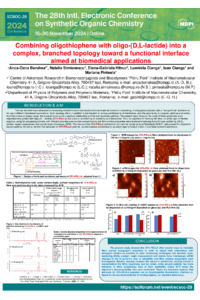
The last decades have witnessed an increasing interest in advanced electroactive biomaterials based on conducting, π-conjugated polymers for use in different biomedical applications. Recently, we reported about synthesis of an oligothiophene grafted with oligo-(D, L-lactide) (OTh-PDLLA) that has been thought to function as a biolectronic interface, biocompatible and bioerodible.
The present report focuses on the study of those properties of OTh-PDLLA that allow to establishing its suitability as a biomaterial. Thus, its capability for forming thin films, on either rigid or flexible supports, using for processing solvents with different polarities and variable concentrations and films surface properties were explored employing dynamic laser-scattering (DLS), contact- angle measurement and atomic force microscopy (AFM). The obtained results, referring to change in particle’s size, in wettability and films surface topography, have shown that OTh-PDLLA offer several ways to modulate films surface topography properties in order to adjust their interactions with biological entities as proteins or cells. Notably, keeping constant the nature of solvent but varying solution’s concentration the films roughness can be varied, while solvent polarity has more influence in films morphology than in their wettability.The biocompatibility of the OTh-PDLLA films deposited on rigid or flexible substrates was assessed by normal human gingival fibroblasts (NHGF) cells interaction. The obtained results confirm the oligomer’s biocompatibility, advocate for OTh-PDLLA potential as electroactive biointerface or as active layer in flexible and/or implantable transient electronics.
Keywords
biomaterials
grafted-conjugated polymers
polylactide
oligothiophenes
electrical biointerfaces
Manuscript
chemproc-sciforum_102168_S4_original_A_Bendrea_Main_Manuscript-done.pdf
Poster
A Bendrea-poster ECSOC-2024.pdf
SYNTHESIS OF PEPTIDE-NSAID HYBRID COMPOUNDS AND THEIR SELECTIVITY IN INHIBITING THE DUAL COX-LOX SYSTEM DESCRIBED THROUGH DOCKING AND MOLECULAR DYNAMICS
Hybrids of methylxanthines or azoderivatives as acetylcholinesterase inhibitors: preliminary structure-activity relationship analysis