Event submissions
Published
 10.3390/ecsoc-28-20262 (registering DOI)
 This submission belongs to the session S2. Chemistry of Bioorganic, Medicinal and Natural Products of the event The 28th International Electronic Conference on Synthetic Organic Chemistry
Published date
15 Nov, 2024
Academic Editor
'%3e%3cpath%20d='M12.6657%2010.9104C12.4185%2010.325%2012.0599%209.79327%2011.6097%209.34482C11.1609%208.89508%2010.6293%208.5365%2010.0442%208.28888C10.0389%208.28626%2010.0337%208.28495%2010.0285%208.28233C10.8446%207.69279%2011.3752%206.73249%2011.3752%205.64904C11.3752%203.8542%209.92103%202.39999%208.1262%202.39999C6.33136%202.39999%204.87715%203.8542%204.87715%205.64904C4.87715%206.73249%205.40774%207.69279%206.22393%208.28364C6.21869%208.28626%206.21345%208.28757%206.20821%208.29019C5.62129%208.5378%205.09463%208.89284%204.64265%209.34613C4.1929%209.79493%203.83432%2010.3266%203.58671%2010.9117C3.34345%2011.4845%203.21226%2012.0987%203.20023%2012.7209C3.19988%2012.7349%203.20233%2012.7488%203.20744%2012.7619C3.21255%2012.7749%203.22022%2012.7867%203.22998%2012.7968C3.23975%2012.8068%203.25142%2012.8147%203.26431%2012.8202C3.2772%2012.8256%203.29105%2012.8284%203.30504%2012.8284H4.09109C4.14874%2012.8284%204.19459%2012.7825%204.1959%2012.7262C4.2221%2011.7148%204.62823%2010.7676%205.34617%2010.0497C6.08899%209.30683%207.0755%208.89808%208.1262%208.89808C9.17689%208.89808%2010.1634%209.30683%2010.9062%2010.0497C11.6242%2010.7676%2012.0303%2011.7148%2012.0565%2012.7262C12.0578%2012.7838%2012.1037%2012.8284%2012.1613%2012.8284H12.9474C12.9613%2012.8284%2012.9752%2012.8256%2012.9881%2012.8202C13.001%2012.8147%2013.0126%2012.8068%2013.0224%2012.7968C13.0322%2012.7867%2013.0398%2012.7749%2013.0449%2012.7619C13.0501%2012.7488%2013.0525%2012.7349%2013.0522%2012.7209C13.0391%2012.0947%2012.9094%2011.4855%2012.6657%2010.9104ZM8.1262%207.9024C7.52486%207.9024%206.9589%207.6679%206.53312%207.24211C6.10733%206.81633%205.87283%206.25037%205.87283%205.64904C5.87283%205.0477%206.10733%204.48174%206.53312%204.05596C6.9589%203.63018%207.52486%203.39567%208.1262%203.39567C8.72753%203.39567%209.29349%203.63018%209.71927%204.05596C10.1451%204.48174%2010.3796%205.0477%2010.3796%205.64904C10.3796%206.25037%2010.1451%206.81633%209.71927%207.24211C9.29349%207.6679%208.72753%207.9024%208.1262%207.9024Z'%20fill='%235D1EE1'/%3e%3c/g%3e%3c/svg%3e) Julio A. Seijas
Julio A. SeijasCitation
Rosalía González-Brito, Coupling biological detection to liquid chromatography as a solid tool for the separation, purification and online biological characterization of chemical compounds present in natural or synthetic mixtures, in Proceedings of The 28th International Electronic Conference on Synthetic Organic Chemistry, 15 November–30 November 2024, MDPI: Basel, Switzerland, doi: 10.3390/ecsoc-28-20262
Share
Email
Facebook
Twitter
LinkedIn
Coupling biological detection to liquid chromatography as a solid tool for the separation, purification and online biological characterization of chemical compounds present in natural or synthetic mixtures
'%3e%3cpath%20d='M12.6647%2010.9104C12.4176%2010.325%2012.0589%209.7933%2011.6088%209.34485C11.16%208.89511%2010.6283%208.53653%2010.0432%208.28891C10.038%208.28629%2010.0327%208.28498%2010.0275%208.28236C10.8437%207.69282%2011.3743%206.73252%2011.3743%205.64907C11.3743%203.85423%209.92005%202.40002%208.12522%202.40002C6.33038%202.40002%204.87618%203.85423%204.87618%205.64907C4.87618%206.73252%205.40677%207.69282%206.22296%208.28367C6.21772%208.28629%206.21248%208.2876%206.20724%208.29022C5.62031%208.53783%205.09365%208.89287%204.64167%209.34616C4.19192%209.79496%203.83334%2010.3266%203.58573%2010.9117C3.34247%2011.4846%203.21128%2012.0987%203.19925%2012.721C3.1989%2012.735%203.20135%2012.7489%203.20646%2012.7619C3.21157%2012.7749%203.21924%2012.7868%203.22901%2012.7968C3.23877%2012.8068%203.25045%2012.8148%203.26334%2012.8202C3.27623%2012.8256%203.29007%2012.8284%203.30406%2012.8284H4.09012C4.14776%2012.8284%204.19362%2012.7825%204.19493%2012.7262C4.22113%2011.7148%204.62726%2010.7676%205.34519%2010.0497C6.08802%209.30686%207.07452%208.89811%208.12522%208.89811C9.17592%208.89811%2010.1624%209.30686%2010.9052%2010.0497C11.6232%2010.7676%2012.0293%2011.7148%2012.0555%2012.7262C12.0568%2012.7839%2012.1027%2012.8284%2012.1603%2012.8284H12.9464C12.9604%2012.8284%2012.9742%2012.8256%2012.9871%2012.8202C13%2012.8148%2013.0117%2012.8068%2013.0214%2012.7968C13.0312%2012.7868%2013.0389%2012.7749%2013.044%2012.7619C13.0491%2012.7489%2013.0515%2012.735%2013.0512%2012.721C13.0381%2012.0947%2012.9084%2011.4856%2012.6647%2010.9104ZM8.12522%207.90243C7.52388%207.90243%206.95792%207.66793%206.53214%207.24215C6.10636%206.81636%205.87185%206.2504%205.87185%205.64907C5.87185%205.04773%206.10636%204.48177%206.53214%204.05599C6.95792%203.63021%207.52388%203.3957%208.12522%203.3957C8.72655%203.3957%209.29252%203.63021%209.7183%204.05599C10.1441%204.48177%2010.3786%205.04773%2010.3786%205.64907C10.3786%206.2504%2010.1441%206.81636%209.7183%207.24215C9.29252%207.66793%208.72655%207.90243%208.12522%207.90243Z'%20fill='%235D1EE1'/%3e%3c/g%3e%3c/svg%3e)
Rosalía González-Brito 1,2
1. Organic Chemistry Department, Universidad de La Laguna, Spain
2. Pharmacology Unit, Medical School, Universidad de La Laguna. Spain
Abstract
Introduction.
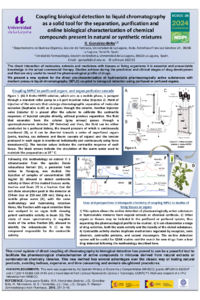
The direct interaction of molecules, extracts and medicines with tissues or living organisms it is essential and unavoidable knowledge in the actual commercial therapy. Studies achieve during the preclinical and clinical stages of drug development and that are very useful to reveal the pharmacological profile of drugs.
Methods.
In previous years, we have presented the results obtained from the study of a hydro-ethanolic extract of Stevia rebaudiana Bertoni (Asteraceae) through a novel system that allows the on-line detection of pharmacologically active substances, based on liquid chromatography (through MPLC or HPLC techniques) coupled to biological detection using perifused or perfused organs.1
In this communication we describe uses and perspectives in Bioorganic Chemistry of coupling MPLC and HPLC to studies of living tissues or organs in the pre-characterization processes of new bioactive compounds present in mixtures derived from chemical synthesis (for example, combinatorial chemistry) or from extracts of natural origin.
Results.
These techniques enabled us to easily identify the fractions that showed contractile activity and according to its mass spectrum we identified the active compound as rebaudioside N from one extract of Stevia rebaudiana Bertoni.1
This type of methodology reduced the number of animals slaughtered, investigation time and the expenses associated with such studies.
Conclusions.
The results show that a direct combination of liquid chromatography with perfusion systems of isolated organs may be a powerful tool to facilite the pharmacological characterization of active compounds in mixtures.
References.
1 Campuzano-Bublitz et al., Naunyn-Schmiedeberg's Arch Pharmacol. 2018, 391, 9–16.
Keywords
Biological sensors
Isolated organs
Natural and synthetic mixtures
Uses and perspectives
Manuscript
chemproc-sciforum-102318-done.pdf
Poster
poster_ECSOC28_ID102318_Rosalia Gonzalez Brito.pdf
The selection of oat extracts with content of suitable avenanthramides for preparation of „green synthesis“ products, poses increased biological activity.
Antimicrobial potential of extracts from agroindustrial residues of Maule Region, Chile