Event submissions
Published

This submission belongs to the session S3. Microwave Assisted Synthesis of the event The 28th International Electronic Conference on Synthetic Organic Chemistry
Published date
14 Nov, 2024
Academic Editor
'%3e%3cpath%20d='M12.6657%2010.9104C12.4185%2010.325%2012.0599%209.79327%2011.6097%209.34482C11.1609%208.89508%2010.6293%208.5365%2010.0442%208.28888C10.0389%208.28626%2010.0337%208.28495%2010.0285%208.28233C10.8446%207.69279%2011.3752%206.73249%2011.3752%205.64904C11.3752%203.8542%209.92103%202.39999%208.1262%202.39999C6.33136%202.39999%204.87715%203.8542%204.87715%205.64904C4.87715%206.73249%205.40774%207.69279%206.22393%208.28364C6.21869%208.28626%206.21345%208.28757%206.20821%208.29019C5.62129%208.5378%205.09463%208.89284%204.64265%209.34613C4.1929%209.79493%203.83432%2010.3266%203.58671%2010.9117C3.34345%2011.4845%203.21226%2012.0987%203.20023%2012.7209C3.19988%2012.7349%203.20233%2012.7488%203.20744%2012.7619C3.21255%2012.7749%203.22022%2012.7867%203.22998%2012.7968C3.23975%2012.8068%203.25142%2012.8147%203.26431%2012.8202C3.2772%2012.8256%203.29105%2012.8284%203.30504%2012.8284H4.09109C4.14874%2012.8284%204.19459%2012.7825%204.1959%2012.7262C4.2221%2011.7148%204.62823%2010.7676%205.34617%2010.0497C6.08899%209.30683%207.0755%208.89808%208.1262%208.89808C9.17689%208.89808%2010.1634%209.30683%2010.9062%2010.0497C11.6242%2010.7676%2012.0303%2011.7148%2012.0565%2012.7262C12.0578%2012.7838%2012.1037%2012.8284%2012.1613%2012.8284H12.9474C12.9613%2012.8284%2012.9752%2012.8256%2012.9881%2012.8202C13.001%2012.8147%2013.0126%2012.8068%2013.0224%2012.7968C13.0322%2012.7867%2013.0398%2012.7749%2013.0449%2012.7619C13.0501%2012.7488%2013.0525%2012.7349%2013.0522%2012.7209C13.0391%2012.0947%2012.9094%2011.4855%2012.6657%2010.9104ZM8.1262%207.9024C7.52486%207.9024%206.9589%207.6679%206.53312%207.24211C6.10733%206.81633%205.87283%206.25037%205.87283%205.64904C5.87283%205.0477%206.10733%204.48174%206.53312%204.05596C6.9589%203.63018%207.52486%203.39567%208.1262%203.39567C8.72753%203.39567%209.29349%203.63018%209.71927%204.05596C10.1451%204.48174%2010.3796%205.0477%2010.3796%205.64904C10.3796%206.25037%2010.1451%206.81633%209.71927%207.24211C9.29349%207.6679%208.72753%207.9024%208.1262%207.9024Z'%20fill='%235D1EE1'/%3e%3c/g%3e%3c/svg%3e) Julio A. Seijas
Julio A. SeijasCitation
Jean Pierre Espinoza Benavides, Elvia Victoria Cabrera Maldonado, Ullrich Stahl, Jhonny Gabriel Correa Abril, Kinetic and equilibrium study of the photocatalytic degradation of tartrazine using biochar using Microwave assisted pyrolysis from Theobroma cacao L. husk doped with iron., in Proceedings of The 28th International Electronic Conference on Synthetic Organic Chemistry, 15 November–30 November 2024, MDPI: Basel, Switzerland, doi: 10.3390/ecsoc-28-20265
Share
Email
Facebook
Twitter
LinkedIn
Kinetic and equilibrium study of the photocatalytic degradation of tartrazine using biochar using Microwave assisted pyrolysis from Theobroma cacao L. husk doped with iron.
'%3e%3cpath%20d='M12.6647%2010.9104C12.4176%2010.325%2012.0589%209.7933%2011.6088%209.34485C11.16%208.89511%2010.6283%208.53653%2010.0432%208.28891C10.038%208.28629%2010.0327%208.28498%2010.0275%208.28236C10.8437%207.69282%2011.3743%206.73252%2011.3743%205.64907C11.3743%203.85423%209.92005%202.40002%208.12522%202.40002C6.33038%202.40002%204.87618%203.85423%204.87618%205.64907C4.87618%206.73252%205.40677%207.69282%206.22296%208.28367C6.21772%208.28629%206.21248%208.2876%206.20724%208.29022C5.62031%208.53783%205.09365%208.89287%204.64167%209.34616C4.19192%209.79496%203.83334%2010.3266%203.58573%2010.9117C3.34247%2011.4846%203.21128%2012.0987%203.19925%2012.721C3.1989%2012.735%203.20135%2012.7489%203.20646%2012.7619C3.21157%2012.7749%203.21924%2012.7868%203.22901%2012.7968C3.23877%2012.8068%203.25045%2012.8148%203.26334%2012.8202C3.27623%2012.8256%203.29007%2012.8284%203.30406%2012.8284H4.09012C4.14776%2012.8284%204.19362%2012.7825%204.19493%2012.7262C4.22113%2011.7148%204.62726%2010.7676%205.34519%2010.0497C6.08802%209.30686%207.07452%208.89811%208.12522%208.89811C9.17592%208.89811%2010.1624%209.30686%2010.9052%2010.0497C11.6232%2010.7676%2012.0293%2011.7148%2012.0555%2012.7262C12.0568%2012.7839%2012.1027%2012.8284%2012.1603%2012.8284H12.9464C12.9604%2012.8284%2012.9742%2012.8256%2012.9871%2012.8202C13%2012.8148%2013.0117%2012.8068%2013.0214%2012.7968C13.0312%2012.7868%2013.0389%2012.7749%2013.044%2012.7619C13.0491%2012.7489%2013.0515%2012.735%2013.0512%2012.721C13.0381%2012.0947%2012.9084%2011.4856%2012.6647%2010.9104ZM8.12522%207.90243C7.52388%207.90243%206.95792%207.66793%206.53214%207.24215C6.10636%206.81636%205.87185%206.2504%205.87185%205.64907C5.87185%205.04773%206.10636%204.48177%206.53214%204.05599C6.95792%203.63021%207.52388%203.3957%208.12522%203.3957C8.72655%203.3957%209.29252%203.63021%209.7183%204.05599C10.1441%204.48177%2010.3786%205.04773%2010.3786%205.64907C10.3786%206.2504%2010.1441%206.81636%209.7183%207.24215C9.29252%207.66793%208.72655%207.90243%208.12522%207.90243Z'%20fill='%235D1EE1'/%3e%3c/g%3e%3c/svg%3e)
Jean Pierre Espinoza Benavides 1

Elvia Victoria Cabrera Maldonado 2
Ullrich Stahl 2
Jhonny Gabriel Correa Abril 1
1. Central University of Ecuador, Department of Chemical Engineering, Investigation Team (ACMME), Ecuador
2. Central University of Ecuador, Department of Chemical Engineering, Head of Investigation Team (ACMME), Ecuador
Abstract
In the microwave-assisted pyrolysis (MAP) process, acid-pretreated cocoa pod husk (CPH) was placed in a microwave at 600 W for 15 minutes, resulting in biochar production (BCCPH). This was followed by a doping process with iron salts (+2, +3) to obtain BCCPH-Fe. Characterization of BCCPH-Fe was carried out using surface analysis (BET), thermogravimetric analysis (TGA), particle size distribution, and Fourier Transform Infrared Spectroscopy (FTIR). Subsequently, the photodegradation process was performed using three different light sources, with tartrazine as the adsorbate. The effect of pH on photodegradation was studied, and the percentage of degradation was evaluated through equilibrium and kinetic studies. The amount of BCCPH-Fe, tartrazine concentration, and exposure time to the light source were also evaluated. The best conditions for the photodegradation process were: 254 nm light source, pH of 5, 1 g/100 mL BCCPH-Fe, 25 ppm tartrazine concentration, and 40 h exposure time. Under these conditions, a 93.45% removal of tartrazine was achieved. The experimental data of the adsorption equilibrium best fit the Langmuir-Hinshelwood model, while the adsorption kinetics best fit the pseudo-first-order model. The apparent kinetic constant was 0.04053 [h-1], and the correlation coefficient was 0.98667. In conclusion, photodegradation using BCCPH-Fe can be an effective method for the removal of tartrazine from wastewater, offering a sustainable alternative to traditional methods.
Keywords
Biochar
Microwave-assisted pyrolysis
Photocatalysis
Tartrazine
Manuscript
sciforum_099892.pdf
Poster
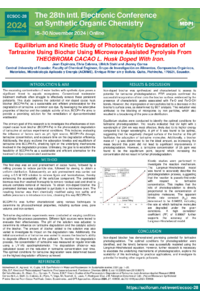
Poster - Biochar.pdf
Double condensation of 3-coumaranone with aromatic carbonyl compounds catalyzed by Brønsted hyperacids under microwaves.