Event submissions
Published

This submission belongs to the session S9. Student Session of the event The 11th International Electronic Conference on Sensors and Applications
Published date
25 Nov, 2024
Academic Editor
'%3e%3cpath%20d='M12.6657%2010.9104C12.4185%2010.325%2012.0599%209.79327%2011.6097%209.34482C11.1609%208.89508%2010.6293%208.5365%2010.0442%208.28888C10.0389%208.28626%2010.0337%208.28495%2010.0285%208.28233C10.8446%207.69279%2011.3752%206.73249%2011.3752%205.64904C11.3752%203.8542%209.92103%202.39999%208.1262%202.39999C6.33136%202.39999%204.87715%203.8542%204.87715%205.64904C4.87715%206.73249%205.40774%207.69279%206.22393%208.28364C6.21869%208.28626%206.21345%208.28757%206.20821%208.29019C5.62129%208.5378%205.09463%208.89284%204.64265%209.34613C4.1929%209.79493%203.83432%2010.3266%203.58671%2010.9117C3.34345%2011.4845%203.21226%2012.0987%203.20023%2012.7209C3.19988%2012.7349%203.20233%2012.7488%203.20744%2012.7619C3.21255%2012.7749%203.22022%2012.7867%203.22998%2012.7968C3.23975%2012.8068%203.25142%2012.8147%203.26431%2012.8202C3.2772%2012.8256%203.29105%2012.8284%203.30504%2012.8284H4.09109C4.14874%2012.8284%204.19459%2012.7825%204.1959%2012.7262C4.2221%2011.7148%204.62823%2010.7676%205.34617%2010.0497C6.08899%209.30683%207.0755%208.89808%208.1262%208.89808C9.17689%208.89808%2010.1634%209.30683%2010.9062%2010.0497C11.6242%2010.7676%2012.0303%2011.7148%2012.0565%2012.7262C12.0578%2012.7838%2012.1037%2012.8284%2012.1613%2012.8284H12.9474C12.9613%2012.8284%2012.9752%2012.8256%2012.9881%2012.8202C13.001%2012.8147%2013.0126%2012.8068%2013.0224%2012.7968C13.0322%2012.7867%2013.0398%2012.7749%2013.0449%2012.7619C13.0501%2012.7488%2013.0525%2012.7349%2013.0522%2012.7209C13.0391%2012.0947%2012.9094%2011.4855%2012.6657%2010.9104ZM8.1262%207.9024C7.52486%207.9024%206.9589%207.6679%206.53312%207.24211C6.10733%206.81633%205.87283%206.25037%205.87283%205.64904C5.87283%205.0477%206.10733%204.48174%206.53312%204.05596C6.9589%203.63018%207.52486%203.39567%208.1262%203.39567C8.72753%203.39567%209.29349%203.63018%209.71927%204.05596C10.1451%204.48174%2010.3796%205.0477%2010.3796%205.64904C10.3796%206.25037%2010.1451%206.81633%209.71927%207.24211C9.29349%207.6679%208.72753%207.9024%208.1262%207.9024Z'%20fill='%235D1EE1'/%3e%3c/g%3e%3c/svg%3e) Francisco Falcone
Francisco FalconeCitation
Stephanie Lopes Morais, Michelle Castanheira, Marlene Santos, Valentina Domingues, Cristina Delerue-Matos, Maria Fátima Barroso, Electrochemical genosensors as a new approach on plant DNA detection and quantification for honey authentication, in Proceedings of The 11th International Electronic Conference on Sensors and Applications, 26 November–28 November 2024, MDPI: Basel, Switzerland, doi: 10.3390/ecsa-11-20353
Share
Email
Facebook
Twitter
LinkedIn
Electrochemical genosensors as a new approach on plant DNA detection and quantification for honey authentication
'%3e%3cpath%20d='M12.6647%2010.9104C12.4176%2010.325%2012.0589%209.7933%2011.6088%209.34485C11.16%208.89511%2010.6283%208.53653%2010.0432%208.28891C10.038%208.28629%2010.0327%208.28498%2010.0275%208.28236C10.8437%207.69282%2011.3743%206.73252%2011.3743%205.64907C11.3743%203.85423%209.92005%202.40002%208.12522%202.40002C6.33038%202.40002%204.87618%203.85423%204.87618%205.64907C4.87618%206.73252%205.40677%207.69282%206.22296%208.28367C6.21772%208.28629%206.21248%208.2876%206.20724%208.29022C5.62031%208.53783%205.09365%208.89287%204.64167%209.34616C4.19192%209.79496%203.83334%2010.3266%203.58573%2010.9117C3.34247%2011.4846%203.21128%2012.0987%203.19925%2012.721C3.1989%2012.735%203.20135%2012.7489%203.20646%2012.7619C3.21157%2012.7749%203.21924%2012.7868%203.22901%2012.7968C3.23877%2012.8068%203.25045%2012.8148%203.26334%2012.8202C3.27623%2012.8256%203.29007%2012.8284%203.30406%2012.8284H4.09012C4.14776%2012.8284%204.19362%2012.7825%204.19493%2012.7262C4.22113%2011.7148%204.62726%2010.7676%205.34519%2010.0497C6.08802%209.30686%207.07452%208.89811%208.12522%208.89811C9.17592%208.89811%2010.1624%209.30686%2010.9052%2010.0497C11.6232%2010.7676%2012.0293%2011.7148%2012.0555%2012.7262C12.0568%2012.7839%2012.1027%2012.8284%2012.1603%2012.8284H12.9464C12.9604%2012.8284%2012.9742%2012.8256%2012.9871%2012.8202C13%2012.8148%2013.0117%2012.8068%2013.0214%2012.7968C13.0312%2012.7868%2013.0389%2012.7749%2013.044%2012.7619C13.0491%2012.7489%2013.0515%2012.735%2013.0512%2012.721C13.0381%2012.0947%2012.9084%2011.4856%2012.6647%2010.9104ZM8.12522%207.90243C7.52388%207.90243%206.95792%207.66793%206.53214%207.24215C6.10636%206.81636%205.87185%206.2504%205.87185%205.64907C5.87185%205.04773%206.10636%204.48177%206.53214%204.05599C6.95792%203.63021%207.52388%203.3957%208.12522%203.3957C8.72655%203.3957%209.29252%203.63021%209.7183%204.05599C10.1441%204.48177%2010.3786%205.04773%2010.3786%205.64907C10.3786%206.2504%2010.1441%206.81636%209.7183%207.24215C9.29252%207.66793%208.72655%207.90243%208.12522%207.90243Z'%20fill='%235D1EE1'/%3e%3c/g%3e%3c/svg%3e)
Stephanie Lopes Morais 1
Michelle Castanheira 1
Marlene Santos 1
Valentina Domingues 1

Cristina Delerue-Matos 1

Maria Fátima Barroso 1
1. REQUIMTE-LAQV, Instituto Superior de Engenharia do Porto, Instituto Politécnico do Porto, Rua Dr. António Bernardino de Almeida 431, Porto, 4249-015, Portugal
Abstract
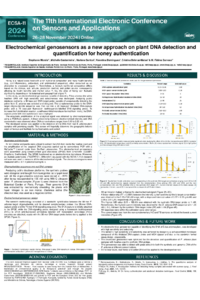
Honey is a natural sweet food product with multiple nutritional and medicinal properties making it a healthy alternative to processed sugars. Nonetheless, its composition differs based on the climate, soil, altitude, production method, and pollen source, consequently affecting its health benefits and market value. With the consumers’ recent interest and purchase of dietary products the global honey market has greatly increased. To keep up with production, or simply for financial gain, some producers/companies are now blending pure honey with cheaper substances that possess similar physical characteristics. As there are no notable visible differences between pure and adulterated honey, it is extremely difficult to determine the purity of the available honeys. In this study, an electrochemical genosensor based on the sandwich format DNA hybridization reaction between two complementary probes was developed for the detection and quantification of Erica arborea pollen DNA in real samples. Analyzing public database platforms, a 98 base-pair DNA-target probe capable of unequivocally detecting the pollen from E. arborea was selected and designed. The complementary probe to the DNA-target oligonucleotide sequence was then cut into a 28 base-pair thiolated DNA-capture probe and a 70 base-pair fluorescein isothiocyanate-labelled DNA-signaling probe. To increase the hybridization reaction, a self-assembled monolayer formed from mixing the DNA-capture probe with mercaptohexanol was employed. Using chronoamperometry, the enzymatic amplification of the electrochemical signal was achieved with a concentration range of 0.07 to 2.00 nM. The DNA from certified E. arborea leaves was extracted using liquid nitrogen and mechanical grinding and the targeted region amplified by PCR. The developed genosensor was successfully applied for the detection and quantification of the DNA concentration of the extracted E. arborea plant leaves. So, the developed genosensor is a promising cost-effective, and innovative analytical method to detect and quantify the DNA concentration of plant DNA in real honey samples.
Keywords
Botanical origin
Electrochemical genosensor
Erica arborea
Honey authentication
Molecular biology
Manuscript
Proceedings paper _sciforum-105901_correct from author.pdf
Poster
Poster_ECSA.pdf
A TinyML Approach to Real-time Snoring Detection in Resource-Constrained Wearables Devices
ANOVA-Based Variance Analysis in Smart Home Energy Consumption Data Using A Case Study of Darmstadt Smart City Germany