Event submissions
Published

This submission belongs to the session S1. Chemo- and Biosensors of the event The 11th International Electronic Conference on Sensors and Applications
Published date
25 Nov, 2024
Academic Editor
'%3e%3cpath%20d='M12.6657%2010.9104C12.4185%2010.325%2012.0599%209.79327%2011.6097%209.34482C11.1609%208.89508%2010.6293%208.5365%2010.0442%208.28888C10.0389%208.28626%2010.0337%208.28495%2010.0285%208.28233C10.8446%207.69279%2011.3752%206.73249%2011.3752%205.64904C11.3752%203.8542%209.92103%202.39999%208.1262%202.39999C6.33136%202.39999%204.87715%203.8542%204.87715%205.64904C4.87715%206.73249%205.40774%207.69279%206.22393%208.28364C6.21869%208.28626%206.21345%208.28757%206.20821%208.29019C5.62129%208.5378%205.09463%208.89284%204.64265%209.34613C4.1929%209.79493%203.83432%2010.3266%203.58671%2010.9117C3.34345%2011.4845%203.21226%2012.0987%203.20023%2012.7209C3.19988%2012.7349%203.20233%2012.7488%203.20744%2012.7619C3.21255%2012.7749%203.22022%2012.7867%203.22998%2012.7968C3.23975%2012.8068%203.25142%2012.8147%203.26431%2012.8202C3.2772%2012.8256%203.29105%2012.8284%203.30504%2012.8284H4.09109C4.14874%2012.8284%204.19459%2012.7825%204.1959%2012.7262C4.2221%2011.7148%204.62823%2010.7676%205.34617%2010.0497C6.08899%209.30683%207.0755%208.89808%208.1262%208.89808C9.17689%208.89808%2010.1634%209.30683%2010.9062%2010.0497C11.6242%2010.7676%2012.0303%2011.7148%2012.0565%2012.7262C12.0578%2012.7838%2012.1037%2012.8284%2012.1613%2012.8284H12.9474C12.9613%2012.8284%2012.9752%2012.8256%2012.9881%2012.8202C13.001%2012.8147%2013.0126%2012.8068%2013.0224%2012.7968C13.0322%2012.7867%2013.0398%2012.7749%2013.0449%2012.7619C13.0501%2012.7488%2013.0525%2012.7349%2013.0522%2012.7209C13.0391%2012.0947%2012.9094%2011.4855%2012.6657%2010.9104ZM8.1262%207.9024C7.52486%207.9024%206.9589%207.6679%206.53312%207.24211C6.10733%206.81633%205.87283%206.25037%205.87283%205.64904C5.87283%205.0477%206.10733%204.48174%206.53312%204.05596C6.9589%203.63018%207.52486%203.39567%208.1262%203.39567C8.72753%203.39567%209.29349%203.63018%209.71927%204.05596C10.1451%204.48174%2010.3796%205.0477%2010.3796%205.64904C10.3796%206.25037%2010.1451%206.81633%209.71927%207.24211C9.29349%207.6679%208.72753%207.9024%208.1262%207.9024Z'%20fill='%235D1EE1'/%3e%3c/g%3e%3c/svg%3e) Francisco Falcone
Francisco FalconeCitation
Borys A. Snopok, Arwa Laroussi, Tetiana V. Snopok, Shavkat Nizamov, Electrostatic Surface Functionalization of Physical Transducers of (Bio)Chemical Sensors: Thiocyanate-Modified Gold Interface, in Proceedings of The 11th International Electronic Conference on Sensors and Applications, 26 November–28 November 2024, MDPI: Basel, Switzerland, doi: 10.3390/ecsa-11-20385
Share
Email
Facebook
Twitter
LinkedIn
Electrostatic Surface Functionalization of Physical Transducers of (Bio)Chemical Sensors: Thiocyanate-Modified Gold Interface
'%3e%3cpath%20d='M12.6647%2010.9104C12.4176%2010.325%2012.0589%209.7933%2011.6088%209.34485C11.16%208.89511%2010.6283%208.53653%2010.0432%208.28891C10.038%208.28629%2010.0327%208.28498%2010.0275%208.28236C10.8437%207.69282%2011.3743%206.73252%2011.3743%205.64907C11.3743%203.85423%209.92005%202.40002%208.12522%202.40002C6.33038%202.40002%204.87618%203.85423%204.87618%205.64907C4.87618%206.73252%205.40677%207.69282%206.22296%208.28367C6.21772%208.28629%206.21248%208.2876%206.20724%208.29022C5.62031%208.53783%205.09365%208.89287%204.64167%209.34616C4.19192%209.79496%203.83334%2010.3266%203.58573%2010.9117C3.34247%2011.4846%203.21128%2012.0987%203.19925%2012.721C3.1989%2012.735%203.20135%2012.7489%203.20646%2012.7619C3.21157%2012.7749%203.21924%2012.7868%203.22901%2012.7968C3.23877%2012.8068%203.25045%2012.8148%203.26334%2012.8202C3.27623%2012.8256%203.29007%2012.8284%203.30406%2012.8284H4.09012C4.14776%2012.8284%204.19362%2012.7825%204.19493%2012.7262C4.22113%2011.7148%204.62726%2010.7676%205.34519%2010.0497C6.08802%209.30686%207.07452%208.89811%208.12522%208.89811C9.17592%208.89811%2010.1624%209.30686%2010.9052%2010.0497C11.6232%2010.7676%2012.0293%2011.7148%2012.0555%2012.7262C12.0568%2012.7839%2012.1027%2012.8284%2012.1603%2012.8284H12.9464C12.9604%2012.8284%2012.9742%2012.8256%2012.9871%2012.8202C13%2012.8148%2013.0117%2012.8068%2013.0214%2012.7968C13.0312%2012.7868%2013.0389%2012.7749%2013.044%2012.7619C13.0491%2012.7489%2013.0515%2012.735%2013.0512%2012.721C13.0381%2012.0947%2012.9084%2011.4856%2012.6647%2010.9104ZM8.12522%207.90243C7.52388%207.90243%206.95792%207.66793%206.53214%207.24215C6.10636%206.81636%205.87185%206.2504%205.87185%205.64907C5.87185%205.04773%206.10636%204.48177%206.53214%204.05599C6.95792%203.63021%207.52388%203.3957%208.12522%203.3957C8.72655%203.3957%209.29252%203.63021%209.7183%204.05599C10.1441%204.48177%2010.3786%205.04773%2010.3786%205.64907C10.3786%206.2504%2010.1441%206.81636%209.7183%207.24215C9.29252%207.66793%208.72655%207.90243%208.12522%207.90243Z'%20fill='%235D1EE1'/%3e%3c/g%3e%3c/svg%3e)
Borys A. Snopok 1,2
Arwa Laroussi 2
Tetiana V. Snopok 3
Shavkat Nizamov 2
1. Optoelectronics - VE Lashkaryov Institute of semiconductor physics, National Academy of Sciences of Ukraine, Kyiv, Ukraine
2. Nanobiotechnology - Institute of Biotechnology, Brandenburg Technical University, Cottbus-Senftenberg, Germany
3. Sensor Science - VE Lashkaryov Institute of semiconductor physics, National Academy of Sciences of Ukraine, Kyiv, Ukraine
Abstract
Surface charging has been widely used in various functionalization technologies to create (bio)chemical sensing layers. This is due to the unique ability of electrostatic interactions not only to immobilize the desired receptors, but also to control their uniform distribution over the surface. This physical process is widely used in interfacial electrostatic driven reactions, classical layer-by-layer deposition, electrostatic levitation of proteins over the surface. Thiocyanates are extremely promising compounds for creating an ultrathin charged layer on the SPR, QCM, etc. transducers, due to their small size and ability to self-organize into a monolayer on the gold surface. For sensor science, an important issue is the experimental confirmation of the presence of the effective negative charge within or near their monolayer. This study is devoted to clarify this issue.
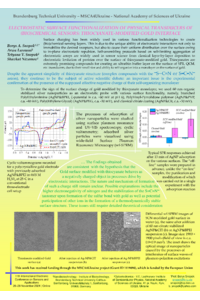
To determine the sign of the surface charge of gold modified by thiocyanate monolayer, we used 60 nm organic stabilized silver nanoparticles as an electrostatic probe: in distilled water, the charge of these compounds changes from the strongly positively charged Ag-NP&BPEI, through Ag-NP&PEG and Ag-NP&PVP with a moderate negative charge, to the highly negatively charged Ag-NP&CIT.
Analysis of SPR and UV-VIS spectroscopy results, electrochemical measurements and wide-field surface plasmon resonance microscopy imaging indicate that gold modified with thiocyanate has the maximum adsorption capacity for objects with a positive charge on their shell. Strongly negatively charged nanoparticles are not adsorbed on a surface modified with thiocyanate. Visualization of nanoparticles using wide-field Surface Plasmon Resonance Microscopy confirmed the sticky adsorption from suspension of Ag-NP&BPEI nanoparticles on the surface of gold modified with a self-assembled thiocyanate layer.
The authors express their gratitude to Professor Vladimir Mirsky for support in the research and fruitful discussions. This work has received funding through the MSCA4Ukraine project (Grant ID 1119494), which is funded by the European Union.
Keywords
bio(chemical) sensors
thiocyanate
surface charge
silver nanoparticles
electrostatic interaction
surface plasmon resonance
Manuscript
engproc-sciforum_105635_S1_correct from author.pdf
Poster
ESCA_11 2024 SCN charge.pdf
Enhanced Weed Detection for Sustainable Agriculture: A YOLOv7 and IoT Sensor Approach for Maximizing Crop Quality and Profitability
Assessment of Cosine Similarity for Acoustic Emission-Based Tool Condition Monitoring in Milling Processes.