Event submissions
Published

This submission belongs to the session S9. Student Session of the event The 11th International Electronic Conference on Sensors and Applications
Published date
26 Nov, 2024
Academic Editor
'%3e%3cpath%20d='M12.6657%2010.9104C12.4185%2010.325%2012.0599%209.79327%2011.6097%209.34482C11.1609%208.89508%2010.6293%208.5365%2010.0442%208.28888C10.0389%208.28626%2010.0337%208.28495%2010.0285%208.28233C10.8446%207.69279%2011.3752%206.73249%2011.3752%205.64904C11.3752%203.8542%209.92103%202.39999%208.1262%202.39999C6.33136%202.39999%204.87715%203.8542%204.87715%205.64904C4.87715%206.73249%205.40774%207.69279%206.22393%208.28364C6.21869%208.28626%206.21345%208.28757%206.20821%208.29019C5.62129%208.5378%205.09463%208.89284%204.64265%209.34613C4.1929%209.79493%203.83432%2010.3266%203.58671%2010.9117C3.34345%2011.4845%203.21226%2012.0987%203.20023%2012.7209C3.19988%2012.7349%203.20233%2012.7488%203.20744%2012.7619C3.21255%2012.7749%203.22022%2012.7867%203.22998%2012.7968C3.23975%2012.8068%203.25142%2012.8147%203.26431%2012.8202C3.2772%2012.8256%203.29105%2012.8284%203.30504%2012.8284H4.09109C4.14874%2012.8284%204.19459%2012.7825%204.1959%2012.7262C4.2221%2011.7148%204.62823%2010.7676%205.34617%2010.0497C6.08899%209.30683%207.0755%208.89808%208.1262%208.89808C9.17689%208.89808%2010.1634%209.30683%2010.9062%2010.0497C11.6242%2010.7676%2012.0303%2011.7148%2012.0565%2012.7262C12.0578%2012.7838%2012.1037%2012.8284%2012.1613%2012.8284H12.9474C12.9613%2012.8284%2012.9752%2012.8256%2012.9881%2012.8202C13.001%2012.8147%2013.0126%2012.8068%2013.0224%2012.7968C13.0322%2012.7867%2013.0398%2012.7749%2013.0449%2012.7619C13.0501%2012.7488%2013.0525%2012.7349%2013.0522%2012.7209C13.0391%2012.0947%2012.9094%2011.4855%2012.6657%2010.9104ZM8.1262%207.9024C7.52486%207.9024%206.9589%207.6679%206.53312%207.24211C6.10733%206.81633%205.87283%206.25037%205.87283%205.64904C5.87283%205.0477%206.10733%204.48174%206.53312%204.05596C6.9589%203.63018%207.52486%203.39567%208.1262%203.39567C8.72753%203.39567%209.29349%203.63018%209.71927%204.05596C10.1451%204.48174%2010.3796%205.0477%2010.3796%205.64904C10.3796%206.25037%2010.1451%206.81633%209.71927%207.24211C9.29349%207.6679%208.72753%207.9024%208.1262%207.9024Z'%20fill='%235D1EE1'/%3e%3c/g%3e%3c/svg%3e) Jean-marc Laheurte
Jean-marc LaheurteCitation
Eren Bülbül, Wearable Sensor Based Gait Analysis and Robotic Exoskeleton Control for Parkinson’s Patients, in Proceedings of The 11th International Electronic Conference on Sensors and Applications, 26 November–28 November 2024, MDPI: Basel, Switzerland, doi: 10.3390/ecsa-11-20456
Share
Email
Facebook
Twitter
LinkedIn
Wearable Sensor Based Gait Analysis and Robotic Exoskeleton Control for Parkinson’s Patients

Eren Bülbül 1
1. Biomedical Engineering, Yildiz Technical University, Istanbul 34220, Türkiye
Abstract
Gait disorders are significant indicators of neurological diseases such as Parkinson’s disease and reduce the quality of life of patients. Although the detection and classification of gait disorders is essential for treatment and diagnosis, there is currently no single standardized gait analysis system. Wearable sensors offer a promising solution, providing accessible gait analysis by capturing periodic movements during walking. In addition to analysis, soft body robotic exoskeletons improve walking by applying controlled robotic forces to correct abnormal gait patterns. However, for optimal therapeutic effects, exoskeletons must be controlled according to the disorder characteristics and real-time feedback.
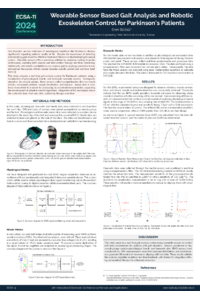
This study presents the design of a real-time gait analysis system using wearable sensors. This analysis system can be used to both diagnose and control soft body exoskeletons in Parkinson's patients. Wearable sensors consist of three low-cost electromyography (EMG) circuits and four 6-axis inertial measurement units (IMUs), positioned on the primary muscle groups involved in gait. Load cells are placed under the feet to capture dynamic force data. All sensor data is acquired and wirelessly transmitted to the server for signal processing by a central microcontroller.
The data is processed to extract both physiological and kinematic parameters from gait cycles. Using the dataset of gait cycle parameters, a machine learning model facilitates a quantitative assessment of the spectrum of gait disorders. This analysis will generate real-time feedback by evaluating kinematic and physiological parameters. The objective of the feedback is to provide an adaptive control mechanism for therapeutic devices such as soft body exoskeletons suitable for gait disorders. The machine learning model is also used to iteratively improve the control model at each step. In this way, our study will offer low-cost adaptive physiologic control for traditional therapeutic exoskeletons especially for Parkinson's patients.
Keywords
Biomedical Engineering
Wearable Sensors
Gait Analysis
Gait Disorder Classification
Electromyography
Manuscript
engproc-sciforum_105840_S9.pdf
Poster
bulbul_ecsa11_poster.pdf
A preliminary study on Arterial Stiffness assessment using Photoplethysmographic Sensors
Lens Distortion Measurement and Correction for Stereovision Multi-Camera System