Event submissions
Published

This submission belongs to the session S9. Student Session of the event The 11th International Electronic Conference on Sensors and Applications
Published date
26 Nov, 2024
Academic Editor
'%3e%3cpath%20d='M12.6657%2010.9104C12.4185%2010.325%2012.0599%209.79327%2011.6097%209.34482C11.1609%208.89508%2010.6293%208.5365%2010.0442%208.28888C10.0389%208.28626%2010.0337%208.28495%2010.0285%208.28233C10.8446%207.69279%2011.3752%206.73249%2011.3752%205.64904C11.3752%203.8542%209.92103%202.39999%208.1262%202.39999C6.33136%202.39999%204.87715%203.8542%204.87715%205.64904C4.87715%206.73249%205.40774%207.69279%206.22393%208.28364C6.21869%208.28626%206.21345%208.28757%206.20821%208.29019C5.62129%208.5378%205.09463%208.89284%204.64265%209.34613C4.1929%209.79493%203.83432%2010.3266%203.58671%2010.9117C3.34345%2011.4845%203.21226%2012.0987%203.20023%2012.7209C3.19988%2012.7349%203.20233%2012.7488%203.20744%2012.7619C3.21255%2012.7749%203.22022%2012.7867%203.22998%2012.7968C3.23975%2012.8068%203.25142%2012.8147%203.26431%2012.8202C3.2772%2012.8256%203.29105%2012.8284%203.30504%2012.8284H4.09109C4.14874%2012.8284%204.19459%2012.7825%204.1959%2012.7262C4.2221%2011.7148%204.62823%2010.7676%205.34617%2010.0497C6.08899%209.30683%207.0755%208.89808%208.1262%208.89808C9.17689%208.89808%2010.1634%209.30683%2010.9062%2010.0497C11.6242%2010.7676%2012.0303%2011.7148%2012.0565%2012.7262C12.0578%2012.7838%2012.1037%2012.8284%2012.1613%2012.8284H12.9474C12.9613%2012.8284%2012.9752%2012.8256%2012.9881%2012.8202C13.001%2012.8147%2013.0126%2012.8068%2013.0224%2012.7968C13.0322%2012.7867%2013.0398%2012.7749%2013.0449%2012.7619C13.0501%2012.7488%2013.0525%2012.7349%2013.0522%2012.7209C13.0391%2012.0947%2012.9094%2011.4855%2012.6657%2010.9104ZM8.1262%207.9024C7.52486%207.9024%206.9589%207.6679%206.53312%207.24211C6.10733%206.81633%205.87283%206.25037%205.87283%205.64904C5.87283%205.0477%206.10733%204.48174%206.53312%204.05596C6.9589%203.63018%207.52486%203.39567%208.1262%203.39567C8.72753%203.39567%209.29349%203.63018%209.71927%204.05596C10.1451%204.48174%2010.3796%205.0477%2010.3796%205.64904C10.3796%206.25037%2010.1451%206.81633%209.71927%207.24211C9.29349%207.6679%208.72753%207.9024%208.1262%207.9024Z'%20fill='%235D1EE1'/%3e%3c/g%3e%3c/svg%3e) Francisco Falcone
Francisco FalconeCitation
Nhung Huyen Hoang, Zilu Liang, Exploring Sleep Apnea Risk Factors with Contrast Set Mining: Findings from the Sleep Heart Health Study, in Proceedings of The 11th International Electronic Conference on Sensors and Applications, 26 November–28 November 2024, MDPI: Basel, Switzerland, doi: 10.3390/ecsa-11-20462
Share
Email
Facebook
Twitter
LinkedIn
Exploring Sleep Apnea Risk Factors with Contrast Set Mining: Findings from the Sleep Heart Health Study
'%3e%3cpath%20d='M12.6647%2010.9104C12.4176%2010.325%2012.0589%209.7933%2011.6088%209.34485C11.16%208.89511%2010.6283%208.53653%2010.0432%208.28891C10.038%208.28629%2010.0327%208.28498%2010.0275%208.28236C10.8437%207.69282%2011.3743%206.73252%2011.3743%205.64907C11.3743%203.85423%209.92005%202.40002%208.12522%202.40002C6.33038%202.40002%204.87618%203.85423%204.87618%205.64907C4.87618%206.73252%205.40677%207.69282%206.22296%208.28367C6.21772%208.28629%206.21248%208.2876%206.20724%208.29022C5.62031%208.53783%205.09365%208.89287%204.64167%209.34616C4.19192%209.79496%203.83334%2010.3266%203.58573%2010.9117C3.34247%2011.4846%203.21128%2012.0987%203.19925%2012.721C3.1989%2012.735%203.20135%2012.7489%203.20646%2012.7619C3.21157%2012.7749%203.21924%2012.7868%203.22901%2012.7968C3.23877%2012.8068%203.25045%2012.8148%203.26334%2012.8202C3.27623%2012.8256%203.29007%2012.8284%203.30406%2012.8284H4.09012C4.14776%2012.8284%204.19362%2012.7825%204.19493%2012.7262C4.22113%2011.7148%204.62726%2010.7676%205.34519%2010.0497C6.08802%209.30686%207.07452%208.89811%208.12522%208.89811C9.17592%208.89811%2010.1624%209.30686%2010.9052%2010.0497C11.6232%2010.7676%2012.0293%2011.7148%2012.0555%2012.7262C12.0568%2012.7839%2012.1027%2012.8284%2012.1603%2012.8284H12.9464C12.9604%2012.8284%2012.9742%2012.8256%2012.9871%2012.8202C13%2012.8148%2013.0117%2012.8068%2013.0214%2012.7968C13.0312%2012.7868%2013.0389%2012.7749%2013.044%2012.7619C13.0491%2012.7489%2013.0515%2012.735%2013.0512%2012.721C13.0381%2012.0947%2012.9084%2011.4856%2012.6647%2010.9104ZM8.12522%207.90243C7.52388%207.90243%206.95792%207.66793%206.53214%207.24215C6.10636%206.81636%205.87185%206.2504%205.87185%205.64907C5.87185%205.04773%206.10636%204.48177%206.53214%204.05599C6.95792%203.63021%207.52388%203.3957%208.12522%203.3957C8.72655%203.3957%209.29252%203.63021%209.7183%204.05599C10.1441%204.48177%2010.3786%205.04773%2010.3786%205.64907C10.3786%206.2504%2010.1441%206.81636%209.7183%207.24215C9.29252%207.66793%208.72655%207.90243%208.12522%207.90243Z'%20fill='%235D1EE1'/%3e%3c/g%3e%3c/svg%3e)
Nhung Huyen Hoang 1

Zilu Liang 1
1. Kyoto University of Advanced Science
Abstract
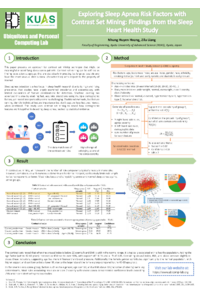
Sleep apnea is a common sleep disorder with potentially serious health consequences. Identifying risk factors for sleep apnea is crucial for early detection and effective management. Traditionally, this has been achieved through statistical methods such as Pearson’s and Spearman’s correlation analysis, which examine relationships between individual variables and sleep apnea. However, these methods often miss complex, nonlinear patterns and interactions among multiple factors. In this study, we applied contrast set mining to identify patterns in attribute-value pair combinations (contrast sets) in the Sleep Heart Health Study database that differentiate between groups with varying levels of sleep apnea severity. Our findings reveal that males and individuals aged 57 to 73 exhibit a higher risk of sleep apnea, with a confidence exceeding 75%. Moreover, male patients diagnosed with second-degree obesity, defined as a body mass index (BMI) between 35 and 39.9 kg/m2, show an elevated risk of severe apnea, with a lift of 2.31, support of 0.18, and confidence above 80%. In contrast, female patients with a BMI within the normal range (18.5-25 kg/m2) demonstrate a lower risk of sleep apnea, with a lift of 2.16, support of 0.13, and confidence exceeding 76%. Contrast set mining helps uncover meaningful rules within subgroups that traditional methods, such as Pearson’s or Spearman’s correlation analysis, might overlook. Future research will focus on developing sleep apnea screening models using the contrast set rules identified in this study, specifically tailored for consumer wearable sensors.
Keywords
sleep apnea
health care
contrast set mining
Manuscript
engproc-sciforum_105797_S9.pdf
Poster
ECSA_11_poster.pdf
Reviewing Current Trends: Machine Learning for risk assessments of Occupational Exoskeletons
Analog Electronics Neural Networks: Analog Computing combined with Digital Data Processing Revisited