Event submissions
Published

This submission belongs to the session S4. Sensors and Artificial Intelligence of the event The 11th International Electronic Conference on Sensors and Applications
Published date
26 Nov, 2024
Academic Editor
'%3e%3cpath%20d='M12.6657%2010.9104C12.4185%2010.325%2012.0599%209.79327%2011.6097%209.34482C11.1609%208.89508%2010.6293%208.5365%2010.0442%208.28888C10.0389%208.28626%2010.0337%208.28495%2010.0285%208.28233C10.8446%207.69279%2011.3752%206.73249%2011.3752%205.64904C11.3752%203.8542%209.92103%202.39999%208.1262%202.39999C6.33136%202.39999%204.87715%203.8542%204.87715%205.64904C4.87715%206.73249%205.40774%207.69279%206.22393%208.28364C6.21869%208.28626%206.21345%208.28757%206.20821%208.29019C5.62129%208.5378%205.09463%208.89284%204.64265%209.34613C4.1929%209.79493%203.83432%2010.3266%203.58671%2010.9117C3.34345%2011.4845%203.21226%2012.0987%203.20023%2012.7209C3.19988%2012.7349%203.20233%2012.7488%203.20744%2012.7619C3.21255%2012.7749%203.22022%2012.7867%203.22998%2012.7968C3.23975%2012.8068%203.25142%2012.8147%203.26431%2012.8202C3.2772%2012.8256%203.29105%2012.8284%203.30504%2012.8284H4.09109C4.14874%2012.8284%204.19459%2012.7825%204.1959%2012.7262C4.2221%2011.7148%204.62823%2010.7676%205.34617%2010.0497C6.08899%209.30683%207.0755%208.89808%208.1262%208.89808C9.17689%208.89808%2010.1634%209.30683%2010.9062%2010.0497C11.6242%2010.7676%2012.0303%2011.7148%2012.0565%2012.7262C12.0578%2012.7838%2012.1037%2012.8284%2012.1613%2012.8284H12.9474C12.9613%2012.8284%2012.9752%2012.8256%2012.9881%2012.8202C13.001%2012.8147%2013.0126%2012.8068%2013.0224%2012.7968C13.0322%2012.7867%2013.0398%2012.7749%2013.0449%2012.7619C13.0501%2012.7488%2013.0525%2012.7349%2013.0522%2012.7209C13.0391%2012.0947%2012.9094%2011.4855%2012.6657%2010.9104ZM8.1262%207.9024C7.52486%207.9024%206.9589%207.6679%206.53312%207.24211C6.10733%206.81633%205.87283%206.25037%205.87283%205.64904C5.87283%205.0477%206.10733%204.48174%206.53312%204.05596C6.9589%203.63018%207.52486%203.39567%208.1262%203.39567C8.72753%203.39567%209.29349%203.63018%209.71927%204.05596C10.1451%204.48174%2010.3796%205.0477%2010.3796%205.64904C10.3796%206.25037%2010.1451%206.81633%209.71927%207.24211C9.29349%207.6679%208.72753%207.9024%208.1262%207.9024Z'%20fill='%235D1EE1'/%3e%3c/g%3e%3c/svg%3e) Jean-marc Laheurte
Jean-marc LaheurteCitation
Malathi Janapati, Leela Priya Allamsetty, Tarun Teja Potluri, Kavya Vijay Mogili, Gait-driven Pose Tracking and Movement Captioning using OpenCV and MediaPipe Machine Learning Framework, in Proceedings of The 11th International Electronic Conference on Sensors and Applications, 26 November–28 November 2024, MDPI: Basel, Switzerland, doi: 10.3390/ecsa-11-20470
Share
Email
Facebook
Twitter
LinkedIn
Gait-driven Pose Tracking and Movement Captioning using OpenCV and MediaPipe Machine Learning Framework

Malathi Janapati 1
'%3e%3cpath%20d='M12.6647%2010.9104C12.4176%2010.325%2012.0589%209.7933%2011.6088%209.34485C11.16%208.89511%2010.6283%208.53653%2010.0432%208.28891C10.038%208.28629%2010.0327%208.28498%2010.0275%208.28236C10.8437%207.69282%2011.3743%206.73252%2011.3743%205.64907C11.3743%203.85423%209.92005%202.40002%208.12522%202.40002C6.33038%202.40002%204.87618%203.85423%204.87618%205.64907C4.87618%206.73252%205.40677%207.69282%206.22296%208.28367C6.21772%208.28629%206.21248%208.2876%206.20724%208.29022C5.62031%208.53783%205.09365%208.89287%204.64167%209.34616C4.19192%209.79496%203.83334%2010.3266%203.58573%2010.9117C3.34247%2011.4846%203.21128%2012.0987%203.19925%2012.721C3.1989%2012.735%203.20135%2012.7489%203.20646%2012.7619C3.21157%2012.7749%203.21924%2012.7868%203.22901%2012.7968C3.23877%2012.8068%203.25045%2012.8148%203.26334%2012.8202C3.27623%2012.8256%203.29007%2012.8284%203.30406%2012.8284H4.09012C4.14776%2012.8284%204.19362%2012.7825%204.19493%2012.7262C4.22113%2011.7148%204.62726%2010.7676%205.34519%2010.0497C6.08802%209.30686%207.07452%208.89811%208.12522%208.89811C9.17592%208.89811%2010.1624%209.30686%2010.9052%2010.0497C11.6232%2010.7676%2012.0293%2011.7148%2012.0555%2012.7262C12.0568%2012.7839%2012.1027%2012.8284%2012.1603%2012.8284H12.9464C12.9604%2012.8284%2012.9742%2012.8256%2012.9871%2012.8202C13%2012.8148%2013.0117%2012.8068%2013.0214%2012.7968C13.0312%2012.7868%2013.0389%2012.7749%2013.044%2012.7619C13.0491%2012.7489%2013.0515%2012.735%2013.0512%2012.721C13.0381%2012.0947%2012.9084%2011.4856%2012.6647%2010.9104ZM8.12522%207.90243C7.52388%207.90243%206.95792%207.66793%206.53214%207.24215C6.10636%206.81636%205.87185%206.2504%205.87185%205.64907C5.87185%205.04773%206.10636%204.48177%206.53214%204.05599C6.95792%203.63021%207.52388%203.3957%208.12522%203.3957C8.72655%203.3957%209.29252%203.63021%209.7183%204.05599C10.1441%204.48177%2010.3786%205.04773%2010.3786%205.64907C10.3786%206.2504%2010.1441%206.81636%209.7183%207.24215C9.29252%207.66793%208.72655%207.90243%208.12522%207.90243Z'%20fill='%235D1EE1'/%3e%3c/g%3e%3c/svg%3e)
Leela Priya Allamsetty 1
Tarun Teja Potluri 1
Kavya Vijay Mogili 1
1. Department of Artificial Intelligence and Data Science, Velagapudi Ramakrishna Siddhartha Engineering College, Kanuru, Vijayawada 520007, Andhra Pradesh, India
Abstract
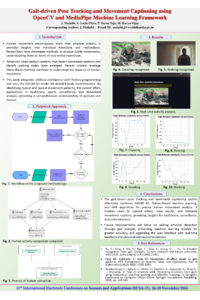
Pose tracking and captioning are extensively employed for motion capturing and activity description in daylight vision scenarios. Activity detection through camera systems presents a complex challenge, necessitating the refinement of numerous algorithms to ensure accurate functionality. Even though there are notable characteristics, IP cameras lack integrated models for effective human activity detection. With this motivation, this paper presents a gait-driven OpenCV and MediaPipe machine-learning framework for human pose and movement captioning. This is implemented by incorporating the Generative 3D Human Shape (GHUM 3D) model which can classify human bones while Python can classify the human movements as either usual or unusual. This model is fed into a website equipped with camera input, activity detection, and gait posture analysis for pose tracking and movement captioning. The proposed approach comprises four modules, two for pose tracking and the remaining two for generating natural language descriptions of movements. The implementation is carried out on two publicly available datasets, CASIA-A and CASIA-B. The proposed methodology emphasizes the diagnostic ability of video analysis by dividing video data available in the datasets into 15-frame segments for detailed examination, where each segment represents a time frame with detailed scrutiny of human movement. Features such as spatial-temporal descriptors, motion characteristics, or key point coordinates are derived from each frame to detect key pose landmarks, focusing on the left shoulder, elbow, and wrist. By calculating the angle between these landmarks, the proposed method classifies the activities as "Walking" (angle between -45 and 45 degrees), "Clapping" (angles below -120 or above 120 degrees), and "Running" (angles below -150 or above 150 degrees). Angles outside these ranges are categorized as "Abnormal," indicating abnormal activities. The experimental results show that the proposed method is robust for individual activity recognition.
Keywords
Activity recognition
Gait analysis
Human movement
Machine learning
Movement captioning
Pose tracking
Manuscript
engproc-sciforum_105715_S4_original_Gait_driven_Pose_.pdf
Poster
ECSA-11_sciforum-105715_Poster.pdf
Enhancing Fault Detection in Distributed Motor Systems Using AI-Driven Cyber-Physical Sensor Networks
LPG Smart Guard: An IoT-Based Solution for Real-Time Gas Cylinder Monitoring and Safety in Smart Homes