Event submissions
Published

This submission belongs to the session S4. Sensors and Artificial Intelligence of the event The 11th International Electronic Conference on Sensors and Applications
Published date
26 Nov, 2024
Academic Editor
'%3e%3cpath%20d='M12.6657%2010.9104C12.4185%2010.325%2012.0599%209.79327%2011.6097%209.34482C11.1609%208.89508%2010.6293%208.5365%2010.0442%208.28888C10.0389%208.28626%2010.0337%208.28495%2010.0285%208.28233C10.8446%207.69279%2011.3752%206.73249%2011.3752%205.64904C11.3752%203.8542%209.92103%202.39999%208.1262%202.39999C6.33136%202.39999%204.87715%203.8542%204.87715%205.64904C4.87715%206.73249%205.40774%207.69279%206.22393%208.28364C6.21869%208.28626%206.21345%208.28757%206.20821%208.29019C5.62129%208.5378%205.09463%208.89284%204.64265%209.34613C4.1929%209.79493%203.83432%2010.3266%203.58671%2010.9117C3.34345%2011.4845%203.21226%2012.0987%203.20023%2012.7209C3.19988%2012.7349%203.20233%2012.7488%203.20744%2012.7619C3.21255%2012.7749%203.22022%2012.7867%203.22998%2012.7968C3.23975%2012.8068%203.25142%2012.8147%203.26431%2012.8202C3.2772%2012.8256%203.29105%2012.8284%203.30504%2012.8284H4.09109C4.14874%2012.8284%204.19459%2012.7825%204.1959%2012.7262C4.2221%2011.7148%204.62823%2010.7676%205.34617%2010.0497C6.08899%209.30683%207.0755%208.89808%208.1262%208.89808C9.17689%208.89808%2010.1634%209.30683%2010.9062%2010.0497C11.6242%2010.7676%2012.0303%2011.7148%2012.0565%2012.7262C12.0578%2012.7838%2012.1037%2012.8284%2012.1613%2012.8284H12.9474C12.9613%2012.8284%2012.9752%2012.8256%2012.9881%2012.8202C13.001%2012.8147%2013.0126%2012.8068%2013.0224%2012.7968C13.0322%2012.7867%2013.0398%2012.7749%2013.0449%2012.7619C13.0501%2012.7488%2013.0525%2012.7349%2013.0522%2012.7209C13.0391%2012.0947%2012.9094%2011.4855%2012.6657%2010.9104ZM8.1262%207.9024C7.52486%207.9024%206.9589%207.6679%206.53312%207.24211C6.10733%206.81633%205.87283%206.25037%205.87283%205.64904C5.87283%205.0477%206.10733%204.48174%206.53312%204.05596C6.9589%203.63018%207.52486%203.39567%208.1262%203.39567C8.72753%203.39567%209.29349%203.63018%209.71927%204.05596C10.1451%204.48174%2010.3796%205.0477%2010.3796%205.64904C10.3796%206.25037%2010.1451%206.81633%209.71927%207.24211C9.29349%207.6679%208.72753%207.9024%208.1262%207.9024Z'%20fill='%235D1EE1'/%3e%3c/g%3e%3c/svg%3e) Jean-marc Laheurte
Jean-marc LaheurteCitation
Eric Boketsu-Boulu, Ghazal Rouhafzay, Enhancing Explainability in Convolutional Neural Networks Using Entropy-Based Class Activation Maps, in Proceedings of The 11th International Electronic Conference on Sensors and Applications, 26 November–28 November 2024, MDPI: Basel, Switzerland, doi: 10.3390/ecsa-11-20472
Share
Email
Facebook
Twitter
LinkedIn
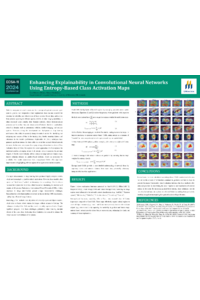
Enhancing Explainability in Convolutional Neural Networks Using Entropy-Based Class Activation Maps

Eric Boketsu-Boulu 1

Ghazal Rouhafzay 1
1. Département d'informatique, Université de Moncton
Abstract
With the emergence of visual sensors and their widespread application in intelligent systems, precise and interpretable visual explanations have become essential for ensuring the reliability and effectiveness of these systems. Sensor data, such as that from cameras operating in different spectra, LiDAR, or other imaging modalities, is often processed using complex deep learning methods, whose decision-making processes can be unclear. Accurate interpretation of network decisions is particularly critical in domains such as autonomous vehicles, medical imaging, and security systems. Moreover, during the development and deployment of deep learning architectures, the ability to accurately interpret results is crucial for identifying and mitigating any sources of bias in the training data, thereby ensuring fairness and robustness in the model's performance. Explainable AI (XAI) techniques have garnered significant interest for their ability to reveal the rationale behind network decisions. In this work, we propose leveraging entropy information to enhance Class Activation Maps (CAMs). We explore two novel approaches: the first replaces the traditional gradient averaging scheme with entropy values to generate feature map weights, while the second directly utilizes entropy to weigh and sum feature maps, thereby reducing reliance on gradient-based methods, which can sometimes be unreliable. Our results demonstrate that entropy-based CAMs offer significant improvements in highlighting relevant regions of the input across various scenarios.
Keywords
Explainable AI
Deep learning
Class Activation Maps
Convolutional Neural Networks
decision interpretation
Manuscript
engproc-sciforum_105700_S4.pdf
Poster
Poster_Paper_105700.pdf
LPG Smart Guard: An IoT-Based Solution for Real-Time Gas Cylinder Monitoring and Safety in Smart Homes
Effect of irregularities on the coupled vibrations of a medium-low speed Maglev system: experimental testing and simulations