Event submissions
Published

This submission belongs to the session S1. Chemo- and Biosensors of the event The 11th International Electronic Conference on Sensors and Applications
Published date
26 Nov, 2024
Academic Editor
'%3e%3cpath%20d='M12.6657%2010.9104C12.4185%2010.325%2012.0599%209.79327%2011.6097%209.34482C11.1609%208.89508%2010.6293%208.5365%2010.0442%208.28888C10.0389%208.28626%2010.0337%208.28495%2010.0285%208.28233C10.8446%207.69279%2011.3752%206.73249%2011.3752%205.64904C11.3752%203.8542%209.92103%202.39999%208.1262%202.39999C6.33136%202.39999%204.87715%203.8542%204.87715%205.64904C4.87715%206.73249%205.40774%207.69279%206.22393%208.28364C6.21869%208.28626%206.21345%208.28757%206.20821%208.29019C5.62129%208.5378%205.09463%208.89284%204.64265%209.34613C4.1929%209.79493%203.83432%2010.3266%203.58671%2010.9117C3.34345%2011.4845%203.21226%2012.0987%203.20023%2012.7209C3.19988%2012.7349%203.20233%2012.7488%203.20744%2012.7619C3.21255%2012.7749%203.22022%2012.7867%203.22998%2012.7968C3.23975%2012.8068%203.25142%2012.8147%203.26431%2012.8202C3.2772%2012.8256%203.29105%2012.8284%203.30504%2012.8284H4.09109C4.14874%2012.8284%204.19459%2012.7825%204.1959%2012.7262C4.2221%2011.7148%204.62823%2010.7676%205.34617%2010.0497C6.08899%209.30683%207.0755%208.89808%208.1262%208.89808C9.17689%208.89808%2010.1634%209.30683%2010.9062%2010.0497C11.6242%2010.7676%2012.0303%2011.7148%2012.0565%2012.7262C12.0578%2012.7838%2012.1037%2012.8284%2012.1613%2012.8284H12.9474C12.9613%2012.8284%2012.9752%2012.8256%2012.9881%2012.8202C13.001%2012.8147%2013.0126%2012.8068%2013.0224%2012.7968C13.0322%2012.7867%2013.0398%2012.7749%2013.0449%2012.7619C13.0501%2012.7488%2013.0525%2012.7349%2013.0522%2012.7209C13.0391%2012.0947%2012.9094%2011.4855%2012.6657%2010.9104ZM8.1262%207.9024C7.52486%207.9024%206.9589%207.6679%206.53312%207.24211C6.10733%206.81633%205.87283%206.25037%205.87283%205.64904C5.87283%205.0477%206.10733%204.48174%206.53312%204.05596C6.9589%203.63018%207.52486%203.39567%208.1262%203.39567C8.72753%203.39567%209.29349%203.63018%209.71927%204.05596C10.1451%204.48174%2010.3796%205.0477%2010.3796%205.64904C10.3796%206.25037%2010.1451%206.81633%209.71927%207.24211C9.29349%207.6679%208.72753%207.9024%208.1262%207.9024Z'%20fill='%235D1EE1'/%3e%3c/g%3e%3c/svg%3e) Francisco Falcone
Francisco FalconeCitation
Svetlana Nalimova, Zamir Shomakhov, Vlada Miroshkina, Cong Doan Bui, Vyacheslav Moshnikov, Control of the response to water vapor of gas-sensitive zinc oxide nanostructures, in Proceedings of The 11th International Electronic Conference on Sensors and Applications, 26 November–28 November 2024, MDPI: Basel, Switzerland, doi: 10.3390/ecsa-11-20477
Share
Email
Facebook
Twitter
LinkedIn
Control of the response to water vapor of gas-sensitive zinc oxide nanostructures
'%3e%3cpath%20d='M12.6647%2010.9104C12.4176%2010.325%2012.0589%209.7933%2011.6088%209.34485C11.16%208.89511%2010.6283%208.53653%2010.0432%208.28891C10.038%208.28629%2010.0327%208.28498%2010.0275%208.28236C10.8437%207.69282%2011.3743%206.73252%2011.3743%205.64907C11.3743%203.85423%209.92005%202.40002%208.12522%202.40002C6.33038%202.40002%204.87618%203.85423%204.87618%205.64907C4.87618%206.73252%205.40677%207.69282%206.22296%208.28367C6.21772%208.28629%206.21248%208.2876%206.20724%208.29022C5.62031%208.53783%205.09365%208.89287%204.64167%209.34616C4.19192%209.79496%203.83334%2010.3266%203.58573%2010.9117C3.34247%2011.4846%203.21128%2012.0987%203.19925%2012.721C3.1989%2012.735%203.20135%2012.7489%203.20646%2012.7619C3.21157%2012.7749%203.21924%2012.7868%203.22901%2012.7968C3.23877%2012.8068%203.25045%2012.8148%203.26334%2012.8202C3.27623%2012.8256%203.29007%2012.8284%203.30406%2012.8284H4.09012C4.14776%2012.8284%204.19362%2012.7825%204.19493%2012.7262C4.22113%2011.7148%204.62726%2010.7676%205.34519%2010.0497C6.08802%209.30686%207.07452%208.89811%208.12522%208.89811C9.17592%208.89811%2010.1624%209.30686%2010.9052%2010.0497C11.6232%2010.7676%2012.0293%2011.7148%2012.0555%2012.7262C12.0568%2012.7839%2012.1027%2012.8284%2012.1603%2012.8284H12.9464C12.9604%2012.8284%2012.9742%2012.8256%2012.9871%2012.8202C13%2012.8148%2013.0117%2012.8068%2013.0214%2012.7968C13.0312%2012.7868%2013.0389%2012.7749%2013.044%2012.7619C13.0491%2012.7489%2013.0515%2012.735%2013.0512%2012.721C13.0381%2012.0947%2012.9084%2011.4856%2012.6647%2010.9104ZM8.12522%207.90243C7.52388%207.90243%206.95792%207.66793%206.53214%207.24215C6.10636%206.81636%205.87185%206.2504%205.87185%205.64907C5.87185%205.04773%206.10636%204.48177%206.53214%204.05599C6.95792%203.63021%207.52388%203.3957%208.12522%203.3957C8.72655%203.3957%209.29252%203.63021%209.7183%204.05599C10.1441%204.48177%2010.3786%205.04773%2010.3786%205.64907C10.3786%206.2504%2010.1441%206.81636%209.7183%207.24215C9.29252%207.66793%208.72655%207.90243%208.12522%207.90243Z'%20fill='%235D1EE1'/%3e%3c/g%3e%3c/svg%3e)
Svetlana Nalimova 1
Zamir Shomakhov 2
Vlada Miroshkina 1
Cong Doan Bui 1
Vyacheslav Moshnikov 1
1. Saint Petersburg Electrotechnical University «LETI»
2. Kabardino-Balkarian State University named after H.M. Berbekov
Abstract
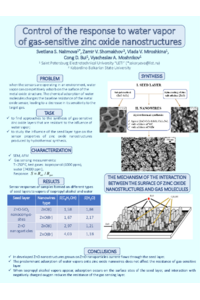
Gas-sensitive devices have great potential for use in a variety of applications, including environmental monitoring, biomedical devices, and the pharmaceutical industry. Zinc oxide is one of the most widely used gas-sensitive materials due to its wide-band n-type semiconductor properties, high biocompatibility, chemical stability, environmental safety, and low cost. However, the stability of gas sensors based on zinc oxide can be significantly affected by the presence of water vapor in the atmosphere. To address this issue, methods for synthesizing gas-sensitive layers of zinc oxide with improved resistance to water vapor have been explored. The effects of different seed layers and the use of additional precursors have been studied in order to optimize the sensor properties of zinc oxide nanostructures. Methods have been developed for the synthesis of sacrifically doped ZnO nanorods using ZnO-SiO2 net-like nanocomposites and ZnO nanoparticles as seed layers. Analysis of the composition of the resulting layers showed that the use of the sacrifice doping approach allows controlling the content of oxygen vacancies on the surface. Sensor layers consisting of zinc oxide nanorods synthesized using sacrifice doping on the seed layer of ZnO nanoparticles exhibited a response to vapor of volatile organic compounds, with almost no response to water vapor. Nanorods can significantly increase the active adsorption area for water vapor, as they can act as capture traps for water molecules and do not interfere with the measurement readings from sensors. Sensor layers on the seed layers of ZnO-SiO2 nanocomposites responded to both vapor of volatile organic compounds and water vapor. This phenomenon can be explained by the presence of silicon dioxide in the composite material, which attracts water molecules. This affects the final performance of the gas sensor. The results can be used to develop highly efficient sensors for industrial, medical, and food applications.
Keywords
ZnO
ZnO-SiO2
gas sensor
nanorods
sacrificial doping
humidity
Manuscript
engproc-sciforum_105661_S1_orginal.pdf
Poster
Nalimova_poster.pdf
Evaluation of modified FGSM-based data augmentation method for convolutional neural network-based image classification
Auto-Tuning Sync in the Acoustic Emission Mapping for CFRP Milling