Event submissions
Published

This submission belongs to the session S3. Sensor Networks, IoT, Smart Cities and Heath Monitoring of the event The 11th International Electronic Conference on Sensors and Applications
Published date
26 Nov, 2024
Academic Editor
'%3e%3cpath%20d='M12.6657%2010.9104C12.4185%2010.325%2012.0599%209.79327%2011.6097%209.34482C11.1609%208.89508%2010.6293%208.5365%2010.0442%208.28888C10.0389%208.28626%2010.0337%208.28495%2010.0285%208.28233C10.8446%207.69279%2011.3752%206.73249%2011.3752%205.64904C11.3752%203.8542%209.92103%202.39999%208.1262%202.39999C6.33136%202.39999%204.87715%203.8542%204.87715%205.64904C4.87715%206.73249%205.40774%207.69279%206.22393%208.28364C6.21869%208.28626%206.21345%208.28757%206.20821%208.29019C5.62129%208.5378%205.09463%208.89284%204.64265%209.34613C4.1929%209.79493%203.83432%2010.3266%203.58671%2010.9117C3.34345%2011.4845%203.21226%2012.0987%203.20023%2012.7209C3.19988%2012.7349%203.20233%2012.7488%203.20744%2012.7619C3.21255%2012.7749%203.22022%2012.7867%203.22998%2012.7968C3.23975%2012.8068%203.25142%2012.8147%203.26431%2012.8202C3.2772%2012.8256%203.29105%2012.8284%203.30504%2012.8284H4.09109C4.14874%2012.8284%204.19459%2012.7825%204.1959%2012.7262C4.2221%2011.7148%204.62823%2010.7676%205.34617%2010.0497C6.08899%209.30683%207.0755%208.89808%208.1262%208.89808C9.17689%208.89808%2010.1634%209.30683%2010.9062%2010.0497C11.6242%2010.7676%2012.0303%2011.7148%2012.0565%2012.7262C12.0578%2012.7838%2012.1037%2012.8284%2012.1613%2012.8284H12.9474C12.9613%2012.8284%2012.9752%2012.8256%2012.9881%2012.8202C13.001%2012.8147%2013.0126%2012.8068%2013.0224%2012.7968C13.0322%2012.7867%2013.0398%2012.7749%2013.0449%2012.7619C13.0501%2012.7488%2013.0525%2012.7349%2013.0522%2012.7209C13.0391%2012.0947%2012.9094%2011.4855%2012.6657%2010.9104ZM8.1262%207.9024C7.52486%207.9024%206.9589%207.6679%206.53312%207.24211C6.10733%206.81633%205.87283%206.25037%205.87283%205.64904C5.87283%205.0477%206.10733%204.48174%206.53312%204.05596C6.9589%203.63018%207.52486%203.39567%208.1262%203.39567C8.72753%203.39567%209.29349%203.63018%209.71927%204.05596C10.1451%204.48174%2010.3796%205.0477%2010.3796%205.64904C10.3796%206.25037%2010.1451%206.81633%209.71927%207.24211C9.29349%207.6679%208.72753%207.9024%208.1262%207.9024Z'%20fill='%235D1EE1'/%3e%3c/g%3e%3c/svg%3e) Stefan Bosse
Stefan BosseCitation
Paulo Vitor Pereira Oliveira, Lucas Zanasi Matheus, Fabio Romano Lofrano Dotto, Pedro de Oliveira Conceição, Alessandro Roger Rodrigues, Dennis Brandao, Auto-Tuning Sync in the Acoustic Emission Mapping for CFRP Milling, in Proceedings of The 11th International Electronic Conference on Sensors and Applications, 26 November–28 November 2024, MDPI: Basel, Switzerland, doi: 10.3390/ecsa-11-20478
Share
Email
Facebook
Twitter
LinkedIn
Auto-Tuning Sync in the Acoustic Emission Mapping for CFRP Milling
'%3e%3cpath%20d='M12.6647%2010.9104C12.4176%2010.325%2012.0589%209.7933%2011.6088%209.34485C11.16%208.89511%2010.6283%208.53653%2010.0432%208.28891C10.038%208.28629%2010.0327%208.28498%2010.0275%208.28236C10.8437%207.69282%2011.3743%206.73252%2011.3743%205.64907C11.3743%203.85423%209.92005%202.40002%208.12522%202.40002C6.33038%202.40002%204.87618%203.85423%204.87618%205.64907C4.87618%206.73252%205.40677%207.69282%206.22296%208.28367C6.21772%208.28629%206.21248%208.2876%206.20724%208.29022C5.62031%208.53783%205.09365%208.89287%204.64167%209.34616C4.19192%209.79496%203.83334%2010.3266%203.58573%2010.9117C3.34247%2011.4846%203.21128%2012.0987%203.19925%2012.721C3.1989%2012.735%203.20135%2012.7489%203.20646%2012.7619C3.21157%2012.7749%203.21924%2012.7868%203.22901%2012.7968C3.23877%2012.8068%203.25045%2012.8148%203.26334%2012.8202C3.27623%2012.8256%203.29007%2012.8284%203.30406%2012.8284H4.09012C4.14776%2012.8284%204.19362%2012.7825%204.19493%2012.7262C4.22113%2011.7148%204.62726%2010.7676%205.34519%2010.0497C6.08802%209.30686%207.07452%208.89811%208.12522%208.89811C9.17592%208.89811%2010.1624%209.30686%2010.9052%2010.0497C11.6232%2010.7676%2012.0293%2011.7148%2012.0555%2012.7262C12.0568%2012.7839%2012.1027%2012.8284%2012.1603%2012.8284H12.9464C12.9604%2012.8284%2012.9742%2012.8256%2012.9871%2012.8202C13%2012.8148%2013.0117%2012.8068%2013.0214%2012.7968C13.0312%2012.7868%2013.0389%2012.7749%2013.044%2012.7619C13.0491%2012.7489%2013.0515%2012.735%2013.0512%2012.721C13.0381%2012.0947%2012.9084%2011.4856%2012.6647%2010.9104ZM8.12522%207.90243C7.52388%207.90243%206.95792%207.66793%206.53214%207.24215C6.10636%206.81636%205.87185%206.2504%205.87185%205.64907C5.87185%205.04773%206.10636%204.48177%206.53214%204.05599C6.95792%203.63021%207.52388%203.3957%208.12522%203.3957C8.72655%203.3957%209.29252%203.63021%209.7183%204.05599C10.1441%204.48177%2010.3786%205.04773%2010.3786%205.64907C10.3786%206.2504%2010.1441%206.81636%209.7183%207.24215C9.29252%207.66793%208.72655%207.90243%208.12522%207.90243Z'%20fill='%235D1EE1'/%3e%3c/g%3e%3c/svg%3e)
Paulo Vitor Pereira Oliveira 1
Lucas Zanasi Matheus 1

Fabio Romano Lofrano Dotto 1
Pedro de Oliveira Conceição 1

Alessandro Roger Rodrigues 1
Dennis Brandao 2
1. São Carlos School of Engineering, University of São Paulo – USP
2. Department of Information Engineering, University of Brescia - UNIBS
Abstract
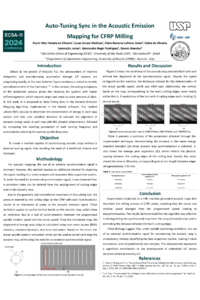
Driven by the growth of Industry 4.0, advanced studies on machine integration and manufacturing automation through IoT systems are progressing rapidly. Specifically, in milling applications of CFRP (Carbon Fiber Reinforced Polymer) composites, acoustic emission sensors employing piezoelectric transducers have been used to generate acoustic maps. These maps are crucial for monitoring the condition of both the tool and the workpiece, providing a visual analysis of the tool-workpiece interaction that facilitates decision-making by the operator in case of failures. Traditionally, creating acoustic maps that visualize the process and correlate with machining conditions requires an external synchronization signal, usually provided by an encoder attached to the spindle. This study introduces an innovative technique that uses the image generated by the acoustic map to perform automatic alignment during the map's production, eliminating the need for an external synchronization signal. Implemented in Matlab software, the algorithm uses digital filters to extract features, recognizing the pattern of the cutting edges in the map. Based on the misalignment of the cutting edges in the image, the algorithm automatically adjusts the rotation parameters in the map reconstruction, resulting in an accurate representation of the process. The results demonstrate that under specific machining conditions, the need for an external synchronization signal to construct an acoustic map is unnecessary, making the data acquisition system simpler, more economical, and computationally less demanding. This advancement significantly contributes to the development of embedded IoT sensor solutions tailored for Industry 4.0.
Keywords
Milling
Acoustic Map
Piezoeletric Transducer
IoT Sensor
Manuscript
engproc-sciforum_100757_S3.pdf
Poster
Painel_Paulo.pptx.pdf
Control of the response to water vapor of gas-sensitive zinc oxide nanostructures
Fault Diagnosis of the Vehicle Lateral System Using Bayesian Networks and EKF with Real-Time ROS Applications