Event submissions
Published

This submission belongs to the session S4. Sensors and Artificial Intelligence of the event The 11th International Electronic Conference on Sensors and Applications
Published date
26 Nov, 2024
Academic Editor
'%3e%3cpath%20d='M12.6657%2010.9104C12.4185%2010.325%2012.0599%209.79327%2011.6097%209.34482C11.1609%208.89508%2010.6293%208.5365%2010.0442%208.28888C10.0389%208.28626%2010.0337%208.28495%2010.0285%208.28233C10.8446%207.69279%2011.3752%206.73249%2011.3752%205.64904C11.3752%203.8542%209.92103%202.39999%208.1262%202.39999C6.33136%202.39999%204.87715%203.8542%204.87715%205.64904C4.87715%206.73249%205.40774%207.69279%206.22393%208.28364C6.21869%208.28626%206.21345%208.28757%206.20821%208.29019C5.62129%208.5378%205.09463%208.89284%204.64265%209.34613C4.1929%209.79493%203.83432%2010.3266%203.58671%2010.9117C3.34345%2011.4845%203.21226%2012.0987%203.20023%2012.7209C3.19988%2012.7349%203.20233%2012.7488%203.20744%2012.7619C3.21255%2012.7749%203.22022%2012.7867%203.22998%2012.7968C3.23975%2012.8068%203.25142%2012.8147%203.26431%2012.8202C3.2772%2012.8256%203.29105%2012.8284%203.30504%2012.8284H4.09109C4.14874%2012.8284%204.19459%2012.7825%204.1959%2012.7262C4.2221%2011.7148%204.62823%2010.7676%205.34617%2010.0497C6.08899%209.30683%207.0755%208.89808%208.1262%208.89808C9.17689%208.89808%2010.1634%209.30683%2010.9062%2010.0497C11.6242%2010.7676%2012.0303%2011.7148%2012.0565%2012.7262C12.0578%2012.7838%2012.1037%2012.8284%2012.1613%2012.8284H12.9474C12.9613%2012.8284%2012.9752%2012.8256%2012.9881%2012.8202C13.001%2012.8147%2013.0126%2012.8068%2013.0224%2012.7968C13.0322%2012.7867%2013.0398%2012.7749%2013.0449%2012.7619C13.0501%2012.7488%2013.0525%2012.7349%2013.0522%2012.7209C13.0391%2012.0947%2012.9094%2011.4855%2012.6657%2010.9104ZM8.1262%207.9024C7.52486%207.9024%206.9589%207.6679%206.53312%207.24211C6.10733%206.81633%205.87283%206.25037%205.87283%205.64904C5.87283%205.0477%206.10733%204.48174%206.53312%204.05596C6.9589%203.63018%207.52486%203.39567%208.1262%203.39567C8.72753%203.39567%209.29349%203.63018%209.71927%204.05596C10.1451%204.48174%2010.3796%205.0477%2010.3796%205.64904C10.3796%206.25037%2010.1451%206.81633%209.71927%207.24211C9.29349%207.6679%208.72753%207.9024%208.1262%207.9024Z'%20fill='%235D1EE1'/%3e%3c/g%3e%3c/svg%3e) Francisco Falcone
Francisco FalconeCitation
Yellapragada Venkata Pavan Kumar, AI-Driven Longitudinal Pitch Attitude Control for Enhanced Flight Control Dynamics, in Proceedings of The 11th International Electronic Conference on Sensors and Applications, 26 November–28 November 2024, MDPI: Basel, Switzerland, doi: 10.3390/ecsa-11-20483
Share
Email
Facebook
Twitter
LinkedIn
AI-Driven Longitudinal Pitch Attitude Control for Enhanced Flight Control Dynamics

Yellapragada Venkata Pavan Kumar 1
1. School of Electronics Engineering, VIT-AP University, Amaravati 522237, Andhra Pradesh, India
Abstract
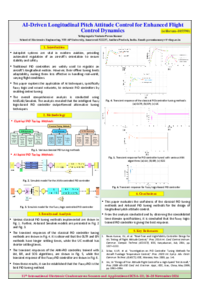
The regulation of the orientation of a flying aircraft under autopilot is a multifaceted and crucial task that requires accuracy and flexibility. To do this, it is essential to have a complex control system that is furnished with an advanced controller capable of actively monitoring and modifying the flying characteristics of the aircraft. This must possess the ability to react dynamically to a range of disturbances experienced throughout the flight, including turbulence, fluctuations in wind, and other pertinent environmental elements. Through real-time adjustment of the flying attitude, the control system guarantees that the aircraft maintains its planned trajectory, stability, and safety along the whole trajectory. Typically, PID controllers are used to regulate the longitudinal direction of flights. However, these offline tuned controllers lack automation and are unable to adjust parameters in response to inherent disturbances seen in practice. Thus, this paper proposes online tuning techniques that are created using artificial intelligence (AI) mechanisms such as fuzzy logic and neural networks. The philosophy involved in this work is the online tuning of PID gain parameters by applying both aforementioned intelligent methods. The study also implements many traditional PID tuning techniques and compares the most effective tuning method with online approaches. To evaluate the effectiveness of online controllers and the optimal traditional PID controller, these controllers are subjected to different disturbances, and their performance is evaluated based on time-domain transient characteristics. The analysis revealed that the intelligent fuzzy controller-based PID controller outperformed alternative tuning techniques in terms of time performance indices such as delay time, rise time, peak time, and settling time, which are improved by 5.88%, 3.26%, 8.05%, and 55.71% respectively when compared to traditional PID tuning methods. The overall comprehensive analysis is conducted using MATLAB/Simulink, and the most optimal online tuning approach is recommended for the controller design.
Keywords
Longitudinal attitude
PID controller
Fuzzy logic
neural networks
closed-loop control
autopilot
MATLAB/Simulink
Manuscript
engproc-sciforum_105590_S4_original.pdf
Poster
ECSA-11_sciforum-105590_Poster.pdf
NR-IQA with Gaussian derivative filter, Convolutional Block Attention Module and Spatial pyramid pooling
Developing an Embedded IoT Platform for Acoustic Emission Monitoring in Industry 4.0