Event submissions
Published

This submission belongs to the session S3. Sensor Networks, IoT, Smart Cities and Heath Monitoring of the event The 11th International Electronic Conference on Sensors and Applications
Published date
26 Nov, 2024
Academic Editor
'%3e%3cpath%20d='M12.6657%2010.9104C12.4185%2010.325%2012.0599%209.79327%2011.6097%209.34482C11.1609%208.89508%2010.6293%208.5365%2010.0442%208.28888C10.0389%208.28626%2010.0337%208.28495%2010.0285%208.28233C10.8446%207.69279%2011.3752%206.73249%2011.3752%205.64904C11.3752%203.8542%209.92103%202.39999%208.1262%202.39999C6.33136%202.39999%204.87715%203.8542%204.87715%205.64904C4.87715%206.73249%205.40774%207.69279%206.22393%208.28364C6.21869%208.28626%206.21345%208.28757%206.20821%208.29019C5.62129%208.5378%205.09463%208.89284%204.64265%209.34613C4.1929%209.79493%203.83432%2010.3266%203.58671%2010.9117C3.34345%2011.4845%203.21226%2012.0987%203.20023%2012.7209C3.19988%2012.7349%203.20233%2012.7488%203.20744%2012.7619C3.21255%2012.7749%203.22022%2012.7867%203.22998%2012.7968C3.23975%2012.8068%203.25142%2012.8147%203.26431%2012.8202C3.2772%2012.8256%203.29105%2012.8284%203.30504%2012.8284H4.09109C4.14874%2012.8284%204.19459%2012.7825%204.1959%2012.7262C4.2221%2011.7148%204.62823%2010.7676%205.34617%2010.0497C6.08899%209.30683%207.0755%208.89808%208.1262%208.89808C9.17689%208.89808%2010.1634%209.30683%2010.9062%2010.0497C11.6242%2010.7676%2012.0303%2011.7148%2012.0565%2012.7262C12.0578%2012.7838%2012.1037%2012.8284%2012.1613%2012.8284H12.9474C12.9613%2012.8284%2012.9752%2012.8256%2012.9881%2012.8202C13.001%2012.8147%2013.0126%2012.8068%2013.0224%2012.7968C13.0322%2012.7867%2013.0398%2012.7749%2013.0449%2012.7619C13.0501%2012.7488%2013.0525%2012.7349%2013.0522%2012.7209C13.0391%2012.0947%2012.9094%2011.4855%2012.6657%2010.9104ZM8.1262%207.9024C7.52486%207.9024%206.9589%207.6679%206.53312%207.24211C6.10733%206.81633%205.87283%206.25037%205.87283%205.64904C5.87283%205.0477%206.10733%204.48174%206.53312%204.05596C6.9589%203.63018%207.52486%203.39567%208.1262%203.39567C8.72753%203.39567%209.29349%203.63018%209.71927%204.05596C10.1451%204.48174%2010.3796%205.0477%2010.3796%205.64904C10.3796%206.25037%2010.1451%206.81633%209.71927%207.24211C9.29349%207.6679%208.72753%207.9024%208.1262%207.9024Z'%20fill='%235D1EE1'/%3e%3c/g%3e%3c/svg%3e) Stefan Bosse
Stefan BosseCitation
Marco Grossi, Martin Omana, Cecilia Metra, Andrea Acquaviva, A ring oscillator based physical unclonable function with enhanced challenge-response pairs to improve the security of internet of things devices, in Proceedings of The 11th International Electronic Conference on Sensors and Applications, 26 November–28 November 2024, MDPI: Basel, Switzerland, doi: 10.3390/ecsa-11-20497
Share
Email
Facebook
Twitter
LinkedIn
A ring oscillator based physical unclonable function with enhanced challenge-response pairs to improve the security of internet of things devices

Marco Grossi 1
'%3e%3cpath%20d='M12.6647%2010.9104C12.4176%2010.325%2012.0589%209.7933%2011.6088%209.34485C11.16%208.89511%2010.6283%208.53653%2010.0432%208.28891C10.038%208.28629%2010.0327%208.28498%2010.0275%208.28236C10.8437%207.69282%2011.3743%206.73252%2011.3743%205.64907C11.3743%203.85423%209.92005%202.40002%208.12522%202.40002C6.33038%202.40002%204.87618%203.85423%204.87618%205.64907C4.87618%206.73252%205.40677%207.69282%206.22296%208.28367C6.21772%208.28629%206.21248%208.2876%206.20724%208.29022C5.62031%208.53783%205.09365%208.89287%204.64167%209.34616C4.19192%209.79496%203.83334%2010.3266%203.58573%2010.9117C3.34247%2011.4846%203.21128%2012.0987%203.19925%2012.721C3.1989%2012.735%203.20135%2012.7489%203.20646%2012.7619C3.21157%2012.7749%203.21924%2012.7868%203.22901%2012.7968C3.23877%2012.8068%203.25045%2012.8148%203.26334%2012.8202C3.27623%2012.8256%203.29007%2012.8284%203.30406%2012.8284H4.09012C4.14776%2012.8284%204.19362%2012.7825%204.19493%2012.7262C4.22113%2011.7148%204.62726%2010.7676%205.34519%2010.0497C6.08802%209.30686%207.07452%208.89811%208.12522%208.89811C9.17592%208.89811%2010.1624%209.30686%2010.9052%2010.0497C11.6232%2010.7676%2012.0293%2011.7148%2012.0555%2012.7262C12.0568%2012.7839%2012.1027%2012.8284%2012.1603%2012.8284H12.9464C12.9604%2012.8284%2012.9742%2012.8256%2012.9871%2012.8202C13%2012.8148%2013.0117%2012.8068%2013.0214%2012.7968C13.0312%2012.7868%2013.0389%2012.7749%2013.044%2012.7619C13.0491%2012.7489%2013.0515%2012.735%2013.0512%2012.721C13.0381%2012.0947%2012.9084%2011.4856%2012.6647%2010.9104ZM8.12522%207.90243C7.52388%207.90243%206.95792%207.66793%206.53214%207.24215C6.10636%206.81636%205.87185%206.2504%205.87185%205.64907C5.87185%205.04773%206.10636%204.48177%206.53214%204.05599C6.95792%203.63021%207.52388%203.3957%208.12522%203.3957C8.72655%203.3957%209.29252%203.63021%209.7183%204.05599C10.1441%204.48177%2010.3786%205.04773%2010.3786%205.64907C10.3786%206.2504%2010.1441%206.81636%209.7183%207.24215C9.29252%207.66793%208.72655%207.90243%208.12522%207.90243Z'%20fill='%235D1EE1'/%3e%3c/g%3e%3c/svg%3e)
Martin Omana 1
Cecilia Metra 1

Andrea Acquaviva 1
1. Department of Electrical Energy and Information Engineering “Guglielmo Marconi” (DEI), University of Bologna, Bologna, Italy
Abstract
The interconnection of measurement devices in the paradigm of the Internet of Things has led to a significant increase in the amount of shared data but, at the same time, has increased system’s vulnerability to cyber-attacks aimed at stealing confidential information and/or damaging the system. Countermeasures have been proposed to mitigate these security risks, such as authentication procedures and cryptographic algorithms. In both cases, however, passwords and cryptographic keys are stored in a non-volatile memory (NVM), that can be hacked to disclose the confidential information.
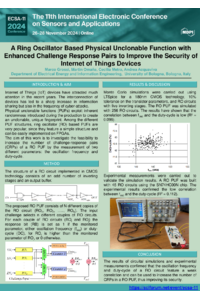
Physical unclonable functions (PUFs) can be adopted as an alternative to NVMs for the generation of secure codes, exploiting the device parameters variations induced by the production process. Among the different PUF architectures, ring oscillator (RO) PUFs are very popular, since they feature a simple structure and can be easily implemented on FPGAs. In their standard implementation, RO PUFs output code is generated by comparing the oscillation frequencies of the periodic signals of different ROs. However, alternate solutions have been proposed in the literature, such as those comparing the duty-cycle of the periodic signals of different ROs. This solution improves the PUF reliability, but the number of generated output codes remains the same.
In this paper, the feasibility of using both the oscillation frequency and the duty-cycle of the periodic signals of different ROs to generate the PUF output code is demonstrated. The correlation between the oscillation frequency and the duty-cycle of a RO PUF is evaluated by means of Spice simulations, as well as by experimental measurements. The results have shown that the oscillation frequency and the duty-cycle of a RO PUF feature a weak correlation and, therefore, can be used to increase the number of output codes of the PUF device, with benefits in terms of increased security.
Keywords
physical unclonable functions
cybersecurity
internet of things
ring oscillator
frequency
duty cycle
Manuscript
engproc-sciforum_101548_S3.pdf
Poster
Poster - RO PUF enhanced CRPs - ECSA-11.pdf
Designing Novel MEMS Cantilevers for Marine Sensing Robots Using COMSOL Modeling and Different Piezoelectric Materials
Robosim: Design, Implementation, and Applications of a Line Follower Robot Simulator