Event submissions
Published

This submission belongs to the session S9. Student Session of the event The 11th International Electronic Conference on Sensors and Applications
Published date
26 Nov, 2024
Academic Editor
'%3e%3cpath%20d='M12.6657%2010.9104C12.4185%2010.325%2012.0599%209.79327%2011.6097%209.34482C11.1609%208.89508%2010.6293%208.5365%2010.0442%208.28888C10.0389%208.28626%2010.0337%208.28495%2010.0285%208.28233C10.8446%207.69279%2011.3752%206.73249%2011.3752%205.64904C11.3752%203.8542%209.92103%202.39999%208.1262%202.39999C6.33136%202.39999%204.87715%203.8542%204.87715%205.64904C4.87715%206.73249%205.40774%207.69279%206.22393%208.28364C6.21869%208.28626%206.21345%208.28757%206.20821%208.29019C5.62129%208.5378%205.09463%208.89284%204.64265%209.34613C4.1929%209.79493%203.83432%2010.3266%203.58671%2010.9117C3.34345%2011.4845%203.21226%2012.0987%203.20023%2012.7209C3.19988%2012.7349%203.20233%2012.7488%203.20744%2012.7619C3.21255%2012.7749%203.22022%2012.7867%203.22998%2012.7968C3.23975%2012.8068%203.25142%2012.8147%203.26431%2012.8202C3.2772%2012.8256%203.29105%2012.8284%203.30504%2012.8284H4.09109C4.14874%2012.8284%204.19459%2012.7825%204.1959%2012.7262C4.2221%2011.7148%204.62823%2010.7676%205.34617%2010.0497C6.08899%209.30683%207.0755%208.89808%208.1262%208.89808C9.17689%208.89808%2010.1634%209.30683%2010.9062%2010.0497C11.6242%2010.7676%2012.0303%2011.7148%2012.0565%2012.7262C12.0578%2012.7838%2012.1037%2012.8284%2012.1613%2012.8284H12.9474C12.9613%2012.8284%2012.9752%2012.8256%2012.9881%2012.8202C13.001%2012.8147%2013.0126%2012.8068%2013.0224%2012.7968C13.0322%2012.7867%2013.0398%2012.7749%2013.0449%2012.7619C13.0501%2012.7488%2013.0525%2012.7349%2013.0522%2012.7209C13.0391%2012.0947%2012.9094%2011.4855%2012.6657%2010.9104ZM8.1262%207.9024C7.52486%207.9024%206.9589%207.6679%206.53312%207.24211C6.10733%206.81633%205.87283%206.25037%205.87283%205.64904C5.87283%205.0477%206.10733%204.48174%206.53312%204.05596C6.9589%203.63018%207.52486%203.39567%208.1262%203.39567C8.72753%203.39567%209.29349%203.63018%209.71927%204.05596C10.1451%204.48174%2010.3796%205.0477%2010.3796%205.64904C10.3796%206.25037%2010.1451%206.81633%209.71927%207.24211C9.29349%207.6679%208.72753%207.9024%208.1262%207.9024Z'%20fill='%235D1EE1'/%3e%3c/g%3e%3c/svg%3e) Stefano Mariani
Stefano MarianiCitation
Warakorn Karasaeng, Jitjark Nualkham, Phatsakul Thitimahatthanakusol, Niwat Angkawisittpan, Somchat Sonasang, The Correlation of Pickled Fish and Frequency Response using Parallel Coupled Lines Band Stop Filter Microstrip, in Proceedings of The 11th International Electronic Conference on Sensors and Applications, 26 November–28 November 2024, MDPI: Basel, Switzerland, doi: 10.3390/ecsa-11-20508
Share
Email
Facebook
Twitter
LinkedIn
The Correlation of Pickled Fish and Frequency Response using Parallel Coupled Lines Band Stop Filter Microstrip
'%3e%3cpath%20d='M12.6647%2010.9104C12.4176%2010.325%2012.0589%209.7933%2011.6088%209.34485C11.16%208.89511%2010.6283%208.53653%2010.0432%208.28891C10.038%208.28629%2010.0327%208.28498%2010.0275%208.28236C10.8437%207.69282%2011.3743%206.73252%2011.3743%205.64907C11.3743%203.85423%209.92005%202.40002%208.12522%202.40002C6.33038%202.40002%204.87618%203.85423%204.87618%205.64907C4.87618%206.73252%205.40677%207.69282%206.22296%208.28367C6.21772%208.28629%206.21248%208.2876%206.20724%208.29022C5.62031%208.53783%205.09365%208.89287%204.64167%209.34616C4.19192%209.79496%203.83334%2010.3266%203.58573%2010.9117C3.34247%2011.4846%203.21128%2012.0987%203.19925%2012.721C3.1989%2012.735%203.20135%2012.7489%203.20646%2012.7619C3.21157%2012.7749%203.21924%2012.7868%203.22901%2012.7968C3.23877%2012.8068%203.25045%2012.8148%203.26334%2012.8202C3.27623%2012.8256%203.29007%2012.8284%203.30406%2012.8284H4.09012C4.14776%2012.8284%204.19362%2012.7825%204.19493%2012.7262C4.22113%2011.7148%204.62726%2010.7676%205.34519%2010.0497C6.08802%209.30686%207.07452%208.89811%208.12522%208.89811C9.17592%208.89811%2010.1624%209.30686%2010.9052%2010.0497C11.6232%2010.7676%2012.0293%2011.7148%2012.0555%2012.7262C12.0568%2012.7839%2012.1027%2012.8284%2012.1603%2012.8284H12.9464C12.9604%2012.8284%2012.9742%2012.8256%2012.9871%2012.8202C13%2012.8148%2013.0117%2012.8068%2013.0214%2012.7968C13.0312%2012.7868%2013.0389%2012.7749%2013.044%2012.7619C13.0491%2012.7489%2013.0515%2012.735%2013.0512%2012.721C13.0381%2012.0947%2012.9084%2011.4856%2012.6647%2010.9104ZM8.12522%207.90243C7.52388%207.90243%206.95792%207.66793%206.53214%207.24215C6.10636%206.81636%205.87185%206.2504%205.87185%205.64907C5.87185%205.04773%206.10636%204.48177%206.53214%204.05599C6.95792%203.63021%207.52388%203.3957%208.12522%203.3957C8.72655%203.3957%209.29252%203.63021%209.7183%204.05599C10.1441%204.48177%2010.3786%205.04773%2010.3786%205.64907C10.3786%206.2504%2010.1441%206.81636%209.7183%207.24215C9.29252%207.66793%208.72655%207.90243%208.12522%207.90243Z'%20fill='%235D1EE1'/%3e%3c/g%3e%3c/svg%3e)
Warakorn Karasaeng 1
Jitjark Nualkham 1
Phatsakul Thitimahatthanakusol 2
Niwat Angkawisittpan 3

Somchat Sonasang 4
1. Graduate student, Faculty of Industrial Technology, Nakhon Phanom University
2. Department of Telecommunication Engineering, Faculty of Engineering and Technology
Rajamangala University of Technology Isan, Nakorn Ratchasima, Thailand
3. Research Unit for Electrical and Computer Engineering Technology (RECENT), Faculty of Engineering, Mahasarakham University, Maha Sarakham 44150, Thailand
4. Electrical Elements and Wireless Devices Research Unit (EEWDRU), Faculty of Industrial Technology , Nakhon Phanom University
Nakhon Phanom, Thailand
Abstract
**Abstract**
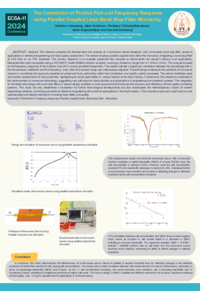
This research presents the development and analysis of a microwave sensor designed with a microstrip band stop filter, aimed at applications in electrical engineering and food quality assessment. The sensor employs parallel coupled lines within the microstrip, integrating a band stop filter at 2.45 GHz on an FR4 substrate. The primary objective is to evaluate preserved fish samples to demonstrate the sensor's efficacy and applicability. Measurements were conducted using a KEYSIGHT model E5063A network analyzer, covering a frequency range from 0.1 GHz to 3 GHz. The analysis focuses on the frequency response of the insertion loss (S21) across specified frequencies. The results indicate a significant correlation between the percentage shift in the transmission coefficient and the frequency, even when the sample range was meticulously adjusted. These findings underscore the potential of microwave sensors in monitoring the physical properties of preserved food, particularly within food production and quality control processes. The sensor facilitates rapid and precise assessments of food properties, highlighting its broad applicability in various sectors of the food industry. Furthermore, this research contributes to the advancement of microwave technology, suggesting new pathways for future studies and applications in engineering and industrial contexts. The integration of microstrip technology with band stop filters in sensor design presents a novel approach that enhances the accuracy and efficiency of food quality monitoring systems. This study not only establishes a foundation for further technological developments but also emphasizes the interdisciplinary nature of modern engineering solutions, combining principles of electrical engineering with practical applications in the food industry. This innovative approach could lead to more sophisticated and reliable methods for ensuring food safety and quality.
Keywords
Pickled Fish
Frequency Response
Parallel Coupled Lines Band Stop Filter
Microstrip
Manuscript
engproc-sciforum_101063.pdf
Poster
Poster Pickled Fish (2).pdf
Frequency Analysis and Transfer Learning across Different Body Sensor Locations in Parkinson's Disease Detection using Inertial Signals
The IMU sensor for in-situ 3D movement monitoring of particulate matter