Event submissions
Published

This submission belongs to the session S2. Physical Sensors of the event The 11th International Electronic Conference on Sensors and Applications
Published date
26 Nov, 2024
Academic Editor
'%3e%3cpath%20d='M12.6657%2010.9104C12.4185%2010.325%2012.0599%209.79327%2011.6097%209.34482C11.1609%208.89508%2010.6293%208.5365%2010.0442%208.28888C10.0389%208.28626%2010.0337%208.28495%2010.0285%208.28233C10.8446%207.69279%2011.3752%206.73249%2011.3752%205.64904C11.3752%203.8542%209.92103%202.39999%208.1262%202.39999C6.33136%202.39999%204.87715%203.8542%204.87715%205.64904C4.87715%206.73249%205.40774%207.69279%206.22393%208.28364C6.21869%208.28626%206.21345%208.28757%206.20821%208.29019C5.62129%208.5378%205.09463%208.89284%204.64265%209.34613C4.1929%209.79493%203.83432%2010.3266%203.58671%2010.9117C3.34345%2011.4845%203.21226%2012.0987%203.20023%2012.7209C3.19988%2012.7349%203.20233%2012.7488%203.20744%2012.7619C3.21255%2012.7749%203.22022%2012.7867%203.22998%2012.7968C3.23975%2012.8068%203.25142%2012.8147%203.26431%2012.8202C3.2772%2012.8256%203.29105%2012.8284%203.30504%2012.8284H4.09109C4.14874%2012.8284%204.19459%2012.7825%204.1959%2012.7262C4.2221%2011.7148%204.62823%2010.7676%205.34617%2010.0497C6.08899%209.30683%207.0755%208.89808%208.1262%208.89808C9.17689%208.89808%2010.1634%209.30683%2010.9062%2010.0497C11.6242%2010.7676%2012.0303%2011.7148%2012.0565%2012.7262C12.0578%2012.7838%2012.1037%2012.8284%2012.1613%2012.8284H12.9474C12.9613%2012.8284%2012.9752%2012.8256%2012.9881%2012.8202C13.001%2012.8147%2013.0126%2012.8068%2013.0224%2012.7968C13.0322%2012.7867%2013.0398%2012.7749%2013.0449%2012.7619C13.0501%2012.7488%2013.0525%2012.7349%2013.0522%2012.7209C13.0391%2012.0947%2012.9094%2011.4855%2012.6657%2010.9104ZM8.1262%207.9024C7.52486%207.9024%206.9589%207.6679%206.53312%207.24211C6.10733%206.81633%205.87283%206.25037%205.87283%205.64904C5.87283%205.0477%206.10733%204.48174%206.53312%204.05596C6.9589%203.63018%207.52486%203.39567%208.1262%203.39567C8.72753%203.39567%209.29349%203.63018%209.71927%204.05596C10.1451%204.48174%2010.3796%205.0477%2010.3796%205.64904C10.3796%206.25037%2010.1451%206.81633%209.71927%207.24211C9.29349%207.6679%208.72753%207.9024%208.1262%207.9024Z'%20fill='%235D1EE1'/%3e%3c/g%3e%3c/svg%3e) Jean-marc Laheurte
Jean-marc LaheurteCitation
Marianna Portaccio, Alessandra Fusco, Giovanna Donnarumma, Maria Lepore, Characterization of Pseudomonas aeruginosa biofilms grown on different substrates by means of FT-IR spectroscopy., in Proceedings of The 11th International Electronic Conference on Sensors and Applications, 26 November–28 November 2024, MDPI: Basel, Switzerland, doi: 10.3390/ecsa-11-20517
Share
Email
Facebook
Twitter
LinkedIn
Characterization of Pseudomonas aeruginosa biofilms grown on different substrates by means of FT-IR spectroscopy.
'%3e%3cpath%20d='M12.6647%2010.9104C12.4176%2010.325%2012.0589%209.7933%2011.6088%209.34485C11.16%208.89511%2010.6283%208.53653%2010.0432%208.28891C10.038%208.28629%2010.0327%208.28498%2010.0275%208.28236C10.8437%207.69282%2011.3743%206.73252%2011.3743%205.64907C11.3743%203.85423%209.92005%202.40002%208.12522%202.40002C6.33038%202.40002%204.87618%203.85423%204.87618%205.64907C4.87618%206.73252%205.40677%207.69282%206.22296%208.28367C6.21772%208.28629%206.21248%208.2876%206.20724%208.29022C5.62031%208.53783%205.09365%208.89287%204.64167%209.34616C4.19192%209.79496%203.83334%2010.3266%203.58573%2010.9117C3.34247%2011.4846%203.21128%2012.0987%203.19925%2012.721C3.1989%2012.735%203.20135%2012.7489%203.20646%2012.7619C3.21157%2012.7749%203.21924%2012.7868%203.22901%2012.7968C3.23877%2012.8068%203.25045%2012.8148%203.26334%2012.8202C3.27623%2012.8256%203.29007%2012.8284%203.30406%2012.8284H4.09012C4.14776%2012.8284%204.19362%2012.7825%204.19493%2012.7262C4.22113%2011.7148%204.62726%2010.7676%205.34519%2010.0497C6.08802%209.30686%207.07452%208.89811%208.12522%208.89811C9.17592%208.89811%2010.1624%209.30686%2010.9052%2010.0497C11.6232%2010.7676%2012.0293%2011.7148%2012.0555%2012.7262C12.0568%2012.7839%2012.1027%2012.8284%2012.1603%2012.8284H12.9464C12.9604%2012.8284%2012.9742%2012.8256%2012.9871%2012.8202C13%2012.8148%2013.0117%2012.8068%2013.0214%2012.7968C13.0312%2012.7868%2013.0389%2012.7749%2013.044%2012.7619C13.0491%2012.7489%2013.0515%2012.735%2013.0512%2012.721C13.0381%2012.0947%2012.9084%2011.4856%2012.6647%2010.9104ZM8.12522%207.90243C7.52388%207.90243%206.95792%207.66793%206.53214%207.24215C6.10636%206.81636%205.87185%206.2504%205.87185%205.64907C5.87185%205.04773%206.10636%204.48177%206.53214%204.05599C6.95792%203.63021%207.52388%203.3957%208.12522%203.3957C8.72655%203.3957%209.29252%203.63021%209.7183%204.05599C10.1441%204.48177%2010.3786%205.04773%2010.3786%205.64907C10.3786%206.2504%2010.1441%206.81636%209.7183%207.24215C9.29252%207.66793%208.72655%207.90243%208.12522%207.90243Z'%20fill='%235D1EE1'/%3e%3c/g%3e%3c/svg%3e)
Marianna Portaccio 1

Alessandra Fusco 2
Giovanna Donnarumma 2

Maria Lepore 2
1. Dipartimento di Medicina Sperimentale Università della Campania Luigi Vanvitelli Napoli
2. Dipartimento di Medicina Sperimentale, Università della Campania “Luigi Vanvitelli”, 80138 Napoli, Italy
Abstract
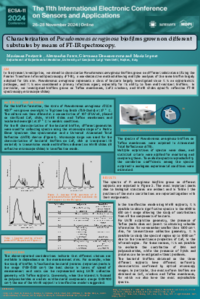
Fourier Transform Infrared Spectroscopy (FT-IR) is a vibrational technique largely adopted for the study of bacterial biofilms [1]. FT-IR is a non-destructive method, that allows multiple analyses of the same biofilm, without damaging the bacteria [2, 3].
Pseudomonas aeruginosa represents a class of bacteria largely investigated since it is an opportunistic pathogen and it is now considered to be a primary infectious agent especially for its ability to form multi-resistant biofilms [4].
In the present investigation, we aimed to characterize P. aeruginosa biofilms grown on different substrates to define better experimental conditions more useful for investigating the interaction of these biofilms with external agents. In particular, we investigated biofilms grown on Teflon membranes, CaF2 windows, and MirrIR slides (specific reflection FT-IR spectroscopy microscope slides). Different geometries were used for collecting spectra using the microscope stage of a Perkin Elmer Spectrum One spectrometer equipped with a mercury cadmium telluride (MCT) detector.
Multiple acquisitions of spectra were done, and statistical criteria were applied for monitoring and comparing them. The positive and negative aspects of the different examined substrates for biofilm formation and acquisition modes are presented and discussed.
References
[1] Amy R. Crisp, Bryn Short, Laurence Rowan, Gordon Ramage, Ihtesham U.R. Rehman, Robert D. Short, Craig Williams, Investigating the chemical pathway to the formation of a single biofilm using infrared spectroscopy. Biofilm, 6, 2023, 100141, doi.org/10.1016/j.bioflm.2023.100141.
[2] Alvarez-Ordonez, A, Mouwen DJM, Lopez M, Prieto M. J Microbiol Methods 2011; 84:369–78.
[3] Z. Pang, R. Raudonis, B.R. Glick, T. Lin, Z. Cheng, Antibiotic resistance in Pseudomonas aeruginosa: mechanisms and alternative therapeutic strategies, Biotechnol. Adv. [Internet]. 37 (1) (2019) 177–192. Available from: 10.1016/j.biotechadv.2018.11.013.
[4] Thi MTT, Wibowo D, Rehm BHA. Pseudomonas aeruginosa Biofilms. Int J Mol Sci. 2020 Nov 17;21(22):8671. doi: 10.3390/ijms21228671.
Keywords
FT-IR spectroscopy
Pseudomonas aeruginosa
bacterial biofilm
ATR
transflection
Manuscript
engproc-sciforum_099722_S2.pdf
Poster
Poster ECSA 11 PORTACCIO.pdf
Detection of Fusarium poae Infestation in Wheat Grain by Measurement with Two Electronic Noses
Characterization of human teeth using vibrational spectroscopies