Event submissions
Published
This submission belongs to the session S7. Water Use and Irrigation of the event The 4th International Electronic Conference on Agronomy
Published date
29 Nov, 2024
Academic Editor
'%3e%3cpath%20d='M12.6657%2010.9104C12.4185%2010.325%2012.0599%209.79327%2011.6097%209.34482C11.1609%208.89508%2010.6293%208.5365%2010.0442%208.28888C10.0389%208.28626%2010.0337%208.28495%2010.0285%208.28233C10.8446%207.69279%2011.3752%206.73249%2011.3752%205.64904C11.3752%203.8542%209.92103%202.39999%208.1262%202.39999C6.33136%202.39999%204.87715%203.8542%204.87715%205.64904C4.87715%206.73249%205.40774%207.69279%206.22393%208.28364C6.21869%208.28626%206.21345%208.28757%206.20821%208.29019C5.62129%208.5378%205.09463%208.89284%204.64265%209.34613C4.1929%209.79493%203.83432%2010.3266%203.58671%2010.9117C3.34345%2011.4845%203.21226%2012.0987%203.20023%2012.7209C3.19988%2012.7349%203.20233%2012.7488%203.20744%2012.7619C3.21255%2012.7749%203.22022%2012.7867%203.22998%2012.7968C3.23975%2012.8068%203.25142%2012.8147%203.26431%2012.8202C3.2772%2012.8256%203.29105%2012.8284%203.30504%2012.8284H4.09109C4.14874%2012.8284%204.19459%2012.7825%204.1959%2012.7262C4.2221%2011.7148%204.62823%2010.7676%205.34617%2010.0497C6.08899%209.30683%207.0755%208.89808%208.1262%208.89808C9.17689%208.89808%2010.1634%209.30683%2010.9062%2010.0497C11.6242%2010.7676%2012.0303%2011.7148%2012.0565%2012.7262C12.0578%2012.7838%2012.1037%2012.8284%2012.1613%2012.8284H12.9474C12.9613%2012.8284%2012.9752%2012.8256%2012.9881%2012.8202C13.001%2012.8147%2013.0126%2012.8068%2013.0224%2012.7968C13.0322%2012.7867%2013.0398%2012.7749%2013.0449%2012.7619C13.0501%2012.7488%2013.0525%2012.7349%2013.0522%2012.7209C13.0391%2012.0947%2012.9094%2011.4855%2012.6657%2010.9104ZM8.1262%207.9024C7.52486%207.9024%206.9589%207.6679%206.53312%207.24211C6.10733%206.81633%205.87283%206.25037%205.87283%205.64904C5.87283%205.0477%206.10733%204.48174%206.53312%204.05596C6.9589%203.63018%207.52486%203.39567%208.1262%203.39567C8.72753%203.39567%209.29349%203.63018%209.71927%204.05596C10.1451%204.48174%2010.3796%205.0477%2010.3796%205.64904C10.3796%206.25037%2010.1451%206.81633%209.71927%207.24211C9.29349%207.6679%208.72753%207.9024%208.1262%207.9024Z'%20fill='%235D1EE1'/%3e%3c/g%3e%3c/svg%3e) J.D. Flores-Félix
J.D. Flores-FélixCitation
Andi Mehmeti, OIfa Boussadia, Pierre Ellsel, Mladen Todorovic, Generosa Calabrese, Assessing the impact of irrigation-based agricultural intensification in Tunisian olive-growing systems from a water–energy–food–environment nexus perspective, in Proceedings of The 4th International Electronic Conference on Agronomy, 2 December–5 December 2024, MDPI: Basel, Switzerland
Share
Email
Facebook
Twitter
LinkedIn
Assessing the impact of irrigation-based agricultural intensification in Tunisian olive-growing systems from a water–energy–food–environment nexus perspective

Andi Mehmeti 1
'%3e%3cpath%20d='M12.6647%2010.9104C12.4176%2010.325%2012.0589%209.7933%2011.6088%209.34485C11.16%208.89511%2010.6283%208.53653%2010.0432%208.28891C10.038%208.28629%2010.0327%208.28498%2010.0275%208.28236C10.8437%207.69282%2011.3743%206.73252%2011.3743%205.64907C11.3743%203.85423%209.92005%202.40002%208.12522%202.40002C6.33038%202.40002%204.87618%203.85423%204.87618%205.64907C4.87618%206.73252%205.40677%207.69282%206.22296%208.28367C6.21772%208.28629%206.21248%208.2876%206.20724%208.29022C5.62031%208.53783%205.09365%208.89287%204.64167%209.34616C4.19192%209.79496%203.83334%2010.3266%203.58573%2010.9117C3.34247%2011.4846%203.21128%2012.0987%203.19925%2012.721C3.1989%2012.735%203.20135%2012.7489%203.20646%2012.7619C3.21157%2012.7749%203.21924%2012.7868%203.22901%2012.7968C3.23877%2012.8068%203.25045%2012.8148%203.26334%2012.8202C3.27623%2012.8256%203.29007%2012.8284%203.30406%2012.8284H4.09012C4.14776%2012.8284%204.19362%2012.7825%204.19493%2012.7262C4.22113%2011.7148%204.62726%2010.7676%205.34519%2010.0497C6.08802%209.30686%207.07452%208.89811%208.12522%208.89811C9.17592%208.89811%2010.1624%209.30686%2010.9052%2010.0497C11.6232%2010.7676%2012.0293%2011.7148%2012.0555%2012.7262C12.0568%2012.7839%2012.1027%2012.8284%2012.1603%2012.8284H12.9464C12.9604%2012.8284%2012.9742%2012.8256%2012.9871%2012.8202C13%2012.8148%2013.0117%2012.8068%2013.0214%2012.7968C13.0312%2012.7868%2013.0389%2012.7749%2013.044%2012.7619C13.0491%2012.7489%2013.0515%2012.735%2013.0512%2012.721C13.0381%2012.0947%2012.9084%2011.4856%2012.6647%2010.9104ZM8.12522%207.90243C7.52388%207.90243%206.95792%207.66793%206.53214%207.24215C6.10636%206.81636%205.87185%206.2504%205.87185%205.64907C5.87185%205.04773%206.10636%204.48177%206.53214%204.05599C6.95792%203.63021%207.52388%203.3957%208.12522%203.3957C8.72655%203.3957%209.29252%203.63021%209.7183%204.05599C10.1441%204.48177%2010.3786%205.04773%2010.3786%205.64907C10.3786%206.2504%2010.1441%206.81636%209.7183%207.24215C9.29252%207.66793%208.72655%207.90243%208.12522%207.90243Z'%20fill='%235D1EE1'/%3e%3c/g%3e%3c/svg%3e)
OIfa Boussadia 2
Pierre Ellsel 3

Mladen Todorovic 1
Generosa Calabrese 1
1. International Center for Advanced Mediterranean Agronomic Studies (CIHEAM-Bari), Italy
2. Olive Institute, Unit of Sousse (IO), Tunisia
3. Department of Crop Sciences, Institute of Agronomy, University of Natural Resources and Life Sciences (BOKU), Gregor-Mendel-Strasse 33, 1180 Vienna, Austria
Abstract
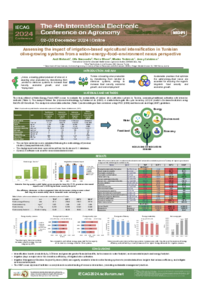
This study utilized a Water–Energy–Food (WEF) nexus approach to evaluate the sustainability performance of various olive cultivation systems in Tunisia, contrasting traditional cultivation (TCIF) with several intensive methods (ICIF 1, ICIF 2, and SICIF). Key indicators included crop yield, water usage and footprint, energy performance indicators (efficiency, productivity, specific energy, and net energy gain), twenty-two environmental impacts, gross farm income, and the eco-efficiency index. Results revealed that intensive systems yield 4.9 times more olives than traditional practices (10,600 kg/ha vs. 2,159 kg/ha), but this productivity comes at a cost: intensive systems require up to 6.5 times more water, consuming 3,600 m³/ha compared to 550 m³/ha for traditional methods. Despite the higher yields, traditional systems show superior water use efficiency, producing 3.93 kg of product per cubic meter of water, raising concerns about the sustainability of intensive methods in arid regions like Tunisia due to their larger water footprint. This study also found that energy input, specific energy consumption, and energy output significantly increase with intensification, but energy use efficiency and productivity fluctuate, suggesting an inconsistent relationship between energy input and output. A multi-indicator Life Cycle Assessment (LCA) using the ReCiPe 2016 method quantified intensity (impact per hectare) and efficiency (impact per ton of product), revealing that emission intensity rises with intensification while production efficiency varies. An aggregated single-score indicator demonstrated that, regardless of the adopted functional unit (mass- or land-based), intensive systems exhibit higher environmental impacts despite their greater economic returns (EUR 3,871 to EUR 5,862 per hectare) compared to traditional systems, which generate EUR 1,193.90 per hectare. An eco-efficiency index indicates that traditional olive production methods outperform intensive systems regarding resource use relative to environmental impact. Overall, while irrigation-based intensification enhances productivity, it raises significant concerns about water use, energy consumption, and sustainability, emphasizing the need for balanced management strategies that optimize productivity and resource efficiency.
Keywords
Olive Growing Systems
life cycle assessment
olive cultivation
agricultural irrigation
North Africa
intensification
Poster
Poster IECAG 2024 sciforum-107096.pdf
Seawater Desalination for Agricultural Watering