Event submissions
Published
This submission belongs to the session S6. Plant–Crop Biology and Biochemistry of the event The 4th International Electronic Conference on Agronomy
Published date
29 Nov, 2024
Academic Editor
'%3e%3cpath%20d='M12.6657%2010.9104C12.4185%2010.325%2012.0599%209.79327%2011.6097%209.34482C11.1609%208.89508%2010.6293%208.5365%2010.0442%208.28888C10.0389%208.28626%2010.0337%208.28495%2010.0285%208.28233C10.8446%207.69279%2011.3752%206.73249%2011.3752%205.64904C11.3752%203.8542%209.92103%202.39999%208.1262%202.39999C6.33136%202.39999%204.87715%203.8542%204.87715%205.64904C4.87715%206.73249%205.40774%207.69279%206.22393%208.28364C6.21869%208.28626%206.21345%208.28757%206.20821%208.29019C5.62129%208.5378%205.09463%208.89284%204.64265%209.34613C4.1929%209.79493%203.83432%2010.3266%203.58671%2010.9117C3.34345%2011.4845%203.21226%2012.0987%203.20023%2012.7209C3.19988%2012.7349%203.20233%2012.7488%203.20744%2012.7619C3.21255%2012.7749%203.22022%2012.7867%203.22998%2012.7968C3.23975%2012.8068%203.25142%2012.8147%203.26431%2012.8202C3.2772%2012.8256%203.29105%2012.8284%203.30504%2012.8284H4.09109C4.14874%2012.8284%204.19459%2012.7825%204.1959%2012.7262C4.2221%2011.7148%204.62823%2010.7676%205.34617%2010.0497C6.08899%209.30683%207.0755%208.89808%208.1262%208.89808C9.17689%208.89808%2010.1634%209.30683%2010.9062%2010.0497C11.6242%2010.7676%2012.0303%2011.7148%2012.0565%2012.7262C12.0578%2012.7838%2012.1037%2012.8284%2012.1613%2012.8284H12.9474C12.9613%2012.8284%2012.9752%2012.8256%2012.9881%2012.8202C13.001%2012.8147%2013.0126%2012.8068%2013.0224%2012.7968C13.0322%2012.7867%2013.0398%2012.7749%2013.0449%2012.7619C13.0501%2012.7488%2013.0525%2012.7349%2013.0522%2012.7209C13.0391%2012.0947%2012.9094%2011.4855%2012.6657%2010.9104ZM8.1262%207.9024C7.52486%207.9024%206.9589%207.6679%206.53312%207.24211C6.10733%206.81633%205.87283%206.25037%205.87283%205.64904C5.87283%205.0477%206.10733%204.48174%206.53312%204.05596C6.9589%203.63018%207.52486%203.39567%208.1262%203.39567C8.72753%203.39567%209.29349%203.63018%209.71927%204.05596C10.1451%204.48174%2010.3796%205.0477%2010.3796%205.64904C10.3796%206.25037%2010.1451%206.81633%209.71927%207.24211C9.29349%207.6679%208.72753%207.9024%208.1262%207.9024Z'%20fill='%235D1EE1'/%3e%3c/g%3e%3c/svg%3e) Monica Boscaiu
Monica BoscaiuCitation
Melanie Desirée Gomez Herrera, Maria VIctoria Avanza, Paula Alayón Luaces, Effect of drought stress on different organs of Pineapple using destructive and non-destructive indicators, in Proceedings of The 4th International Electronic Conference on Agronomy, 2 December–5 December 2024, MDPI: Basel, Switzerland
Share
Email
Facebook
Twitter
LinkedIn
Effect of drought stress on different organs of Pineapple using destructive and non-destructive indicators
'%3e%3cpath%20d='M12.6647%2010.9104C12.4176%2010.325%2012.0589%209.7933%2011.6088%209.34485C11.16%208.89511%2010.6283%208.53653%2010.0432%208.28891C10.038%208.28629%2010.0327%208.28498%2010.0275%208.28236C10.8437%207.69282%2011.3743%206.73252%2011.3743%205.64907C11.3743%203.85423%209.92005%202.40002%208.12522%202.40002C6.33038%202.40002%204.87618%203.85423%204.87618%205.64907C4.87618%206.73252%205.40677%207.69282%206.22296%208.28367C6.21772%208.28629%206.21248%208.2876%206.20724%208.29022C5.62031%208.53783%205.09365%208.89287%204.64167%209.34616C4.19192%209.79496%203.83334%2010.3266%203.58573%2010.9117C3.34247%2011.4846%203.21128%2012.0987%203.19925%2012.721C3.1989%2012.735%203.20135%2012.7489%203.20646%2012.7619C3.21157%2012.7749%203.21924%2012.7868%203.22901%2012.7968C3.23877%2012.8068%203.25045%2012.8148%203.26334%2012.8202C3.27623%2012.8256%203.29007%2012.8284%203.30406%2012.8284H4.09012C4.14776%2012.8284%204.19362%2012.7825%204.19493%2012.7262C4.22113%2011.7148%204.62726%2010.7676%205.34519%2010.0497C6.08802%209.30686%207.07452%208.89811%208.12522%208.89811C9.17592%208.89811%2010.1624%209.30686%2010.9052%2010.0497C11.6232%2010.7676%2012.0293%2011.7148%2012.0555%2012.7262C12.0568%2012.7839%2012.1027%2012.8284%2012.1603%2012.8284H12.9464C12.9604%2012.8284%2012.9742%2012.8256%2012.9871%2012.8202C13%2012.8148%2013.0117%2012.8068%2013.0214%2012.7968C13.0312%2012.7868%2013.0389%2012.7749%2013.044%2012.7619C13.0491%2012.7489%2013.0515%2012.735%2013.0512%2012.721C13.0381%2012.0947%2012.9084%2011.4856%2012.6647%2010.9104ZM8.12522%207.90243C7.52388%207.90243%206.95792%207.66793%206.53214%207.24215C6.10636%206.81636%205.87185%206.2504%205.87185%205.64907C5.87185%205.04773%206.10636%204.48177%206.53214%204.05599C6.95792%203.63021%207.52388%203.3957%208.12522%203.3957C8.72655%203.3957%209.29252%203.63021%209.7183%204.05599C10.1441%204.48177%2010.3786%205.04773%2010.3786%205.64907C10.3786%206.2504%2010.1441%206.81636%209.7183%207.24215C9.29252%207.66793%208.72655%207.90243%208.12522%207.90243Z'%20fill='%235D1EE1'/%3e%3c/g%3e%3c/svg%3e)
Melanie Desirée Gomez Herrera 1
Maria VIctoria Avanza 1
Paula Alayón Luaces 2
1. Roca Campus, Institute of basic and applied chemistry (IQUIBA NEA UNNE CONICET), National University of the Northeast (UNNE), Corrientes, 3400, Argentina.
2. Department of Plant Production, National University of the Northeast (UNNE), Corrientes, 3400, Argentina.
Abstract
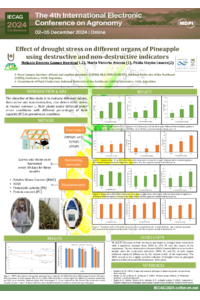
Plants of Ananas comosus (cultivar Smooth Cayenne) were grown in pots filled with a commercial substrate and exposed to different water content treatments: 100% field capacity (FC), 50% FC, and 25% FC. The experiment was conducted under controlled greenhouse conditions for three months. Every month, relative water content (RWC), NDVI, proteolytic activity (PA), and protein content (PC) were measured in the "D" leaves. Additionally, proteolytic activity and protein content were measured monthly in the stem and leaves. RWC showed no significant differences during the first month. However, by the second month, the 50% and 100% FC treatments had significantly higher values than the 25% FC treatment. By the third month, all three treatments were statistically different, with the 100% FC treatment having the highest RWC. In the first month, the 100% treatment showed statically higher NDVI values than the 50% and 25% FC treatments. By the second and third months, the three treatments were statistically different, with average NDVI values of 0.57, 0.67, and 0.72 for the 25%, 50%, and 100% FC treatments, respectively. PA and PC increased in both the leaves and stems as drought stress intensified, with a significant increase from 100% to 25% FC over the course of the experiment. The non-destructive indicator (NDVI) showed differences in the first month, while the destructive indicators (RWC, PA, and PC) in both organs exhibited statistical differences by the second month of the experiment. The NDVI proved to be a highly sensitive indicator of drought stress in pineapple plants and did not require the destruction of the plant.
Keywords
Field Capacity
Ananas comosus
NDVI
RWC
Protein content
Proteolytic activity
Poster
Gomez Herrera IECAG 2024.pdf
MICROBIAL GROWTH KINETICS OF FERMENTING BOTANICALS USED AS GLUTEN-FREE FLOUR BLENDS
EFFECTS OF FERTILIZATION ON PHENOLIC AND GLUCOSINOLATE LEVELS IN DIPLOTAXIS TENUIFOLIA (L.) DC HYBRID VENERE