Event submissions
Published
This submission belongs to the session S6. Plant–Crop Biology and Biochemistry of the event The 4th International Electronic Conference on Agronomy
Published date
29 Nov, 2024
Academic Editor
'%3e%3cpath%20d='M12.6657%2010.9104C12.4185%2010.325%2012.0599%209.79327%2011.6097%209.34482C11.1609%208.89508%2010.6293%208.5365%2010.0442%208.28888C10.0389%208.28626%2010.0337%208.28495%2010.0285%208.28233C10.8446%207.69279%2011.3752%206.73249%2011.3752%205.64904C11.3752%203.8542%209.92103%202.39999%208.1262%202.39999C6.33136%202.39999%204.87715%203.8542%204.87715%205.64904C4.87715%206.73249%205.40774%207.69279%206.22393%208.28364C6.21869%208.28626%206.21345%208.28757%206.20821%208.29019C5.62129%208.5378%205.09463%208.89284%204.64265%209.34613C4.1929%209.79493%203.83432%2010.3266%203.58671%2010.9117C3.34345%2011.4845%203.21226%2012.0987%203.20023%2012.7209C3.19988%2012.7349%203.20233%2012.7488%203.20744%2012.7619C3.21255%2012.7749%203.22022%2012.7867%203.22998%2012.7968C3.23975%2012.8068%203.25142%2012.8147%203.26431%2012.8202C3.2772%2012.8256%203.29105%2012.8284%203.30504%2012.8284H4.09109C4.14874%2012.8284%204.19459%2012.7825%204.1959%2012.7262C4.2221%2011.7148%204.62823%2010.7676%205.34617%2010.0497C6.08899%209.30683%207.0755%208.89808%208.1262%208.89808C9.17689%208.89808%2010.1634%209.30683%2010.9062%2010.0497C11.6242%2010.7676%2012.0303%2011.7148%2012.0565%2012.7262C12.0578%2012.7838%2012.1037%2012.8284%2012.1613%2012.8284H12.9474C12.9613%2012.8284%2012.9752%2012.8256%2012.9881%2012.8202C13.001%2012.8147%2013.0126%2012.8068%2013.0224%2012.7968C13.0322%2012.7867%2013.0398%2012.7749%2013.0449%2012.7619C13.0501%2012.7488%2013.0525%2012.7349%2013.0522%2012.7209C13.0391%2012.0947%2012.9094%2011.4855%2012.6657%2010.9104ZM8.1262%207.9024C7.52486%207.9024%206.9589%207.6679%206.53312%207.24211C6.10733%206.81633%205.87283%206.25037%205.87283%205.64904C5.87283%205.0477%206.10733%204.48174%206.53312%204.05596C6.9589%203.63018%207.52486%203.39567%208.1262%203.39567C8.72753%203.39567%209.29349%203.63018%209.71927%204.05596C10.1451%204.48174%2010.3796%205.0477%2010.3796%205.64904C10.3796%206.25037%2010.1451%206.81633%209.71927%207.24211C9.29349%207.6679%208.72753%207.9024%208.1262%207.9024Z'%20fill='%235D1EE1'/%3e%3c/g%3e%3c/svg%3e) Monica Boscaiu
Monica BoscaiuCitation
Sofija Kilibarda, Danijel D. Milinčić, Sandra Vuković, Đorđe Moravčević, Mirjana B. Pešić, Aleksandar Ž. Kostić, EFFECTS OF FERTILIZATION ON PHENOLIC AND GLUCOSINOLATE LEVELS IN DIPLOTAXIS TENUIFOLIA (L.) DC HYBRID VENERE, in Proceedings of The 4th International Electronic Conference on Agronomy, 2 December–5 December 2024, MDPI: Basel, Switzerland
Share
Email
Facebook
Twitter
LinkedIn
EFFECTS OF FERTILIZATION ON PHENOLIC AND GLUCOSINOLATE LEVELS IN DIPLOTAXIS TENUIFOLIA (L.) DC HYBRID VENERE
'%3e%3cpath%20d='M12.6647%2010.9104C12.4176%2010.325%2012.0589%209.7933%2011.6088%209.34485C11.16%208.89511%2010.6283%208.53653%2010.0432%208.28891C10.038%208.28629%2010.0327%208.28498%2010.0275%208.28236C10.8437%207.69282%2011.3743%206.73252%2011.3743%205.64907C11.3743%203.85423%209.92005%202.40002%208.12522%202.40002C6.33038%202.40002%204.87618%203.85423%204.87618%205.64907C4.87618%206.73252%205.40677%207.69282%206.22296%208.28367C6.21772%208.28629%206.21248%208.2876%206.20724%208.29022C5.62031%208.53783%205.09365%208.89287%204.64167%209.34616C4.19192%209.79496%203.83334%2010.3266%203.58573%2010.9117C3.34247%2011.4846%203.21128%2012.0987%203.19925%2012.721C3.1989%2012.735%203.20135%2012.7489%203.20646%2012.7619C3.21157%2012.7749%203.21924%2012.7868%203.22901%2012.7968C3.23877%2012.8068%203.25045%2012.8148%203.26334%2012.8202C3.27623%2012.8256%203.29007%2012.8284%203.30406%2012.8284H4.09012C4.14776%2012.8284%204.19362%2012.7825%204.19493%2012.7262C4.22113%2011.7148%204.62726%2010.7676%205.34519%2010.0497C6.08802%209.30686%207.07452%208.89811%208.12522%208.89811C9.17592%208.89811%2010.1624%209.30686%2010.9052%2010.0497C11.6232%2010.7676%2012.0293%2011.7148%2012.0555%2012.7262C12.0568%2012.7839%2012.1027%2012.8284%2012.1603%2012.8284H12.9464C12.9604%2012.8284%2012.9742%2012.8256%2012.9871%2012.8202C13%2012.8148%2013.0117%2012.8068%2013.0214%2012.7968C13.0312%2012.7868%2013.0389%2012.7749%2013.044%2012.7619C13.0491%2012.7489%2013.0515%2012.735%2013.0512%2012.721C13.0381%2012.0947%2012.9084%2011.4856%2012.6647%2010.9104ZM8.12522%207.90243C7.52388%207.90243%206.95792%207.66793%206.53214%207.24215C6.10636%206.81636%205.87185%206.2504%205.87185%205.64907C5.87185%205.04773%206.10636%204.48177%206.53214%204.05599C6.95792%203.63021%207.52388%203.3957%208.12522%203.3957C8.72655%203.3957%209.29252%203.63021%209.7183%204.05599C10.1441%204.48177%2010.3786%205.04773%2010.3786%205.64907C10.3786%206.2504%2010.1441%206.81636%209.7183%207.24215C9.29252%207.66793%208.72655%207.90243%208.12522%207.90243Z'%20fill='%235D1EE1'/%3e%3c/g%3e%3c/svg%3e)
Sofija Kilibarda 1
Danijel D. Milinčić 2
Sandra Vuković 1
Đorđe Moravčević 1

Mirjana B. Pešić 2

Aleksandar Ž. Kostić 2
1. Chair of Crop and Vegetable Production, Faculty of Agriculture, University of Belgrade, Belgrade, 11080, Serbia
2. Chair of Chemistry and Biochemistry, Faculty of Agriculture, University of Belgrade, Belgrade, 11080, Serbia
Abstract
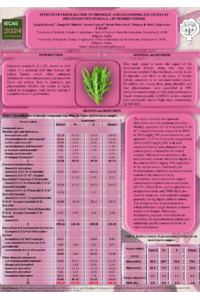
Diplotaxis tenuifolia (L.) DC, known as wild rocket, is a perennial herb that features the hybrid Venere, which offers enhanced resilience to lower temperatures, and improved flavor and texture. Rich in phenolics, and glucosinolates (GLSs), this variety is highly valued for its peppery, nutty leaves, making it a popular choice in gastronomy. This study aimed to assess the impact of the biostimulant Kelpak, along with iron and potassium-enriched foliar fertilizers, on the levels of phenolics and GLSs in the leaves of this hybrid, compared to an untreated control group. To achieve this, twenty-three plant phenolics and four glucosinolates were quantified in 70% methanol extracts using an ultra-high-performance liquid chromatography (UHPLC) system coupled with quadrupole time-of-flight mass spectrometry (Q-ToF-MS). The results revealed that quercetin derivatives were the dominant phenolics. Notably, quercetin-3,4'-di-O-hexoside-3'-O-(6"-sinapoyl)-hexoside ranged from 505.9 to 700.6 mg/kg FW across treatments, and quercetin 3,7,4'-tri-O-hexoside ranged from 424.8 to 653.7 mg/kg FW, with both compounds being more abundant in the control group compared to the treated samples. This trend was mirrored in the total phenolic content, which was higher in the control (3681.9 mg/kg FW) compared to the treated leaves. Conversely, the fertilized plants exhibited increased relative content of the dominant GLSs, glucosativin, which reached its highest concentration in potassium-treated plants (89.5%). Other GLSs, such as glucoerucin, neoglucobrassicin, and DMB-GLS, also showed variations, with untreated samples generally having higher relative content. The exception was neoglucobrassicin, which exhibited a slight increase in leaves treated with Kelpak. Ultimately, fertilization practices were effective in modifying the phytochemical content and enhancing specific compound levels of wild rocket leaves.
Keywords
wild rocket
phenolics
glucosinolates
UHPLC- Q-ToF-MS
Poster
EFFECTS OF FERTILIZATION ON PHENOLIC AND GLUCOSINOLATE LEVELS IN DIPLOTAXIS TENUIFOLIA (L.) DC HYBRID VENERE.pdf
Effect of drought stress on different organs of Pineapple using destructive and non-destructive indicators
Comparison of osmotic stress tolerance in two durum wheat (Triticum durum Desf) cultivars during germination