Event submissions
Published
This submission belongs to the session S6. Plant–Crop Biology and Biochemistry of the event The 4th International Electronic Conference on Agronomy
Published date
29 Nov, 2024
Academic Editor
'%3e%3cpath%20d='M12.6657%2010.9104C12.4185%2010.325%2012.0599%209.79327%2011.6097%209.34482C11.1609%208.89508%2010.6293%208.5365%2010.0442%208.28888C10.0389%208.28626%2010.0337%208.28495%2010.0285%208.28233C10.8446%207.69279%2011.3752%206.73249%2011.3752%205.64904C11.3752%203.8542%209.92103%202.39999%208.1262%202.39999C6.33136%202.39999%204.87715%203.8542%204.87715%205.64904C4.87715%206.73249%205.40774%207.69279%206.22393%208.28364C6.21869%208.28626%206.21345%208.28757%206.20821%208.29019C5.62129%208.5378%205.09463%208.89284%204.64265%209.34613C4.1929%209.79493%203.83432%2010.3266%203.58671%2010.9117C3.34345%2011.4845%203.21226%2012.0987%203.20023%2012.7209C3.19988%2012.7349%203.20233%2012.7488%203.20744%2012.7619C3.21255%2012.7749%203.22022%2012.7867%203.22998%2012.7968C3.23975%2012.8068%203.25142%2012.8147%203.26431%2012.8202C3.2772%2012.8256%203.29105%2012.8284%203.30504%2012.8284H4.09109C4.14874%2012.8284%204.19459%2012.7825%204.1959%2012.7262C4.2221%2011.7148%204.62823%2010.7676%205.34617%2010.0497C6.08899%209.30683%207.0755%208.89808%208.1262%208.89808C9.17689%208.89808%2010.1634%209.30683%2010.9062%2010.0497C11.6242%2010.7676%2012.0303%2011.7148%2012.0565%2012.7262C12.0578%2012.7838%2012.1037%2012.8284%2012.1613%2012.8284H12.9474C12.9613%2012.8284%2012.9752%2012.8256%2012.9881%2012.8202C13.001%2012.8147%2013.0126%2012.8068%2013.0224%2012.7968C13.0322%2012.7867%2013.0398%2012.7749%2013.0449%2012.7619C13.0501%2012.7488%2013.0525%2012.7349%2013.0522%2012.7209C13.0391%2012.0947%2012.9094%2011.4855%2012.6657%2010.9104ZM8.1262%207.9024C7.52486%207.9024%206.9589%207.6679%206.53312%207.24211C6.10733%206.81633%205.87283%206.25037%205.87283%205.64904C5.87283%205.0477%206.10733%204.48174%206.53312%204.05596C6.9589%203.63018%207.52486%203.39567%208.1262%203.39567C8.72753%203.39567%209.29349%203.63018%209.71927%204.05596C10.1451%204.48174%2010.3796%205.0477%2010.3796%205.64904C10.3796%206.25037%2010.1451%206.81633%209.71927%207.24211C9.29349%207.6679%208.72753%207.9024%208.1262%207.9024Z'%20fill='%235D1EE1'/%3e%3c/g%3e%3c/svg%3e) Monica Boscaiu
Monica BoscaiuCitation
Fadhilnor Abdullah, Muhammad Akmal Noor Huzaili, Zainal Abidin Arsat, Muhammad Nur Aiman Uda, Mohd Khairul Rabani Hashim, Muhammad Firdaus Abdul Muttalib, Syarifah Rokiah Syd Kamaruzaman, Leaf characteristics of ‘Harumanis’ mango (Mangifera Indica L.) trees planted under open-area and greenhouse conditions, in Proceedings of The 4th International Electronic Conference on Agronomy, 2 December–5 December 2024, MDPI: Basel, Switzerland
Share
Email
Facebook
Twitter
LinkedIn
Leaf characteristics of ‘Harumanis’ mango (Mangifera Indica L.) trees planted under open-area and greenhouse conditions

Fadhilnor Abdullah 1
'%3e%3cpath%20d='M12.6647%2010.9104C12.4176%2010.325%2012.0589%209.7933%2011.6088%209.34485C11.16%208.89511%2010.6283%208.53653%2010.0432%208.28891C10.038%208.28629%2010.0327%208.28498%2010.0275%208.28236C10.8437%207.69282%2011.3743%206.73252%2011.3743%205.64907C11.3743%203.85423%209.92005%202.40002%208.12522%202.40002C6.33038%202.40002%204.87618%203.85423%204.87618%205.64907C4.87618%206.73252%205.40677%207.69282%206.22296%208.28367C6.21772%208.28629%206.21248%208.2876%206.20724%208.29022C5.62031%208.53783%205.09365%208.89287%204.64167%209.34616C4.19192%209.79496%203.83334%2010.3266%203.58573%2010.9117C3.34247%2011.4846%203.21128%2012.0987%203.19925%2012.721C3.1989%2012.735%203.20135%2012.7489%203.20646%2012.7619C3.21157%2012.7749%203.21924%2012.7868%203.22901%2012.7968C3.23877%2012.8068%203.25045%2012.8148%203.26334%2012.8202C3.27623%2012.8256%203.29007%2012.8284%203.30406%2012.8284H4.09012C4.14776%2012.8284%204.19362%2012.7825%204.19493%2012.7262C4.22113%2011.7148%204.62726%2010.7676%205.34519%2010.0497C6.08802%209.30686%207.07452%208.89811%208.12522%208.89811C9.17592%208.89811%2010.1624%209.30686%2010.9052%2010.0497C11.6232%2010.7676%2012.0293%2011.7148%2012.0555%2012.7262C12.0568%2012.7839%2012.1027%2012.8284%2012.1603%2012.8284H12.9464C12.9604%2012.8284%2012.9742%2012.8256%2012.9871%2012.8202C13%2012.8148%2013.0117%2012.8068%2013.0214%2012.7968C13.0312%2012.7868%2013.0389%2012.7749%2013.044%2012.7619C13.0491%2012.7489%2013.0515%2012.735%2013.0512%2012.721C13.0381%2012.0947%2012.9084%2011.4856%2012.6647%2010.9104ZM8.12522%207.90243C7.52388%207.90243%206.95792%207.66793%206.53214%207.24215C6.10636%206.81636%205.87185%206.2504%205.87185%205.64907C5.87185%205.04773%206.10636%204.48177%206.53214%204.05599C6.95792%203.63021%207.52388%203.3957%208.12522%203.3957C8.72655%203.3957%209.29252%203.63021%209.7183%204.05599C10.1441%204.48177%2010.3786%205.04773%2010.3786%205.64907C10.3786%206.2504%2010.1441%206.81636%209.7183%207.24215C9.29252%207.66793%208.72655%207.90243%208.12522%207.90243Z'%20fill='%235D1EE1'/%3e%3c/g%3e%3c/svg%3e)
Muhammad Akmal Noor Huzaili 2
Zainal Abidin Arsat 2
Muhammad Nur Aiman Uda 2
Mohd Khairul Rabani Hashim 2
Muhammad Firdaus Abdul Muttalib 2
Syarifah Rokiah Syd Kamaruzaman 1
1. Institute of Sustainable Agrotechnology (INSAT), University Malaysia Perlis (UniMAP) Sg. Chuchuh Campus, 02100 Padang Besar, Perlis, Malaysia
2. Department of Agrotechnology, Faculty of Engineering & Mechanical Technology (FKTM), University Malaysia Perlis (UniMAP), 02600 Arau, Perlis, Malaysia.
Abstract
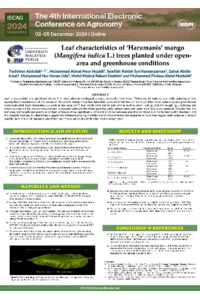
Information on the physiological mechanisms of the development organs, such as leaf, of fruit tree crops is still limited, especially in tropical mangoes. Therefore, the leaf morphological characteristics of the mango cultivar named ‘Harumanis’ that have been planted under different conditions (i.e. open-area and greenhouse) were evaluated. Various sizes of leaves from selected Harumanis mango trees were randomly collected and analysed. Data on the leaf area (LA) (cm2), leaf width (LW) (cm), leaf length (LL) (cm), as well as fresh (FW) (g) and dry weight (DW) (g) including leaf moisture content (LMC), were measured and compared between these two growing conditions. Results indicate that the LA, LL and LMC were significantly different (P<0.05) between both growing conditions. The LA of Harumanis mango trees planted in the greenhouse was approximately 25% larger compared with the trees planted in the open area. Similarly, Harumanis trees planted in a greenhouse had 11% longer LL and contained higher LMC than the trees in open areas. However, no significant differences were recorded on LW, FW, and DW between both growing conditions. Our results, therefore, suggest that different growing conditions may have affected the characteristics of tree organs, such as leaves, that may contribute to the environmental adaptation and tree productivity of this high-value mango crop.
Keywords
greenhouse
open area
leaf characteristic
tree organ
Poster
Poster IECAG2024 (Fadhilnor Abdullah, UniMAP, Malaysia) - Registration No. IECAG2024-051211 (1).pdf
Biochemical and Phytochemical Response of two Mediterranean Aromatic Species (Lamiaceae) to Abiotic Stress Conditions
Biomonitoring lanthanum in tree bark samples from urban and rural areas across Leicestershire (UK)