Event submissions
Published
This submission belongs to the session S3. Sustainable Soil Management and Farming Systems of the event The 4th International Electronic Conference on Agronomy
Published date
02 Dec, 2024
Academic Editor
'%3e%3cpath%20d='M12.6657%2010.9104C12.4185%2010.325%2012.0599%209.79327%2011.6097%209.34482C11.1609%208.89508%2010.6293%208.5365%2010.0442%208.28888C10.0389%208.28626%2010.0337%208.28495%2010.0285%208.28233C10.8446%207.69279%2011.3752%206.73249%2011.3752%205.64904C11.3752%203.8542%209.92103%202.39999%208.1262%202.39999C6.33136%202.39999%204.87715%203.8542%204.87715%205.64904C4.87715%206.73249%205.40774%207.69279%206.22393%208.28364C6.21869%208.28626%206.21345%208.28757%206.20821%208.29019C5.62129%208.5378%205.09463%208.89284%204.64265%209.34613C4.1929%209.79493%203.83432%2010.3266%203.58671%2010.9117C3.34345%2011.4845%203.21226%2012.0987%203.20023%2012.7209C3.19988%2012.7349%203.20233%2012.7488%203.20744%2012.7619C3.21255%2012.7749%203.22022%2012.7867%203.22998%2012.7968C3.23975%2012.8068%203.25142%2012.8147%203.26431%2012.8202C3.2772%2012.8256%203.29105%2012.8284%203.30504%2012.8284H4.09109C4.14874%2012.8284%204.19459%2012.7825%204.1959%2012.7262C4.2221%2011.7148%204.62823%2010.7676%205.34617%2010.0497C6.08899%209.30683%207.0755%208.89808%208.1262%208.89808C9.17689%208.89808%2010.1634%209.30683%2010.9062%2010.0497C11.6242%2010.7676%2012.0303%2011.7148%2012.0565%2012.7262C12.0578%2012.7838%2012.1037%2012.8284%2012.1613%2012.8284H12.9474C12.9613%2012.8284%2012.9752%2012.8256%2012.9881%2012.8202C13.001%2012.8147%2013.0126%2012.8068%2013.0224%2012.7968C13.0322%2012.7867%2013.0398%2012.7749%2013.0449%2012.7619C13.0501%2012.7488%2013.0525%2012.7349%2013.0522%2012.7209C13.0391%2012.0947%2012.9094%2011.4855%2012.6657%2010.9104ZM8.1262%207.9024C7.52486%207.9024%206.9589%207.6679%206.53312%207.24211C6.10733%206.81633%205.87283%206.25037%205.87283%205.64904C5.87283%205.0477%206.10733%204.48174%206.53312%204.05596C6.9589%203.63018%207.52486%203.39567%208.1262%203.39567C8.72753%203.39567%209.29349%203.63018%209.71927%204.05596C10.1451%204.48174%2010.3796%205.0477%2010.3796%205.64904C10.3796%206.25037%2010.1451%206.81633%209.71927%207.24211C9.29349%207.6679%208.72753%207.9024%208.1262%207.9024Z'%20fill='%235D1EE1'/%3e%3c/g%3e%3c/svg%3e) J.D. Flores-Félix
J.D. Flores-FélixCitation
A. O. S. Jorge, F. Chamorro, P. Barciela, A. Perez-Vazquez, M. Beatriz P. P. Oliveira, M.A. Prieto, Reviving Ancient Practices: Modern Perspectives on Rice-Fish Culture, in Proceedings of The 4th International Electronic Conference on Agronomy, 2 December–5 December 2024, MDPI: Basel, Switzerland
Share
Email
Facebook
Twitter
LinkedIn
Reviving Ancient Practices: Modern Perspectives on Rice-Fish Culture
'%3e%3cpath%20d='M12.6647%2010.9104C12.4176%2010.325%2012.0589%209.7933%2011.6088%209.34485C11.16%208.89511%2010.6283%208.53653%2010.0432%208.28891C10.038%208.28629%2010.0327%208.28498%2010.0275%208.28236C10.8437%207.69282%2011.3743%206.73252%2011.3743%205.64907C11.3743%203.85423%209.92005%202.40002%208.12522%202.40002C6.33038%202.40002%204.87618%203.85423%204.87618%205.64907C4.87618%206.73252%205.40677%207.69282%206.22296%208.28367C6.21772%208.28629%206.21248%208.2876%206.20724%208.29022C5.62031%208.53783%205.09365%208.89287%204.64167%209.34616C4.19192%209.79496%203.83334%2010.3266%203.58573%2010.9117C3.34247%2011.4846%203.21128%2012.0987%203.19925%2012.721C3.1989%2012.735%203.20135%2012.7489%203.20646%2012.7619C3.21157%2012.7749%203.21924%2012.7868%203.22901%2012.7968C3.23877%2012.8068%203.25045%2012.8148%203.26334%2012.8202C3.27623%2012.8256%203.29007%2012.8284%203.30406%2012.8284H4.09012C4.14776%2012.8284%204.19362%2012.7825%204.19493%2012.7262C4.22113%2011.7148%204.62726%2010.7676%205.34519%2010.0497C6.08802%209.30686%207.07452%208.89811%208.12522%208.89811C9.17592%208.89811%2010.1624%209.30686%2010.9052%2010.0497C11.6232%2010.7676%2012.0293%2011.7148%2012.0555%2012.7262C12.0568%2012.7839%2012.1027%2012.8284%2012.1603%2012.8284H12.9464C12.9604%2012.8284%2012.9742%2012.8256%2012.9871%2012.8202C13%2012.8148%2013.0117%2012.8068%2013.0214%2012.7968C13.0312%2012.7868%2013.0389%2012.7749%2013.044%2012.7619C13.0491%2012.7489%2013.0515%2012.735%2013.0512%2012.721C13.0381%2012.0947%2012.9084%2011.4856%2012.6647%2010.9104ZM8.12522%207.90243C7.52388%207.90243%206.95792%207.66793%206.53214%207.24215C6.10636%206.81636%205.87185%206.2504%205.87185%205.64907C5.87185%205.04773%206.10636%204.48177%206.53214%204.05599C6.95792%203.63021%207.52388%203.3957%208.12522%203.3957C8.72655%203.3957%209.29252%203.63021%209.7183%204.05599C10.1441%204.48177%2010.3786%205.04773%2010.3786%205.64907C10.3786%206.2504%2010.1441%206.81636%209.7183%207.24215C9.29252%207.66793%208.72655%207.90243%208.12522%207.90243Z'%20fill='%235D1EE1'/%3e%3c/g%3e%3c/svg%3e)
A. O. S. Jorge 1

F. Chamorro 2

P. Barciela 2
A. Perez-Vazquez 2

M. Beatriz P. P. Oliveira 3

M.A. Prieto 2
1. Faculty of Pharmacy of the University of Porto, Jorge Viterbo Ferreira Street 228, 4050-313, Porto, Portugal
2. Universidade de Vigo, Nutrition and Bromatology Group, Department of Analytical Chemistry and Food Science, Instituto de Agroecoloxía e Alimentación (IAA) – CITEXVI, 36310 Vigo, España.
3. LAQV@REQUIMTE, Department of Chemical Sciences, Faculdade de Farmácia, Universidade do Porto, R. Jorge Viterbo Ferreira 228, 4050-313, Porto, Portugal.
Abstract
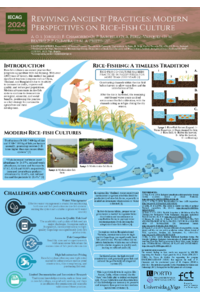
Rice-fish culture, an ancient agronomic practice, integrates aquaculture with rice farming, a sustainable solution for enhancing food security and agricultural productivity. The recent advancements and historical perspectives on rice-fish culture have increased its ecological, economic, and social impacts. The practice, which spans over 2,000 years, has seen significant technological improvements, especially in regions like China, Thailand, and Bangladesh [1]. Implementations of modernized rice-fish systems demonstrate increased rice yields, reduced pest and weed prevalence, improvements on soil quality, and higher profits for farmers [2]. For example, in China it was reported that a rice-fishing system produced 6 000-7 000 kg or rice and 1 500-7 500 kg of fish per hectare per year [3]. Furthermore, the fish reduce herbivore insect abundance, as well as reduced weed abundance, effectively eliminating the need for pesticides [2].
Despite its advantages, challenges such as water management, the availability of quality fish seed, and socio-economic barriers remain [2]. By synthesizing findings from various studies, we will highlight the potential of rice-fish culture to contribute to sustainable agriculture and rural development, recommending strategies for optimizing its adoption and addressing existing constraints.
[1] Lu, J., & Li, X. (2006). Review of rice–fish-farming systems in China — One of the Globally Important Ingenious Agricultural Heritage Systems (GIAHS). Aquaculture, 260, 106-113. https://doi.org/10.1016/J.AQUACULTURE.2006.05.059.
[2] Tsuruta, T., Yamaguchi, M., Abe, S., & Iguchi, K. (2010). Effect of fish in rice-fish culture on the rice yield. Fisheries Science, 77, 95-106. https://doi.org/10.1007/s12562-010-0299-2.
[3] Yi, Y., & Wu Z. (2020). Rice-fish culture in China. CABI Compedium, https://doi.org/10.1079/ac.66147.20203483342.
Keywords
Rice-fish culture
Aquaculture
Rice farming
Poster
Poster_IECAG_2024_Olivia.pdf
Biomonitoring lanthanum in tree bark samples from urban and rural areas across Leicestershire (UK)
“Alternative” crops to enhance Mediterranean agrodiversity and fight the climate emergency