Event submissions
Published
This submission belongs to the session S1. Crops of the event The 4th International Electronic Conference on Agronomy
Published date
02 Dec, 2024
Academic Editor
'%3e%3cpath%20d='M12.6657%2010.9104C12.4185%2010.325%2012.0599%209.79327%2011.6097%209.34482C11.1609%208.89508%2010.6293%208.5365%2010.0442%208.28888C10.0389%208.28626%2010.0337%208.28495%2010.0285%208.28233C10.8446%207.69279%2011.3752%206.73249%2011.3752%205.64904C11.3752%203.8542%209.92103%202.39999%208.1262%202.39999C6.33136%202.39999%204.87715%203.8542%204.87715%205.64904C4.87715%206.73249%205.40774%207.69279%206.22393%208.28364C6.21869%208.28626%206.21345%208.28757%206.20821%208.29019C5.62129%208.5378%205.09463%208.89284%204.64265%209.34613C4.1929%209.79493%203.83432%2010.3266%203.58671%2010.9117C3.34345%2011.4845%203.21226%2012.0987%203.20023%2012.7209C3.19988%2012.7349%203.20233%2012.7488%203.20744%2012.7619C3.21255%2012.7749%203.22022%2012.7867%203.22998%2012.7968C3.23975%2012.8068%203.25142%2012.8147%203.26431%2012.8202C3.2772%2012.8256%203.29105%2012.8284%203.30504%2012.8284H4.09109C4.14874%2012.8284%204.19459%2012.7825%204.1959%2012.7262C4.2221%2011.7148%204.62823%2010.7676%205.34617%2010.0497C6.08899%209.30683%207.0755%208.89808%208.1262%208.89808C9.17689%208.89808%2010.1634%209.30683%2010.9062%2010.0497C11.6242%2010.7676%2012.0303%2011.7148%2012.0565%2012.7262C12.0578%2012.7838%2012.1037%2012.8284%2012.1613%2012.8284H12.9474C12.9613%2012.8284%2012.9752%2012.8256%2012.9881%2012.8202C13.001%2012.8147%2013.0126%2012.8068%2013.0224%2012.7968C13.0322%2012.7867%2013.0398%2012.7749%2013.0449%2012.7619C13.0501%2012.7488%2013.0525%2012.7349%2013.0522%2012.7209C13.0391%2012.0947%2012.9094%2011.4855%2012.6657%2010.9104ZM8.1262%207.9024C7.52486%207.9024%206.9589%207.6679%206.53312%207.24211C6.10733%206.81633%205.87283%206.25037%205.87283%205.64904C5.87283%205.0477%206.10733%204.48174%206.53312%204.05596C6.9589%203.63018%207.52486%203.39567%208.1262%203.39567C8.72753%203.39567%209.29349%203.63018%209.71927%204.05596C10.1451%204.48174%2010.3796%205.0477%2010.3796%205.64904C10.3796%206.25037%2010.1451%206.81633%209.71927%207.24211C9.29349%207.6679%208.72753%207.9024%208.1262%207.9024Z'%20fill='%235D1EE1'/%3e%3c/g%3e%3c/svg%3e) Oscar Vicente
Oscar VicenteCitation
Sheeba Rebecca Isaac, Arunjith P, Manju R V, Source- sink modulation in Chinese potato through agronomic management in the southern laterites of Kerala, India, in Proceedings of The 4th International Electronic Conference on Agronomy, 2 December–5 December 2024, MDPI: Basel, Switzerland
Share
Email
Facebook
Twitter
LinkedIn
Source- sink modulation in Chinese potato through agronomic management in the southern laterites of Kerala, India
'%3e%3cpath%20d='M12.6647%2010.9104C12.4176%2010.325%2012.0589%209.7933%2011.6088%209.34485C11.16%208.89511%2010.6283%208.53653%2010.0432%208.28891C10.038%208.28629%2010.0327%208.28498%2010.0275%208.28236C10.8437%207.69282%2011.3743%206.73252%2011.3743%205.64907C11.3743%203.85423%209.92005%202.40002%208.12522%202.40002C6.33038%202.40002%204.87618%203.85423%204.87618%205.64907C4.87618%206.73252%205.40677%207.69282%206.22296%208.28367C6.21772%208.28629%206.21248%208.2876%206.20724%208.29022C5.62031%208.53783%205.09365%208.89287%204.64167%209.34616C4.19192%209.79496%203.83334%2010.3266%203.58573%2010.9117C3.34247%2011.4846%203.21128%2012.0987%203.19925%2012.721C3.1989%2012.735%203.20135%2012.7489%203.20646%2012.7619C3.21157%2012.7749%203.21924%2012.7868%203.22901%2012.7968C3.23877%2012.8068%203.25045%2012.8148%203.26334%2012.8202C3.27623%2012.8256%203.29007%2012.8284%203.30406%2012.8284H4.09012C4.14776%2012.8284%204.19362%2012.7825%204.19493%2012.7262C4.22113%2011.7148%204.62726%2010.7676%205.34519%2010.0497C6.08802%209.30686%207.07452%208.89811%208.12522%208.89811C9.17592%208.89811%2010.1624%209.30686%2010.9052%2010.0497C11.6232%2010.7676%2012.0293%2011.7148%2012.0555%2012.7262C12.0568%2012.7839%2012.1027%2012.8284%2012.1603%2012.8284H12.9464C12.9604%2012.8284%2012.9742%2012.8256%2012.9871%2012.8202C13%2012.8148%2013.0117%2012.8068%2013.0214%2012.7968C13.0312%2012.7868%2013.0389%2012.7749%2013.044%2012.7619C13.0491%2012.7489%2013.0515%2012.735%2013.0512%2012.721C13.0381%2012.0947%2012.9084%2011.4856%2012.6647%2010.9104ZM8.12522%207.90243C7.52388%207.90243%206.95792%207.66793%206.53214%207.24215C6.10636%206.81636%205.87185%206.2504%205.87185%205.64907C5.87185%205.04773%206.10636%204.48177%206.53214%204.05599C6.95792%203.63021%207.52388%203.3957%208.12522%203.3957C8.72655%203.3957%209.29252%203.63021%209.7183%204.05599C10.1441%204.48177%2010.3786%205.04773%2010.3786%205.64907C10.3786%206.2504%2010.1441%206.81636%209.7183%207.24215C9.29252%207.66793%208.72655%207.90243%208.12522%207.90243Z'%20fill='%235D1EE1'/%3e%3c/g%3e%3c/svg%3e)
Sheeba Rebecca Isaac 1
Arunjith P 2
Manju R V 3
1. Department of Agronomy, Regional Agricultural Research Station, Kerala Agricultural University, Kottayam, 686563, India
2. Specialist (Soil Scientist), Kerala State Land Use Board, Thiruvananthapuram, 695033, India
3. Department of Plant Physiology, College of Agriculture, Kerala Agricultural University, Thiruvananthapuram, 695522, India
Abstract
Introduction
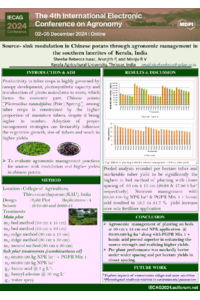
Tuber crops, considered as second most important food crops after cereals, are bestowed with climate resilient characters that enable it to perform under abiotic stress situations. Productivity in tuber crops is highly governed by canopy development, photosynthetic capacity and translocation of the photo assimilates to the roots, which forms the economic part. Chinese potato [Plectranthus rotundifolius (Poir.) Spreng.] is preferred for its short duration, nutritive and good energy value. Nevertheless, the crop is constrained by the higher proportion of miniature tubers, despite it being higher in number. Adoption of proper management strategies can favourably influence the size of tubers and result in higher yields.
Methods
The experiment was laid out in in split plot design with main plot treatments, m1: bed method (30 cm x 15 cm), m2: bed method (30 cm x 30 cm), m3: ridge method (30 cm x 15 cm), m4: ridge method (30 cm x 30 cm) and m5: mound method (30 cm x 30 cm) and sub plot treatments, combinations of n1: 60:30:120 kg NPK ha-1 + PGPR Mix 1, n2: 60:30:120 kg NPK ha-1) and g1: humic acid @@ 5 g L-1, g2: benzyl adenine @ 50 mg L-1 and g3: water spray) in four replications for two seasons.
Results
Pooled analysis revealed per hectare tuber yield and marketable tuber yield to be significantly the highest in bed method of planting with closer spacing of 30 cm x 15 cm (20.93 and 17.46 t ha-1 respectively). Application of 60:30:120 kg NPK ha-1 + PGPR Mix 1 + humic acid could result in 19.7 to 21.7 per cent increase in yields sole fertilizer application .
Conclusion
Resource management options of planting on beds at 30 cm x 15 cm and NPK application @ 60:30:120 kg ha-1 along with PGPR Mix 1 and humic acid proved superior in enhancing the source strength and realizing higher yields. Per plant performance remained markedly better under wider spacing and per hectare yields in closer spacing.
Keywords
chinese potato
growth regulator
foliar
nutrient
planting geometry
Poster
Dr. Sheeba Rebecca Isaac 02.12.24.pdf
“Alternative” crops to enhance Mediterranean agrodiversity and fight the climate emergency
Farming systems potentate sustainable soil management and crop production in Africa