Event submissions
Published
This submission belongs to the session S1. Crops of the event The 4th International Electronic Conference on Agronomy
Published date
02 Dec, 2024
Academic Editor
'%3e%3cpath%20d='M12.6657%2010.9104C12.4185%2010.325%2012.0599%209.79327%2011.6097%209.34482C11.1609%208.89508%2010.6293%208.5365%2010.0442%208.28888C10.0389%208.28626%2010.0337%208.28495%2010.0285%208.28233C10.8446%207.69279%2011.3752%206.73249%2011.3752%205.64904C11.3752%203.8542%209.92103%202.39999%208.1262%202.39999C6.33136%202.39999%204.87715%203.8542%204.87715%205.64904C4.87715%206.73249%205.40774%207.69279%206.22393%208.28364C6.21869%208.28626%206.21345%208.28757%206.20821%208.29019C5.62129%208.5378%205.09463%208.89284%204.64265%209.34613C4.1929%209.79493%203.83432%2010.3266%203.58671%2010.9117C3.34345%2011.4845%203.21226%2012.0987%203.20023%2012.7209C3.19988%2012.7349%203.20233%2012.7488%203.20744%2012.7619C3.21255%2012.7749%203.22022%2012.7867%203.22998%2012.7968C3.23975%2012.8068%203.25142%2012.8147%203.26431%2012.8202C3.2772%2012.8256%203.29105%2012.8284%203.30504%2012.8284H4.09109C4.14874%2012.8284%204.19459%2012.7825%204.1959%2012.7262C4.2221%2011.7148%204.62823%2010.7676%205.34617%2010.0497C6.08899%209.30683%207.0755%208.89808%208.1262%208.89808C9.17689%208.89808%2010.1634%209.30683%2010.9062%2010.0497C11.6242%2010.7676%2012.0303%2011.7148%2012.0565%2012.7262C12.0578%2012.7838%2012.1037%2012.8284%2012.1613%2012.8284H12.9474C12.9613%2012.8284%2012.9752%2012.8256%2012.9881%2012.8202C13.001%2012.8147%2013.0126%2012.8068%2013.0224%2012.7968C13.0322%2012.7867%2013.0398%2012.7749%2013.0449%2012.7619C13.0501%2012.7488%2013.0525%2012.7349%2013.0522%2012.7209C13.0391%2012.0947%2012.9094%2011.4855%2012.6657%2010.9104ZM8.1262%207.9024C7.52486%207.9024%206.9589%207.6679%206.53312%207.24211C6.10733%206.81633%205.87283%206.25037%205.87283%205.64904C5.87283%205.0477%206.10733%204.48174%206.53312%204.05596C6.9589%203.63018%207.52486%203.39567%208.1262%203.39567C8.72753%203.39567%209.29349%203.63018%209.71927%204.05596C10.1451%204.48174%2010.3796%205.0477%2010.3796%205.64904C10.3796%206.25037%2010.1451%206.81633%209.71927%207.24211C9.29349%207.6679%208.72753%207.9024%208.1262%207.9024Z'%20fill='%235D1EE1'/%3e%3c/g%3e%3c/svg%3e) Oscar Vicente
Oscar VicenteCitation
Syeda Maryam Hussain, Ishrat Naz, Paulo Henrique Mazza Rodrigue, Valdo Rodrigues Herling, Metabolomic Discrimination of Brachiaria decumbens and Brachiaria brizantha using 1H-Nuclear Magnetic Resonance (NMR) Spectroscopy and Ultra-High-Performance Liquid Chromatography–Mass Spectrometry (UHPLC-MS): A Comparative Phytochemical Analysis, in Proceedings of The 4th International Electronic Conference on Agronomy, 2 December–5 December 2024, MDPI: Basel, Switzerland
Share
Email
Facebook
Twitter
LinkedIn
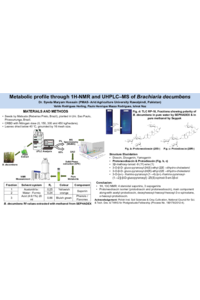
Metabolomic Discrimination of Brachiaria decumbens and Brachiaria brizantha using 1H-Nuclear Magnetic Resonance (NMR) Spectroscopy and Ultra-High-Performance Liquid Chromatography–Mass Spectrometry (UHPLC-MS): A Comparative Phytochemical Analysis
'%3e%3cpath%20d='M12.6647%2010.9104C12.4176%2010.325%2012.0589%209.7933%2011.6088%209.34485C11.16%208.89511%2010.6283%208.53653%2010.0432%208.28891C10.038%208.28629%2010.0327%208.28498%2010.0275%208.28236C10.8437%207.69282%2011.3743%206.73252%2011.3743%205.64907C11.3743%203.85423%209.92005%202.40002%208.12522%202.40002C6.33038%202.40002%204.87618%203.85423%204.87618%205.64907C4.87618%206.73252%205.40677%207.69282%206.22296%208.28367C6.21772%208.28629%206.21248%208.2876%206.20724%208.29022C5.62031%208.53783%205.09365%208.89287%204.64167%209.34616C4.19192%209.79496%203.83334%2010.3266%203.58573%2010.9117C3.34247%2011.4846%203.21128%2012.0987%203.19925%2012.721C3.1989%2012.735%203.20135%2012.7489%203.20646%2012.7619C3.21157%2012.7749%203.21924%2012.7868%203.22901%2012.7968C3.23877%2012.8068%203.25045%2012.8148%203.26334%2012.8202C3.27623%2012.8256%203.29007%2012.8284%203.30406%2012.8284H4.09012C4.14776%2012.8284%204.19362%2012.7825%204.19493%2012.7262C4.22113%2011.7148%204.62726%2010.7676%205.34519%2010.0497C6.08802%209.30686%207.07452%208.89811%208.12522%208.89811C9.17592%208.89811%2010.1624%209.30686%2010.9052%2010.0497C11.6232%2010.7676%2012.0293%2011.7148%2012.0555%2012.7262C12.0568%2012.7839%2012.1027%2012.8284%2012.1603%2012.8284H12.9464C12.9604%2012.8284%2012.9742%2012.8256%2012.9871%2012.8202C13%2012.8148%2013.0117%2012.8068%2013.0214%2012.7968C13.0312%2012.7868%2013.0389%2012.7749%2013.044%2012.7619C13.0491%2012.7489%2013.0515%2012.735%2013.0512%2012.721C13.0381%2012.0947%2012.9084%2011.4856%2012.6647%2010.9104ZM8.12522%207.90243C7.52388%207.90243%206.95792%207.66793%206.53214%207.24215C6.10636%206.81636%205.87185%206.2504%205.87185%205.64907C5.87185%205.04773%206.10636%204.48177%206.53214%204.05599C6.95792%203.63021%207.52388%203.3957%208.12522%203.3957C8.72655%203.3957%209.29252%203.63021%209.7183%204.05599C10.1441%204.48177%2010.3786%205.04773%2010.3786%205.64907C10.3786%206.2504%2010.1441%206.81636%209.7183%207.24215C9.29252%207.66793%208.72655%207.90243%208.12522%207.90243Z'%20fill='%235D1EE1'/%3e%3c/g%3e%3c/svg%3e)
Syeda Maryam Hussain 1
Ishrat Naz 2
Paulo Henrique Mazza Rodrigue 3
Valdo Rodrigues Herling 4
1. Faculty of Veterinary and Animal Sciences, Department of Livestock management and production, Pir Mehr Ali Shah, Arid Agriculture University, Rawalpindi, 46300, Pakistan
2. Faculty of Crop Protection, Department of Plant Pathology, Agriculture University Peshawer, Peshawer, Pakistan
3. Department of Animal Nutrition and Production, Faculty of Veterinary and Animal Sciences, FZEA, University of Sao Paulo, Pirassununga, 13635-900, Brazil
4. Department of Forage Science, Faculty of Veterinary and Animal Sciences, University of Sao Paulo, Pirassununga, 13635-900, Brazil
Abstract
Brazil is one of the largest herd holders with a dependency on natural and cultivated pastures (Brachiaria species (100 million hectares)). The two most reported toxic pasture species (Brachiaria decumbens and Brachiaria brizantha) were grown in the greenhouse greenhouse of the Faculty of Animal Science and Food Engineering on different doses of nitrogen (0, 100, 200 and 300 mg/Kg) and were evaluated for a year. We explored the expected secondary metabolic compounds first by performing thin-layer chromatography, and then by confirming the compounds, their types and metabolic profiles, which were identified by ultra-high-performance liquid chromatography. Differential metabolites, steroidal saponin concentrations and their sub-types were confirmed by nano-magnetic resonance. The main source of differential probably toxic components in both species was the protodioscin isomer (Protoneodioscin and Protodioscin). We isolated four steroidal saponins and three sapogenins in leaves of Brachiaria decumbens and Brachiaria brizantha by MS-MS/MS-ESI/UPLC as diosgenin, dioscin, and yamogenin (already detected earlier) were detected. We identified protoneodioscin isomer (protodioscin and protoneodioscin (19 and 20) as the main differential (probably toxic)component between B. decumbens and B. brizantha along with acetyl-protodioscin, deoxyhexosyl-hexosyl-hexosyl-3-o-spirostane, and o-hexosyl-protodioscin in Brachiaria species. Additionally, the new findings included the fact that flavo-lignans, Tricin-4'-O-(β-guaiacyl glyceryl) ether isomers, acetyl-protodioscin, O-hexosyl-protodioscin, protodioscin isomer, tribulosaponin A and glycoside structures were also detected and established by 1H and 13C NMR spectroscopy.
Keywords
Pasture
saponin
protoneodioscin
NMR
Metabolites
Toxic
Poster
FINAl agronomy-ABAS-2024.pdf
INVESTIGATING THE IMPACT OF DIFFERENT SOWING METHODS ON WHEAT (TRITICUM AESTIVUM L.) GROWTH AND YIELD IN LARKANA
Biopesticides from marine macroalgae against bacterial and fungal pathogens towards crop disease management