Event submissions
Published
This submission belongs to the session S1. Crops of the event The 4th International Electronic Conference on Agronomy
Published date
02 Dec, 2024
Academic Editor
'%3e%3cpath%20d='M12.6657%2010.9104C12.4185%2010.325%2012.0599%209.79327%2011.6097%209.34482C11.1609%208.89508%2010.6293%208.5365%2010.0442%208.28888C10.0389%208.28626%2010.0337%208.28495%2010.0285%208.28233C10.8446%207.69279%2011.3752%206.73249%2011.3752%205.64904C11.3752%203.8542%209.92103%202.39999%208.1262%202.39999C6.33136%202.39999%204.87715%203.8542%204.87715%205.64904C4.87715%206.73249%205.40774%207.69279%206.22393%208.28364C6.21869%208.28626%206.21345%208.28757%206.20821%208.29019C5.62129%208.5378%205.09463%208.89284%204.64265%209.34613C4.1929%209.79493%203.83432%2010.3266%203.58671%2010.9117C3.34345%2011.4845%203.21226%2012.0987%203.20023%2012.7209C3.19988%2012.7349%203.20233%2012.7488%203.20744%2012.7619C3.21255%2012.7749%203.22022%2012.7867%203.22998%2012.7968C3.23975%2012.8068%203.25142%2012.8147%203.26431%2012.8202C3.2772%2012.8256%203.29105%2012.8284%203.30504%2012.8284H4.09109C4.14874%2012.8284%204.19459%2012.7825%204.1959%2012.7262C4.2221%2011.7148%204.62823%2010.7676%205.34617%2010.0497C6.08899%209.30683%207.0755%208.89808%208.1262%208.89808C9.17689%208.89808%2010.1634%209.30683%2010.9062%2010.0497C11.6242%2010.7676%2012.0303%2011.7148%2012.0565%2012.7262C12.0578%2012.7838%2012.1037%2012.8284%2012.1613%2012.8284H12.9474C12.9613%2012.8284%2012.9752%2012.8256%2012.9881%2012.8202C13.001%2012.8147%2013.0126%2012.8068%2013.0224%2012.7968C13.0322%2012.7867%2013.0398%2012.7749%2013.0449%2012.7619C13.0501%2012.7488%2013.0525%2012.7349%2013.0522%2012.7209C13.0391%2012.0947%2012.9094%2011.4855%2012.6657%2010.9104ZM8.1262%207.9024C7.52486%207.9024%206.9589%207.6679%206.53312%207.24211C6.10733%206.81633%205.87283%206.25037%205.87283%205.64904C5.87283%205.0477%206.10733%204.48174%206.53312%204.05596C6.9589%203.63018%207.52486%203.39567%208.1262%203.39567C8.72753%203.39567%209.29349%203.63018%209.71927%204.05596C10.1451%204.48174%2010.3796%205.0477%2010.3796%205.64904C10.3796%206.25037%2010.1451%206.81633%209.71927%207.24211C9.29349%207.6679%208.72753%207.9024%208.1262%207.9024Z'%20fill='%235D1EE1'/%3e%3c/g%3e%3c/svg%3e) Ionut Spatar
Ionut SpatarCitation
Jonathan Alfredo Fernandez-Mendiola, Elisa Dominguez-Hernandez, Martha Elena Domínguez Hernandez, Jorge Ortiz-Romero, Vianney Villafranco-Godinez, Isaac Fernando Soriano Gonzalez, Fernando Ortiz-Salgado, Edgar Orlando Sotelo-Noguez, Comparing the effect of chemical and biol fertilization on the yield and quality of greenhouse-grown Cucumber (Cucumis sativus), in Proceedings of The 4th International Electronic Conference on Agronomy, 2 December–5 December 2024, MDPI: Basel, Switzerland
Share
Email
Facebook
Twitter
LinkedIn
Comparing the effect of chemical and biol fertilization on the yield and quality of greenhouse-grown Cucumber (Cucumis sativus)
'%3e%3cpath%20d='M12.6647%2010.9104C12.4176%2010.325%2012.0589%209.7933%2011.6088%209.34485C11.16%208.89511%2010.6283%208.53653%2010.0432%208.28891C10.038%208.28629%2010.0327%208.28498%2010.0275%208.28236C10.8437%207.69282%2011.3743%206.73252%2011.3743%205.64907C11.3743%203.85423%209.92005%202.40002%208.12522%202.40002C6.33038%202.40002%204.87618%203.85423%204.87618%205.64907C4.87618%206.73252%205.40677%207.69282%206.22296%208.28367C6.21772%208.28629%206.21248%208.2876%206.20724%208.29022C5.62031%208.53783%205.09365%208.89287%204.64167%209.34616C4.19192%209.79496%203.83334%2010.3266%203.58573%2010.9117C3.34247%2011.4846%203.21128%2012.0987%203.19925%2012.721C3.1989%2012.735%203.20135%2012.7489%203.20646%2012.7619C3.21157%2012.7749%203.21924%2012.7868%203.22901%2012.7968C3.23877%2012.8068%203.25045%2012.8148%203.26334%2012.8202C3.27623%2012.8256%203.29007%2012.8284%203.30406%2012.8284H4.09012C4.14776%2012.8284%204.19362%2012.7825%204.19493%2012.7262C4.22113%2011.7148%204.62726%2010.7676%205.34519%2010.0497C6.08802%209.30686%207.07452%208.89811%208.12522%208.89811C9.17592%208.89811%2010.1624%209.30686%2010.9052%2010.0497C11.6232%2010.7676%2012.0293%2011.7148%2012.0555%2012.7262C12.0568%2012.7839%2012.1027%2012.8284%2012.1603%2012.8284H12.9464C12.9604%2012.8284%2012.9742%2012.8256%2012.9871%2012.8202C13%2012.8148%2013.0117%2012.8068%2013.0214%2012.7968C13.0312%2012.7868%2013.0389%2012.7749%2013.044%2012.7619C13.0491%2012.7489%2013.0515%2012.735%2013.0512%2012.721C13.0381%2012.0947%2012.9084%2011.4856%2012.6647%2010.9104ZM8.12522%207.90243C7.52388%207.90243%206.95792%207.66793%206.53214%207.24215C6.10636%206.81636%205.87185%206.2504%205.87185%205.64907C5.87185%205.04773%206.10636%204.48177%206.53214%204.05599C6.95792%203.63021%207.52388%203.3957%208.12522%203.3957C8.72655%203.3957%209.29252%203.63021%209.7183%204.05599C10.1441%204.48177%2010.3786%205.04773%2010.3786%205.64907C10.3786%206.2504%2010.1441%206.81636%209.7183%207.24215C9.29252%207.66793%208.72655%207.90243%208.12522%207.90243Z'%20fill='%235D1EE1'/%3e%3c/g%3e%3c/svg%3e)
Jonathan Alfredo Fernandez-Mendiola 1
Elisa Dominguez-Hernandez 1,2

Martha Elena Domínguez Hernandez 1
Jorge Ortiz-Romero 1
Vianney Villafranco-Godinez 1
Isaac Fernando Soriano Gonzalez 1
Fernando Ortiz-Salgado 1
Edgar Orlando Sotelo-Noguez 1
1. Departamento de Ciencias Agrícolas, Facultad de Estudios Superiores Cuautitlán, Universidad Nacional Autónoma de México
2. Posgrado en Ingeniería de Sistemas, Sección de Estudios de Posgrado e Investigación, ESIME Zacatenco, Instituto Politécnico Nacional
Abstract
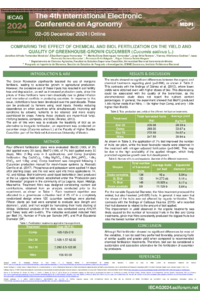
Cucumber (Cucumis sativus) production in greenhouses has proven to be an efficient alternative for achieving higher yields and better quality compared to open-field cultivation. However, successful greenhouse cultivation also depends on well-balanced fertilization. Conventionally, this is achieved using inorganic fertilizers, but there is a growing push to change this, given the environmental impact of such chemical inputs. This study aims to compare two conventional fertilization treatments using chemical sources and two treatments using biol (liquid organic fertilizer) on the quality and yield of cucumber fruits (Centauro 1 variety). Each treatment repetition was allocated to a greenhouse cultivation bed of 25 m2 in a completely randomized design where 120 cucumber seedlings were planted. The fertilization treatments evaluated were Biol30 (100L of 3% biol applied every 30 days), Biol70 (100L of 7% biol applied every 30 days), Nitro (1.9kg urea in 3 applications), and Comp [complete fertilization: 2kg Ca(NO₃)₂, 1.6kg MgSO4, 0.8kg (NH4)2HPO4, 1.6kg KNO3, and 1.6kg urea]. Phosphorus and potassium were applied 14 days after planting (dap), and the rest were split into three applications: 14, 42, and 63dap. Fifteen plants per bed were sampled to evaluate size (length and diameter), yield, and fruit weight by harvesting their fruits starting at 50dap. The results showed no significant differences between the organic and chemical treatments regarding yield (p=0.094), but Biol70 produced 1.44x higher yields than Nitro, 1.18x higher than Comp, and only 1.09x higher than Biol30. This improvement in yield was caused by the number of harvested fruits in the Biol (Biol30:133; Biol70:149) and Comp (134) treatments, given that Nitro consistently produced the longest, widest, and heaviest (p≤0.029) but lowest number of fruits (p=0.046). In summary, organic fertilization treatments performed favourably, producing fruits of similar quality and greater yield when compared to recommended chemical fertilization treatments.
Keywords
bio-fertilizer
fruit quality
fruit yield
inorganic fertilizer
Poster
Cucumber_Eng.pdf
Evaluating wheat cultivars for their quality and performance in Kosovo
Indoor green and purple lettuce seedling production under LED lights