Event submissions
Published
This submission belongs to the session S1. Crops of the event The 4th International Electronic Conference on Agronomy
Published date
02 Dec, 2024
Academic Editor
'%3e%3cpath%20d='M12.6657%2010.9104C12.4185%2010.325%2012.0599%209.79327%2011.6097%209.34482C11.1609%208.89508%2010.6293%208.5365%2010.0442%208.28888C10.0389%208.28626%2010.0337%208.28495%2010.0285%208.28233C10.8446%207.69279%2011.3752%206.73249%2011.3752%205.64904C11.3752%203.8542%209.92103%202.39999%208.1262%202.39999C6.33136%202.39999%204.87715%203.8542%204.87715%205.64904C4.87715%206.73249%205.40774%207.69279%206.22393%208.28364C6.21869%208.28626%206.21345%208.28757%206.20821%208.29019C5.62129%208.5378%205.09463%208.89284%204.64265%209.34613C4.1929%209.79493%203.83432%2010.3266%203.58671%2010.9117C3.34345%2011.4845%203.21226%2012.0987%203.20023%2012.7209C3.19988%2012.7349%203.20233%2012.7488%203.20744%2012.7619C3.21255%2012.7749%203.22022%2012.7867%203.22998%2012.7968C3.23975%2012.8068%203.25142%2012.8147%203.26431%2012.8202C3.2772%2012.8256%203.29105%2012.8284%203.30504%2012.8284H4.09109C4.14874%2012.8284%204.19459%2012.7825%204.1959%2012.7262C4.2221%2011.7148%204.62823%2010.7676%205.34617%2010.0497C6.08899%209.30683%207.0755%208.89808%208.1262%208.89808C9.17689%208.89808%2010.1634%209.30683%2010.9062%2010.0497C11.6242%2010.7676%2012.0303%2011.7148%2012.0565%2012.7262C12.0578%2012.7838%2012.1037%2012.8284%2012.1613%2012.8284H12.9474C12.9613%2012.8284%2012.9752%2012.8256%2012.9881%2012.8202C13.001%2012.8147%2013.0126%2012.8068%2013.0224%2012.7968C13.0322%2012.7867%2013.0398%2012.7749%2013.0449%2012.7619C13.0501%2012.7488%2013.0525%2012.7349%2013.0522%2012.7209C13.0391%2012.0947%2012.9094%2011.4855%2012.6657%2010.9104ZM8.1262%207.9024C7.52486%207.9024%206.9589%207.6679%206.53312%207.24211C6.10733%206.81633%205.87283%206.25037%205.87283%205.64904C5.87283%205.0477%206.10733%204.48174%206.53312%204.05596C6.9589%203.63018%207.52486%203.39567%208.1262%203.39567C8.72753%203.39567%209.29349%203.63018%209.71927%204.05596C10.1451%204.48174%2010.3796%205.0477%2010.3796%205.64904C10.3796%206.25037%2010.1451%206.81633%209.71927%207.24211C9.29349%207.6679%208.72753%207.9024%208.1262%207.9024Z'%20fill='%235D1EE1'/%3e%3c/g%3e%3c/svg%3e) Oscar Vicente
Oscar VicenteCitation
Kristina Luković, Slađan Adžić, Kamenko Bratković, Vladimir Miladinović, Nenad Đurić, Radiša Đorđević, Aleksandra Rakonjac, Indoor green and purple lettuce seedling production under LED lights, in Proceedings of The 4th International Electronic Conference on Agronomy, 2 December–5 December 2024, MDPI: Basel, Switzerland
Share
Email
Facebook
Twitter
LinkedIn
Indoor green and purple lettuce seedling production under LED lights
'%3e%3cpath%20d='M12.6647%2010.9104C12.4176%2010.325%2012.0589%209.7933%2011.6088%209.34485C11.16%208.89511%2010.6283%208.53653%2010.0432%208.28891C10.038%208.28629%2010.0327%208.28498%2010.0275%208.28236C10.8437%207.69282%2011.3743%206.73252%2011.3743%205.64907C11.3743%203.85423%209.92005%202.40002%208.12522%202.40002C6.33038%202.40002%204.87618%203.85423%204.87618%205.64907C4.87618%206.73252%205.40677%207.69282%206.22296%208.28367C6.21772%208.28629%206.21248%208.2876%206.20724%208.29022C5.62031%208.53783%205.09365%208.89287%204.64167%209.34616C4.19192%209.79496%203.83334%2010.3266%203.58573%2010.9117C3.34247%2011.4846%203.21128%2012.0987%203.19925%2012.721C3.1989%2012.735%203.20135%2012.7489%203.20646%2012.7619C3.21157%2012.7749%203.21924%2012.7868%203.22901%2012.7968C3.23877%2012.8068%203.25045%2012.8148%203.26334%2012.8202C3.27623%2012.8256%203.29007%2012.8284%203.30406%2012.8284H4.09012C4.14776%2012.8284%204.19362%2012.7825%204.19493%2012.7262C4.22113%2011.7148%204.62726%2010.7676%205.34519%2010.0497C6.08802%209.30686%207.07452%208.89811%208.12522%208.89811C9.17592%208.89811%2010.1624%209.30686%2010.9052%2010.0497C11.6232%2010.7676%2012.0293%2011.7148%2012.0555%2012.7262C12.0568%2012.7839%2012.1027%2012.8284%2012.1603%2012.8284H12.9464C12.9604%2012.8284%2012.9742%2012.8256%2012.9871%2012.8202C13%2012.8148%2013.0117%2012.8068%2013.0214%2012.7968C13.0312%2012.7868%2013.0389%2012.7749%2013.044%2012.7619C13.0491%2012.7489%2013.0515%2012.735%2013.0512%2012.721C13.0381%2012.0947%2012.9084%2011.4856%2012.6647%2010.9104ZM8.12522%207.90243C7.52388%207.90243%206.95792%207.66793%206.53214%207.24215C6.10636%206.81636%205.87185%206.2504%205.87185%205.64907C5.87185%205.04773%206.10636%204.48177%206.53214%204.05599C6.95792%203.63021%207.52388%203.3957%208.12522%203.3957C8.72655%203.3957%209.29252%203.63021%209.7183%204.05599C10.1441%204.48177%2010.3786%205.04773%2010.3786%205.64907C10.3786%206.2504%2010.1441%206.81636%209.7183%207.24215C9.29252%207.66793%208.72655%207.90243%208.12522%207.90243Z'%20fill='%235D1EE1'/%3e%3c/g%3e%3c/svg%3e)
Kristina Luković 1
Slađan Adžić 1
Kamenko Bratković 2
Vladimir Miladinović 1
Nenad Đurić 1
Radiša Đorđević 1

Aleksandra Rakonjac 1
1. Institute for Vegetable Crops, Karađorđeva 71, 11420 Smederevska Palanka, Serbia
2. Center for Small Grains and Rural Development, Save Kovačevića 31, 34000 Kragujevac, Serbia
Abstract
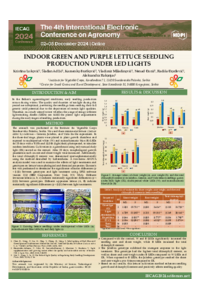
In the Balkans' agroecological conditions, early seedling production occurs during winter. The quality and duration of sunlight during this period are suboptimal, preventing the seedlings from reaching their full genetic yield potential due to the deprivation of certain light qualities. Therefore, our study aimed to test whether the usage of energy-efficient light-emitting diodes (LEDs) can fulfill the plants' light requirements during the early stages of seedling production. The research was performed at the Institute for Vegetable Crops Smederevska Palanka, Serbia. We used three commercial lettuce (Lactuca sativa L.) cultivars—Genesis, Jukebox, and Viola—for the experiment. In the three-leaf stage, plants were placed in plant growth chambers and exposed to multispectral white (W) and monochromatic blue (B) LEDs for 25 days with a 9/15h and 10/14h (light/dark) photoperiod, to simulate outdoor conditions. Cultivation in a greenhouse using only natural daily light (DL) served as the control. After 25 days, morphological growth parameters such as root and shoot weight were measured. Additionally, the total chlorophyll content was determined spectrophotometrically using the method described by Lichtenthaler. Our results showed that compared with the control, W and B LEDs significantly increased the seedling root and shoot weight, while B LEDs increased the total chlorophyll content. In plants grown under DL and W LEDs, the total chlorophyll content did not differ significantly. The Jukebox genotype exhibited the strongest response to the light treatment. This genotype had the highest total chlorophyll content, as well as shoot and root weight under B LEDs compared to W LEDs and DL. When exposed to B LEDs, the Jukebox genotype reached a shoot and root weight up to 4 times that of to DL. Based on our results, this lettuce cultivation method enhances seedling growth and chlorophyll content and positively affects seedling quality.
Keywords
Lactuca sativa L.
morphological traits
light-emitting diodes
chlorophyll content
vegetables
Poster
Luković et al., 2024.pdf
Comparing the effect of chemical and biol fertilization on the yield and quality of greenhouse-grown Cucumber (Cucumis sativus)
Combined effects of micro-/nanoplastics and humic substance on Allium sativum and importance of humic substance in alleviating toxicity