Event submissions
Published
This submission belongs to the session S6. Plant–Crop Biology and Biochemistry of the event The 4th International Electronic Conference on Agronomy
Published date
02 Dec, 2024
Academic Editor
'%3e%3cpath%20d='M12.6657%2010.9104C12.4185%2010.325%2012.0599%209.79327%2011.6097%209.34482C11.1609%208.89508%2010.6293%208.5365%2010.0442%208.28888C10.0389%208.28626%2010.0337%208.28495%2010.0285%208.28233C10.8446%207.69279%2011.3752%206.73249%2011.3752%205.64904C11.3752%203.8542%209.92103%202.39999%208.1262%202.39999C6.33136%202.39999%204.87715%203.8542%204.87715%205.64904C4.87715%206.73249%205.40774%207.69279%206.22393%208.28364C6.21869%208.28626%206.21345%208.28757%206.20821%208.29019C5.62129%208.5378%205.09463%208.89284%204.64265%209.34613C4.1929%209.79493%203.83432%2010.3266%203.58671%2010.9117C3.34345%2011.4845%203.21226%2012.0987%203.20023%2012.7209C3.19988%2012.7349%203.20233%2012.7488%203.20744%2012.7619C3.21255%2012.7749%203.22022%2012.7867%203.22998%2012.7968C3.23975%2012.8068%203.25142%2012.8147%203.26431%2012.8202C3.2772%2012.8256%203.29105%2012.8284%203.30504%2012.8284H4.09109C4.14874%2012.8284%204.19459%2012.7825%204.1959%2012.7262C4.2221%2011.7148%204.62823%2010.7676%205.34617%2010.0497C6.08899%209.30683%207.0755%208.89808%208.1262%208.89808C9.17689%208.89808%2010.1634%209.30683%2010.9062%2010.0497C11.6242%2010.7676%2012.0303%2011.7148%2012.0565%2012.7262C12.0578%2012.7838%2012.1037%2012.8284%2012.1613%2012.8284H12.9474C12.9613%2012.8284%2012.9752%2012.8256%2012.9881%2012.8202C13.001%2012.8147%2013.0126%2012.8068%2013.0224%2012.7968C13.0322%2012.7867%2013.0398%2012.7749%2013.0449%2012.7619C13.0501%2012.7488%2013.0525%2012.7349%2013.0522%2012.7209C13.0391%2012.0947%2012.9094%2011.4855%2012.6657%2010.9104ZM8.1262%207.9024C7.52486%207.9024%206.9589%207.6679%206.53312%207.24211C6.10733%206.81633%205.87283%206.25037%205.87283%205.64904C5.87283%205.0477%206.10733%204.48174%206.53312%204.05596C6.9589%203.63018%207.52486%203.39567%208.1262%203.39567C8.72753%203.39567%209.29349%203.63018%209.71927%204.05596C10.1451%204.48174%2010.3796%205.0477%2010.3796%205.64904C10.3796%206.25037%2010.1451%206.81633%209.71927%207.24211C9.29349%207.6679%208.72753%207.9024%208.1262%207.9024Z'%20fill='%235D1EE1'/%3e%3c/g%3e%3c/svg%3e) Monica Boscaiu
Monica BoscaiuCitation
Antonio Peña-Fernández, Maria del Carmen Lobo-Bedmar, Mark D. Evans, Gurminderjeet S Jagdev, María de los Ángeles Peña, Tree bark as a bioindicator of yttrium in urban and suburban areas from Leicestershire, England., in Proceedings of The 4th International Electronic Conference on Agronomy, 2 December–5 December 2024, MDPI: Basel, Switzerland
Share
Email
Facebook
Twitter
LinkedIn
Tree bark as a bioindicator of yttrium in urban and suburban areas from Leicestershire, England.

Antonio Peña-Fernández 1,2
'%3e%3cpath%20d='M12.6647%2010.9104C12.4176%2010.325%2012.0589%209.7933%2011.6088%209.34485C11.16%208.89511%2010.6283%208.53653%2010.0432%208.28891C10.038%208.28629%2010.0327%208.28498%2010.0275%208.28236C10.8437%207.69282%2011.3743%206.73252%2011.3743%205.64907C11.3743%203.85423%209.92005%202.40002%208.12522%202.40002C6.33038%202.40002%204.87618%203.85423%204.87618%205.64907C4.87618%206.73252%205.40677%207.69282%206.22296%208.28367C6.21772%208.28629%206.21248%208.2876%206.20724%208.29022C5.62031%208.53783%205.09365%208.89287%204.64167%209.34616C4.19192%209.79496%203.83334%2010.3266%203.58573%2010.9117C3.34247%2011.4846%203.21128%2012.0987%203.19925%2012.721C3.1989%2012.735%203.20135%2012.7489%203.20646%2012.7619C3.21157%2012.7749%203.21924%2012.7868%203.22901%2012.7968C3.23877%2012.8068%203.25045%2012.8148%203.26334%2012.8202C3.27623%2012.8256%203.29007%2012.8284%203.30406%2012.8284H4.09012C4.14776%2012.8284%204.19362%2012.7825%204.19493%2012.7262C4.22113%2011.7148%204.62726%2010.7676%205.34519%2010.0497C6.08802%209.30686%207.07452%208.89811%208.12522%208.89811C9.17592%208.89811%2010.1624%209.30686%2010.9052%2010.0497C11.6232%2010.7676%2012.0293%2011.7148%2012.0555%2012.7262C12.0568%2012.7839%2012.1027%2012.8284%2012.1603%2012.8284H12.9464C12.9604%2012.8284%2012.9742%2012.8256%2012.9871%2012.8202C13%2012.8148%2013.0117%2012.8068%2013.0214%2012.7968C13.0312%2012.7868%2013.0389%2012.7749%2013.044%2012.7619C13.0491%2012.7489%2013.0515%2012.735%2013.0512%2012.721C13.0381%2012.0947%2012.9084%2011.4856%2012.6647%2010.9104ZM8.12522%207.90243C7.52388%207.90243%206.95792%207.66793%206.53214%207.24215C6.10636%206.81636%205.87185%206.2504%205.87185%205.64907C5.87185%205.04773%206.10636%204.48177%206.53214%204.05599C6.95792%203.63021%207.52388%203.3957%208.12522%203.3957C8.72655%203.3957%209.29252%203.63021%209.7183%204.05599C10.1441%204.48177%2010.3786%205.04773%2010.3786%205.64907C10.3786%206.2504%2010.1441%206.81636%209.7183%207.24215C9.29252%207.66793%208.72655%207.90243%208.12522%207.90243Z'%20fill='%235D1EE1'/%3e%3c/g%3e%3c/svg%3e)
Maria del Carmen Lobo-Bedmar 3
Mark D. Evans 2
Gurminderjeet S Jagdev 2

María de los Ángeles Peña 4
1. Department of Surgery, Medical and Social Sciences, Faculty of Medicine and Health Sciences, University of Alcalá, Ctra. Madrid-Barcelona, Km. 33.600, 28871 Alcalá de Henares, Madrid, Spain.
2. Leicester School of Allied Health Sciences, De Montfort University, Leicester, LE1 9BH, UK.
3. Departamento de Investigación Agroambiental. IMIDRA. Finca el Encín, Crta. Madrid-Barcelona Km, 38.2, 28800 Alcalá de Henares, Madrid, Spain.
4. Departamento de Ciencias Biomédicas, Universidad de Alcalá, Crta. Madrid-Barcelona Km, 33.6, 28871 Alcalá de Henares, Madrid, Spain
Abstract
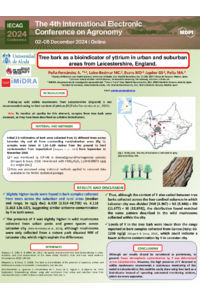
Background: Picking wild edible mushrooms from Leicestershire (England) is not recommended owing to their content of yttrium (Y). To monitor the air quality for this element, samples from tree bark were assessed, as they are considered suitable bioindicators.
Methods: Bark samples were collected from 55 trees from Leicester city and 41 surrounding suburban areas at a height of 1.50–1.80 metres to reduce potential effects of dust from the soil. Samples were cleaned, ground, homogenised and mineralised with HNO3/H2O2 to monitor Y by ICP-MS [LoD=0.00073 ng/g dry weight (dw)].
Results: Slightly higher levels were found in bark samples collected from trees across the suburban and rural areas (median and range, in ng/g dw), specifically 6.339 (1.514-48.705) vs. 6.118 (1.832-126.027), suggesting similar airborne contamination by Y in both areas. Levels of Y were slightly higher in wild mushrooms collected from urban parks and green spaces across Leicester city, although mushrooms were only collected from a nature park situated NW of Leicester city, which might explain the differences. Thus, although the content of Y also varied between tree barks collected across the four cardinal subareas in which Leicester city was divided [NW (4.967) < NE (5.946) < SW (11.677) < SE (32.974)], the distribution found matched the same pattern described in the wild mushrooms collected within the city. Levels of Y in the tree bark were lower than the range reported in bark samples collected from Genoa (Italy; 60-1290 ng/g), which could indicate a lower airborne contamination by Y in Leicester city.
Conclusions: Although our results should be considered as preliminary, in general, lower atmospheric contamination by Y was determined across Leicestershire. However, the high presence of Y detected in edible mushrooms recommends a continuous monitoring of this metal in Leicestershire; this could be easily carried out using tree bark as a bioindicator instead of operating automated monitoring stations, which are more expensive.
Keywords
Yttrium
tree bark
Leicester
mushrooms
risks.
Poster
MDPI 2024 Agronmy Y tree bark_APF.pdf
Breeding for Stripe rust resistance against new aggressive pathotypes "238S119" and 46S119 in hot spot "Pyuthan" of Nepal
Response of a boron-tolerant Triticum dicoccum genotype under high boron concentrations