Event submissions
Published
This submission belongs to the session S2. Breeding/Selection Technologies and Strategies of the event The 4th International Electronic Conference on Agronomy
Published date
02 Dec, 2024
Academic Editor
'%3e%3cpath%20d='M12.6657%2010.9104C12.4185%2010.325%2012.0599%209.79327%2011.6097%209.34482C11.1609%208.89508%2010.6293%208.5365%2010.0442%208.28888C10.0389%208.28626%2010.0337%208.28495%2010.0285%208.28233C10.8446%207.69279%2011.3752%206.73249%2011.3752%205.64904C11.3752%203.8542%209.92103%202.39999%208.1262%202.39999C6.33136%202.39999%204.87715%203.8542%204.87715%205.64904C4.87715%206.73249%205.40774%207.69279%206.22393%208.28364C6.21869%208.28626%206.21345%208.28757%206.20821%208.29019C5.62129%208.5378%205.09463%208.89284%204.64265%209.34613C4.1929%209.79493%203.83432%2010.3266%203.58671%2010.9117C3.34345%2011.4845%203.21226%2012.0987%203.20023%2012.7209C3.19988%2012.7349%203.20233%2012.7488%203.20744%2012.7619C3.21255%2012.7749%203.22022%2012.7867%203.22998%2012.7968C3.23975%2012.8068%203.25142%2012.8147%203.26431%2012.8202C3.2772%2012.8256%203.29105%2012.8284%203.30504%2012.8284H4.09109C4.14874%2012.8284%204.19459%2012.7825%204.1959%2012.7262C4.2221%2011.7148%204.62823%2010.7676%205.34617%2010.0497C6.08899%209.30683%207.0755%208.89808%208.1262%208.89808C9.17689%208.89808%2010.1634%209.30683%2010.9062%2010.0497C11.6242%2010.7676%2012.0303%2011.7148%2012.0565%2012.7262C12.0578%2012.7838%2012.1037%2012.8284%2012.1613%2012.8284H12.9474C12.9613%2012.8284%2012.9752%2012.8256%2012.9881%2012.8202C13.001%2012.8147%2013.0126%2012.8068%2013.0224%2012.7968C13.0322%2012.7867%2013.0398%2012.7749%2013.0449%2012.7619C13.0501%2012.7488%2013.0525%2012.7349%2013.0522%2012.7209C13.0391%2012.0947%2012.9094%2011.4855%2012.6657%2010.9104ZM8.1262%207.9024C7.52486%207.9024%206.9589%207.6679%206.53312%207.24211C6.10733%206.81633%205.87283%206.25037%205.87283%205.64904C5.87283%205.0477%206.10733%204.48174%206.53312%204.05596C6.9589%203.63018%207.52486%203.39567%208.1262%203.39567C8.72753%203.39567%209.29349%203.63018%209.71927%204.05596C10.1451%204.48174%2010.3796%205.0477%2010.3796%205.64904C10.3796%206.25037%2010.1451%206.81633%209.71927%207.24211C9.29349%207.6679%208.72753%207.9024%208.1262%207.9024Z'%20fill='%235D1EE1'/%3e%3c/g%3e%3c/svg%3e) Dilip Panthee
Dilip PantheeCitation
Nabilah Amany Samsurizal, Marta Monder, Andrzej Pacholczak, Influence of Sucrose Levels and LED Light Spectra on In Vitro Propagation of Cornelian cherry (Cornus mas 'Podolski'), in Proceedings of The 4th International Electronic Conference on Agronomy, 2 December–5 December 2024, MDPI: Basel, Switzerland
Share
Email
Facebook
Twitter
LinkedIn
Influence of Sucrose Levels and LED Light Spectra on In Vitro Propagation of Cornelian cherry (Cornus mas 'Podolski')
'%3e%3cpath%20d='M12.6647%2010.9104C12.4176%2010.325%2012.0589%209.7933%2011.6088%209.34485C11.16%208.89511%2010.6283%208.53653%2010.0432%208.28891C10.038%208.28629%2010.0327%208.28498%2010.0275%208.28236C10.8437%207.69282%2011.3743%206.73252%2011.3743%205.64907C11.3743%203.85423%209.92005%202.40002%208.12522%202.40002C6.33038%202.40002%204.87618%203.85423%204.87618%205.64907C4.87618%206.73252%205.40677%207.69282%206.22296%208.28367C6.21772%208.28629%206.21248%208.2876%206.20724%208.29022C5.62031%208.53783%205.09365%208.89287%204.64167%209.34616C4.19192%209.79496%203.83334%2010.3266%203.58573%2010.9117C3.34247%2011.4846%203.21128%2012.0987%203.19925%2012.721C3.1989%2012.735%203.20135%2012.7489%203.20646%2012.7619C3.21157%2012.7749%203.21924%2012.7868%203.22901%2012.7968C3.23877%2012.8068%203.25045%2012.8148%203.26334%2012.8202C3.27623%2012.8256%203.29007%2012.8284%203.30406%2012.8284H4.09012C4.14776%2012.8284%204.19362%2012.7825%204.19493%2012.7262C4.22113%2011.7148%204.62726%2010.7676%205.34519%2010.0497C6.08802%209.30686%207.07452%208.89811%208.12522%208.89811C9.17592%208.89811%2010.1624%209.30686%2010.9052%2010.0497C11.6232%2010.7676%2012.0293%2011.7148%2012.0555%2012.7262C12.0568%2012.7839%2012.1027%2012.8284%2012.1603%2012.8284H12.9464C12.9604%2012.8284%2012.9742%2012.8256%2012.9871%2012.8202C13%2012.8148%2013.0117%2012.8068%2013.0214%2012.7968C13.0312%2012.7868%2013.0389%2012.7749%2013.044%2012.7619C13.0491%2012.7489%2013.0515%2012.735%2013.0512%2012.721C13.0381%2012.0947%2012.9084%2011.4856%2012.6647%2010.9104ZM8.12522%207.90243C7.52388%207.90243%206.95792%207.66793%206.53214%207.24215C6.10636%206.81636%205.87185%206.2504%205.87185%205.64907C5.87185%205.04773%206.10636%204.48177%206.53214%204.05599C6.95792%203.63021%207.52388%203.3957%208.12522%203.3957C8.72655%203.3957%209.29252%203.63021%209.7183%204.05599C10.1441%204.48177%2010.3786%205.04773%2010.3786%205.64907C10.3786%206.2504%2010.1441%206.81636%209.7183%207.24215C9.29252%207.66793%208.72655%207.90243%208.12522%207.90243Z'%20fill='%235D1EE1'/%3e%3c/g%3e%3c/svg%3e)
Nabilah Amany Samsurizal 1
Marta Monder 1
Andrzej Pacholczak 1
1. Section of Ornamental Plants, Faculty of Agriculture and Horticulture, Warsaw University of Life Sciences (SGGW), Nowoursynowska 166, 02-787 Warsaw, Poland.
Abstract
Cornelian cherry or Cornus mas is well known for its nutritional, medicinal, and ornamental uses. The cultivar Cornus mas 'Podolski' is particularly valued for its larger fruit size, high yield, and adaptability, making it a promising candidate for commercial cultivation and landscape use. However, conventional propagation methods are limited, necessitating the development of efficient in vitro techniques. Light-emitting diodes (LEDs) are currently being used as a light source for in vitro regeneration or the growth of plants in a controlled environment. The objective of the present work was to investigate the influence of varying sucrose concentrations (10 g·L⁻¹, 15 g·L⁻¹, 20 g·L⁻¹) and different dominating LED light spectra; White (Control); Blue (B); Blue-Red (BR); and Red (R) on the in vitro growth and morphogenesis of C. mas 'Podolski'. The parameters measured included the number of shoots, the shoot length, the number of leaves, callus induction, and regeneration rate. It was observed that both sucrose concentration and light spectrum significantly influence the in vitro growth and morphogenesis of Cornus mas 'Podolski'. Higher sucrose levels, particularly 20 g·L⁻¹ with white spectra, promote greater shoot production, while red spectra with varying sucrose concentrations enhance shoot elongation and leaf formation. Furthermore, 100% regeneration was observed in several treatments, indicating a high potential for successful plant regeneration under specific sucrose and light spectrum combinations. The lack of significant differences in callus formation across treatments suggests that callus induction is largely independent of sucrose concentration and light quality under the tested conditions. Collectively, Blue-Red spectra with varying sucrose levels are most effective for overall plant regeneration. This optimized protocol is considered for enhancing the large-scale propagation of this valuable cultivar, supporting both commercial production and conservation efforts.
Keywords
In vitro propagation
Cornus mas 'Podolski'
Sucrose concentration
LED
Shoot regeneration
Poster
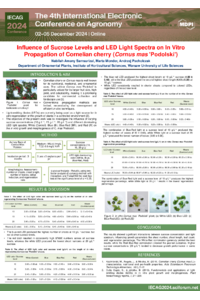
Nabilah_Samsurizal_29.11.24 (Poster).pdf
Effect of silica spraying on physiological performance of Cucumis sativus and Capsicum annum under heat stress
Understanding the role of vermicompost microbial diversity in agriculture