Event submissions
Published
This submission belongs to the session S5. Biostimulation and Biocontrol Microbial-Based Strategies of the event The 4th International Electronic Conference on Agronomy
Published date
02 Dec, 2024
Academic Editor
'%3e%3cpath%20d='M12.6657%2010.9104C12.4185%2010.325%2012.0599%209.79327%2011.6097%209.34482C11.1609%208.89508%2010.6293%208.5365%2010.0442%208.28888C10.0389%208.28626%2010.0337%208.28495%2010.0285%208.28233C10.8446%207.69279%2011.3752%206.73249%2011.3752%205.64904C11.3752%203.8542%209.92103%202.39999%208.1262%202.39999C6.33136%202.39999%204.87715%203.8542%204.87715%205.64904C4.87715%206.73249%205.40774%207.69279%206.22393%208.28364C6.21869%208.28626%206.21345%208.28757%206.20821%208.29019C5.62129%208.5378%205.09463%208.89284%204.64265%209.34613C4.1929%209.79493%203.83432%2010.3266%203.58671%2010.9117C3.34345%2011.4845%203.21226%2012.0987%203.20023%2012.7209C3.19988%2012.7349%203.20233%2012.7488%203.20744%2012.7619C3.21255%2012.7749%203.22022%2012.7867%203.22998%2012.7968C3.23975%2012.8068%203.25142%2012.8147%203.26431%2012.8202C3.2772%2012.8256%203.29105%2012.8284%203.30504%2012.8284H4.09109C4.14874%2012.8284%204.19459%2012.7825%204.1959%2012.7262C4.2221%2011.7148%204.62823%2010.7676%205.34617%2010.0497C6.08899%209.30683%207.0755%208.89808%208.1262%208.89808C9.17689%208.89808%2010.1634%209.30683%2010.9062%2010.0497C11.6242%2010.7676%2012.0303%2011.7148%2012.0565%2012.7262C12.0578%2012.7838%2012.1037%2012.8284%2012.1613%2012.8284H12.9474C12.9613%2012.8284%2012.9752%2012.8256%2012.9881%2012.8202C13.001%2012.8147%2013.0126%2012.8068%2013.0224%2012.7968C13.0322%2012.7867%2013.0398%2012.7749%2013.0449%2012.7619C13.0501%2012.7488%2013.0525%2012.7349%2013.0522%2012.7209C13.0391%2012.0947%2012.9094%2011.4855%2012.6657%2010.9104ZM8.1262%207.9024C7.52486%207.9024%206.9589%207.6679%206.53312%207.24211C6.10733%206.81633%205.87283%206.25037%205.87283%205.64904C5.87283%205.0477%206.10733%204.48174%206.53312%204.05596C6.9589%203.63018%207.52486%203.39567%208.1262%203.39567C8.72753%203.39567%209.29349%203.63018%209.71927%204.05596C10.1451%204.48174%2010.3796%205.0477%2010.3796%205.64904C10.3796%206.25037%2010.1451%206.81633%209.71927%207.24211C9.29349%207.6679%208.72753%207.9024%208.1262%207.9024Z'%20fill='%235D1EE1'/%3e%3c/g%3e%3c/svg%3e) Mariateresa Cardarelli
Mariateresa CardarelliCitation
Adrián Sapiña-Solano, Claudia Palloti, Monica Boscaiu, Francisco Collado, Oscar Vicente, Mario X Ruiz-González, Lotus creticus response to abiotic stress: role of plant density and soil microorganisms, in Proceedings of The 4th International Electronic Conference on Agronomy, 2 December–5 December 2024, MDPI: Basel, Switzerland
Share
Email
Facebook
Twitter
LinkedIn
Lotus creticus response to abiotic stress: role of plant density and soil microorganisms
'%3e%3cpath%20d='M12.6647%2010.9104C12.4176%2010.325%2012.0589%209.7933%2011.6088%209.34485C11.16%208.89511%2010.6283%208.53653%2010.0432%208.28891C10.038%208.28629%2010.0327%208.28498%2010.0275%208.28236C10.8437%207.69282%2011.3743%206.73252%2011.3743%205.64907C11.3743%203.85423%209.92005%202.40002%208.12522%202.40002C6.33038%202.40002%204.87618%203.85423%204.87618%205.64907C4.87618%206.73252%205.40677%207.69282%206.22296%208.28367C6.21772%208.28629%206.21248%208.2876%206.20724%208.29022C5.62031%208.53783%205.09365%208.89287%204.64167%209.34616C4.19192%209.79496%203.83334%2010.3266%203.58573%2010.9117C3.34247%2011.4846%203.21128%2012.0987%203.19925%2012.721C3.1989%2012.735%203.20135%2012.7489%203.20646%2012.7619C3.21157%2012.7749%203.21924%2012.7868%203.22901%2012.7968C3.23877%2012.8068%203.25045%2012.8148%203.26334%2012.8202C3.27623%2012.8256%203.29007%2012.8284%203.30406%2012.8284H4.09012C4.14776%2012.8284%204.19362%2012.7825%204.19493%2012.7262C4.22113%2011.7148%204.62726%2010.7676%205.34519%2010.0497C6.08802%209.30686%207.07452%208.89811%208.12522%208.89811C9.17592%208.89811%2010.1624%209.30686%2010.9052%2010.0497C11.6232%2010.7676%2012.0293%2011.7148%2012.0555%2012.7262C12.0568%2012.7839%2012.1027%2012.8284%2012.1603%2012.8284H12.9464C12.9604%2012.8284%2012.9742%2012.8256%2012.9871%2012.8202C13%2012.8148%2013.0117%2012.8068%2013.0214%2012.7968C13.0312%2012.7868%2013.0389%2012.7749%2013.044%2012.7619C13.0491%2012.7489%2013.0515%2012.735%2013.0512%2012.721C13.0381%2012.0947%2012.9084%2011.4856%2012.6647%2010.9104ZM8.12522%207.90243C7.52388%207.90243%206.95792%207.66793%206.53214%207.24215C6.10636%206.81636%205.87185%206.2504%205.87185%205.64907C5.87185%205.04773%206.10636%204.48177%206.53214%204.05599C6.95792%203.63021%207.52388%203.3957%208.12522%203.3957C8.72655%203.3957%209.29252%203.63021%209.7183%204.05599C10.1441%204.48177%2010.3786%205.04773%2010.3786%205.64907C10.3786%206.2504%2010.1441%206.81636%209.7183%207.24215C9.29252%207.66793%208.72655%207.90243%208.12522%207.90243Z'%20fill='%235D1EE1'/%3e%3c/g%3e%3c/svg%3e)
Adrián Sapiña-Solano 1
Claudia Palloti 1

Monica Boscaiu 2
Francisco Collado 3

Oscar Vicente 1

Mario X Ruiz-González 1
1. Institute for Conservation and Improvement of Valencian Agrodiversity (COMAV), Universitat Politècnica de València, Camino de Vera s/n, 46022 Valencia, Spain
2. Mediterranean Agroforestry Institute (IAM), Universitat Politècnica de València, Camino de Vera s/n, 46022 Valencia, Spain
3. Servici Devesa-Albufera, Vivers Municipals de El Saler, Valencia, Spain
Abstract
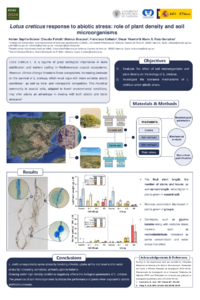
Coastal ecosystems are exposed to extreme abiotic conditions, primarily water deficit and salt stress, as well as resource availability, which exacerbates interspecific competition. In this context, soil microbial communities may provide an advantage in coping with abiotic and biotic stresses.
This study investigates the effects of both soil microbiota and plant density on L. creticus performance under salt and water stresses. We applied two saline treatments (100 mM and 200 mM NaCl), and water deficit (complete withholding of irrigation), to plants grown either individually or in groups of three, in coastal dune soil (with the natural soil microbial community) or sterile soil. When the plants started to wilt, we measured the morphometric traits, mycorrhizal structures, and biochemical markers indicative of plant responses to abiotic stress. The latter were photosynthetic pigments (chlorophylls and carotenoids), ion content in leaves and roots, osmolytes (proline, total soluble sugars, and glycine betaine), and oxidative stress markers (malondialdehyde and hydrogen peroxide). We also analysed antioxidant mechanisms, both enzymatic (catalase, glutathione reductase, superoxide dismutase and ascorbate peroxidase activities) and non-enzymatic (total phenolic compounds and flavonoids).
Plants grown in coastal soils exhibited greater biomass compared to plants grown in sterile soils (leaf dry weights were 0.52 ± 0.07 g vs 0.28 ± 0.02 g, respectively). Plants cultivated in groups showed higher levels of osmolytes than those cultivated individually (e.g., proline concentrations were 12.70 ± 2.73 µmol/g DW vs 1.60 ± 0.41 µmol/g DW, respectively). Salt and water stresses had a negative effect on morphological development (e.g., average leaves produced in 0.2 M NaCl: 34.72 ± 9.98; in water stress: 37.71 ± 12.70; in control plants: 82.39 ± 17.45) and triggered some stress markers (e.g., total soluble sugars, control plants: 18.49 ± 3.16 mg eq. G /g DW; 0.2 M NaCl: 46.90 ± 11.72 mg eq. G /g DW; water stress: 55.35 ± 19.85 mg eq. G /g DW). These findings support the positive effects of local soil microbial communities on plant performance under abiotic stresses and population density conditions.
Keywords
Abiotic stress
coastal ecosystems
Lotus creticus
plant-soil interaction
Poster
Lotus creticus response to abiotic stress. Role of plant density and soil microorganisms. Adrián Sapiña Solano.pdf
Aromadendrane Sesquiterpenoids from Santolina chamaecyparissus L. Flowers: Chemical Profiling and Antifungal Activity Against Neocosmospora Species
Comparative Yield Response of Two Alfalfa Cultivars to Biostimulant Supply