Event submissions
Published
This submission belongs to the session S5. Biostimulation and Biocontrol Microbial-Based Strategies of the event The 4th International Electronic Conference on Agronomy
Published date
02 Dec, 2024
Academic Editor
'%3e%3cpath%20d='M12.6657%2010.9104C12.4185%2010.325%2012.0599%209.79327%2011.6097%209.34482C11.1609%208.89508%2010.6293%208.5365%2010.0442%208.28888C10.0389%208.28626%2010.0337%208.28495%2010.0285%208.28233C10.8446%207.69279%2011.3752%206.73249%2011.3752%205.64904C11.3752%203.8542%209.92103%202.39999%208.1262%202.39999C6.33136%202.39999%204.87715%203.8542%204.87715%205.64904C4.87715%206.73249%205.40774%207.69279%206.22393%208.28364C6.21869%208.28626%206.21345%208.28757%206.20821%208.29019C5.62129%208.5378%205.09463%208.89284%204.64265%209.34613C4.1929%209.79493%203.83432%2010.3266%203.58671%2010.9117C3.34345%2011.4845%203.21226%2012.0987%203.20023%2012.7209C3.19988%2012.7349%203.20233%2012.7488%203.20744%2012.7619C3.21255%2012.7749%203.22022%2012.7867%203.22998%2012.7968C3.23975%2012.8068%203.25142%2012.8147%203.26431%2012.8202C3.2772%2012.8256%203.29105%2012.8284%203.30504%2012.8284H4.09109C4.14874%2012.8284%204.19459%2012.7825%204.1959%2012.7262C4.2221%2011.7148%204.62823%2010.7676%205.34617%2010.0497C6.08899%209.30683%207.0755%208.89808%208.1262%208.89808C9.17689%208.89808%2010.1634%209.30683%2010.9062%2010.0497C11.6242%2010.7676%2012.0303%2011.7148%2012.0565%2012.7262C12.0578%2012.7838%2012.1037%2012.8284%2012.1613%2012.8284H12.9474C12.9613%2012.8284%2012.9752%2012.8256%2012.9881%2012.8202C13.001%2012.8147%2013.0126%2012.8068%2013.0224%2012.7968C13.0322%2012.7867%2013.0398%2012.7749%2013.0449%2012.7619C13.0501%2012.7488%2013.0525%2012.7349%2013.0522%2012.7209C13.0391%2012.0947%2012.9094%2011.4855%2012.6657%2010.9104ZM8.1262%207.9024C7.52486%207.9024%206.9589%207.6679%206.53312%207.24211C6.10733%206.81633%205.87283%206.25037%205.87283%205.64904C5.87283%205.0477%206.10733%204.48174%206.53312%204.05596C6.9589%203.63018%207.52486%203.39567%208.1262%203.39567C8.72753%203.39567%209.29349%203.63018%209.71927%204.05596C10.1451%204.48174%2010.3796%205.0477%2010.3796%205.64904C10.3796%206.25037%2010.1451%206.81633%209.71927%207.24211C9.29349%207.6679%208.72753%207.9024%208.1262%207.9024Z'%20fill='%235D1EE1'/%3e%3c/g%3e%3c/svg%3e) Mariateresa Cardarelli
Mariateresa CardarelliCitation
Lénia Rodrigues, Inês Santana, Renato Coelho, Gabriela Murta, Pedro Oliveira, Hélia Cardoso, Catarina Campos, João Barroso, Ana Elisa Rato, The role of Opuntia ficus-indica in mitigating climate change impacts on vineyards: a physiological and molecular approach, in Proceedings of The 4th International Electronic Conference on Agronomy, 2 December–5 December 2024, MDPI: Basel, Switzerland
Share
Email
Facebook
Twitter
LinkedIn
The role of Opuntia ficus-indica in mitigating climate change impacts on vineyards: a physiological and molecular approach

Lénia Rodrigues 1
'%3e%3cpath%20d='M12.6647%2010.9104C12.4176%2010.325%2012.0589%209.7933%2011.6088%209.34485C11.16%208.89511%2010.6283%208.53653%2010.0432%208.28891C10.038%208.28629%2010.0327%208.28498%2010.0275%208.28236C10.8437%207.69282%2011.3743%206.73252%2011.3743%205.64907C11.3743%203.85423%209.92005%202.40002%208.12522%202.40002C6.33038%202.40002%204.87618%203.85423%204.87618%205.64907C4.87618%206.73252%205.40677%207.69282%206.22296%208.28367C6.21772%208.28629%206.21248%208.2876%206.20724%208.29022C5.62031%208.53783%205.09365%208.89287%204.64167%209.34616C4.19192%209.79496%203.83334%2010.3266%203.58573%2010.9117C3.34247%2011.4846%203.21128%2012.0987%203.19925%2012.721C3.1989%2012.735%203.20135%2012.7489%203.20646%2012.7619C3.21157%2012.7749%203.21924%2012.7868%203.22901%2012.7968C3.23877%2012.8068%203.25045%2012.8148%203.26334%2012.8202C3.27623%2012.8256%203.29007%2012.8284%203.30406%2012.8284H4.09012C4.14776%2012.8284%204.19362%2012.7825%204.19493%2012.7262C4.22113%2011.7148%204.62726%2010.7676%205.34519%2010.0497C6.08802%209.30686%207.07452%208.89811%208.12522%208.89811C9.17592%208.89811%2010.1624%209.30686%2010.9052%2010.0497C11.6232%2010.7676%2012.0293%2011.7148%2012.0555%2012.7262C12.0568%2012.7839%2012.1027%2012.8284%2012.1603%2012.8284H12.9464C12.9604%2012.8284%2012.9742%2012.8256%2012.9871%2012.8202C13%2012.8148%2013.0117%2012.8068%2013.0214%2012.7968C13.0312%2012.7868%2013.0389%2012.7749%2013.044%2012.7619C13.0491%2012.7489%2013.0515%2012.735%2013.0512%2012.721C13.0381%2012.0947%2012.9084%2011.4856%2012.6647%2010.9104ZM8.12522%207.90243C7.52388%207.90243%206.95792%207.66793%206.53214%207.24215C6.10636%206.81636%205.87185%206.2504%205.87185%205.64907C5.87185%205.04773%206.10636%204.48177%206.53214%204.05599C6.95792%203.63021%207.52388%203.3957%208.12522%203.3957C8.72655%203.3957%209.29252%203.63021%209.7183%204.05599C10.1441%204.48177%2010.3786%205.04773%2010.3786%205.64907C10.3786%206.2504%2010.1441%206.81636%209.7183%207.24215C9.29252%207.66793%208.72655%207.90243%208.12522%207.90243Z'%20fill='%235D1EE1'/%3e%3c/g%3e%3c/svg%3e)
Inês Santana 2
Renato Coelho 3
Gabriela Murta 3
Pedro Oliveira 3

Hélia Cardoso 3

Catarina Campos 4
João Barroso 3

Ana Elisa Rato 3
1. MED (Mediterranean Institute for Agriculture, Environment and Development) & CHANGE — Global Change and Sustainability Institute, Institute for Advanced Studies and Research, University of Évora, Pólo da Mitra, Ap. 94, 7006-554 Évora, Portugal.
2. School of Science and Technology, Colégio Luís António Verney, Rua Romão Ramalho, 59, 7000-671 Évora, Portugal.
3. MED—Mediterranean Institute for Agriculture, Environment and Development & CHANGE—Global Change and Sustainability Institute, School of Science and Technology, Department of Biology, University of Évora, Pólo da Mitra, Ap. 94, 7006-554 Évora, Portugal.
4. MED—Mediterranean Institute for Agriculture, Environment and Development & CHANGE—Global Change and Sustainability Institute, Institute for Advanced Studies and Research, Department of Biology, University of Évora, Pólo da Mitra, Ap. 94, 7006-554 Évora, P
Abstract
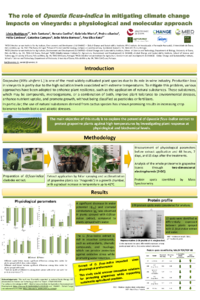
Grapevine (Vitis vinifera L.) is one of the most widely cultivated species globally, due to its role in the wine industry. Production loss in vineyards is partly due to the high radiation levels associated with extreme temperatures. To mitigate this problem, various techniques have been adopted to enhance plant resilience, such as the application of natural substances. These substances are compounds, microorganisms or an amalgamation of both that, when applied to plants, could improve tolerance under environmental stresses and increase nutrient uptake and plant growth, without being classified as pesticides or fertilizers.
The application of natural substances derived from cactus species to agricultural crops has proven effective in increasing tolerance to both biotic and abiotic stress. In this study, an aqueous extract prepared from the cladodes of prickly pear (Opuntia ficus-indica) was applied to V. vinifera cv. 'Aragonês' plants under heat stress (42◦C) to explore its potential for protecting vines from heat stress. The effect of extract application was assessed by measuring various physiological parameters (stomatal conductance, relative water content, chlorophyll content, water potential and leaf temperature) and by analysing the whole proteome profile through the two-dimensional electrophoresis technique. Parameters were evaluated in leaves collected prior to extract application, and at 2, 7 and 15 days post-application.
The analysis of physiological parameters did not indicate a positive effect of the extract application in mitigating the effects of heat stress in grapevine. The protein spots detected as differentially expressed between vines submitted to heat stress with and without application of the extract suggest a probable involvement of proteins related to abiotic stress response, revealing an effect of Opuntia ficus-indica extract on grapevines. To our knowledge, this study is the first to employ Opuntia ficus-indica extract as a natural substance to mitigate sunburn effects on grapevines, providing strategies for future field applications.
Keywords
Vitis vinifera L
Opuntia ficus-indica
physiological parameters
proteome profile
Poster
Póster_Agronomy conference2024_Lénia_2.pdf
The Jatropha curcas as a substitute for Ricinus communis in biodiesel production in the semi-arid region of Brazil
Brewing Sustainability: Transforming Coffee Waste into Powerful Crop Protectors—A Circular Economy Approach