Event submissions
Published
This submission belongs to the session S5. Biostimulation and Biocontrol Microbial-Based Strategies of the event The 4th International Electronic Conference on Agronomy
Published date
02 Dec, 2024
Academic Editor
'%3e%3cpath%20d='M12.6657%2010.9104C12.4185%2010.325%2012.0599%209.79327%2011.6097%209.34482C11.1609%208.89508%2010.6293%208.5365%2010.0442%208.28888C10.0389%208.28626%2010.0337%208.28495%2010.0285%208.28233C10.8446%207.69279%2011.3752%206.73249%2011.3752%205.64904C11.3752%203.8542%209.92103%202.39999%208.1262%202.39999C6.33136%202.39999%204.87715%203.8542%204.87715%205.64904C4.87715%206.73249%205.40774%207.69279%206.22393%208.28364C6.21869%208.28626%206.21345%208.28757%206.20821%208.29019C5.62129%208.5378%205.09463%208.89284%204.64265%209.34613C4.1929%209.79493%203.83432%2010.3266%203.58671%2010.9117C3.34345%2011.4845%203.21226%2012.0987%203.20023%2012.7209C3.19988%2012.7349%203.20233%2012.7488%203.20744%2012.7619C3.21255%2012.7749%203.22022%2012.7867%203.22998%2012.7968C3.23975%2012.8068%203.25142%2012.8147%203.26431%2012.8202C3.2772%2012.8256%203.29105%2012.8284%203.30504%2012.8284H4.09109C4.14874%2012.8284%204.19459%2012.7825%204.1959%2012.7262C4.2221%2011.7148%204.62823%2010.7676%205.34617%2010.0497C6.08899%209.30683%207.0755%208.89808%208.1262%208.89808C9.17689%208.89808%2010.1634%209.30683%2010.9062%2010.0497C11.6242%2010.7676%2012.0303%2011.7148%2012.0565%2012.7262C12.0578%2012.7838%2012.1037%2012.8284%2012.1613%2012.8284H12.9474C12.9613%2012.8284%2012.9752%2012.8256%2012.9881%2012.8202C13.001%2012.8147%2013.0126%2012.8068%2013.0224%2012.7968C13.0322%2012.7867%2013.0398%2012.7749%2013.0449%2012.7619C13.0501%2012.7488%2013.0525%2012.7349%2013.0522%2012.7209C13.0391%2012.0947%2012.9094%2011.4855%2012.6657%2010.9104ZM8.1262%207.9024C7.52486%207.9024%206.9589%207.6679%206.53312%207.24211C6.10733%206.81633%205.87283%206.25037%205.87283%205.64904C5.87283%205.0477%206.10733%204.48174%206.53312%204.05596C6.9589%203.63018%207.52486%203.39567%208.1262%203.39567C8.72753%203.39567%209.29349%203.63018%209.71927%204.05596C10.1451%204.48174%2010.3796%205.0477%2010.3796%205.64904C10.3796%206.25037%2010.1451%206.81633%209.71927%207.24211C9.29349%207.6679%208.72753%207.9024%208.1262%207.9024Z'%20fill='%235D1EE1'/%3e%3c/g%3e%3c/svg%3e) Mariateresa Cardarelli
Mariateresa CardarelliCitation
Eva Sánchez Hernández, Jorge Clérigo De Santiago, Vicente Gonzalez, Zacarías Clérigo Pérez, Jesús Martín Gil, Pablo Martín Ramos, Brewing Sustainability: Transforming Coffee Waste into Powerful Crop Protectors—A Circular Economy Approach, in Proceedings of The 4th International Electronic Conference on Agronomy, 2 December–5 December 2024, MDPI: Basel, Switzerland
Share
Email
Facebook
Twitter
LinkedIn
Brewing Sustainability: Transforming Coffee Waste into Powerful Crop Protectors—A Circular Economy Approach

Eva Sánchez Hernández 1
'%3e%3cpath%20d='M12.6647%2010.9104C12.4176%2010.325%2012.0589%209.7933%2011.6088%209.34485C11.16%208.89511%2010.6283%208.53653%2010.0432%208.28891C10.038%208.28629%2010.0327%208.28498%2010.0275%208.28236C10.8437%207.69282%2011.3743%206.73252%2011.3743%205.64907C11.3743%203.85423%209.92005%202.40002%208.12522%202.40002C6.33038%202.40002%204.87618%203.85423%204.87618%205.64907C4.87618%206.73252%205.40677%207.69282%206.22296%208.28367C6.21772%208.28629%206.21248%208.2876%206.20724%208.29022C5.62031%208.53783%205.09365%208.89287%204.64167%209.34616C4.19192%209.79496%203.83334%2010.3266%203.58573%2010.9117C3.34247%2011.4846%203.21128%2012.0987%203.19925%2012.721C3.1989%2012.735%203.20135%2012.7489%203.20646%2012.7619C3.21157%2012.7749%203.21924%2012.7868%203.22901%2012.7968C3.23877%2012.8068%203.25045%2012.8148%203.26334%2012.8202C3.27623%2012.8256%203.29007%2012.8284%203.30406%2012.8284H4.09012C4.14776%2012.8284%204.19362%2012.7825%204.19493%2012.7262C4.22113%2011.7148%204.62726%2010.7676%205.34519%2010.0497C6.08802%209.30686%207.07452%208.89811%208.12522%208.89811C9.17592%208.89811%2010.1624%209.30686%2010.9052%2010.0497C11.6232%2010.7676%2012.0293%2011.7148%2012.0555%2012.7262C12.0568%2012.7839%2012.1027%2012.8284%2012.1603%2012.8284H12.9464C12.9604%2012.8284%2012.9742%2012.8256%2012.9871%2012.8202C13%2012.8148%2013.0117%2012.8068%2013.0214%2012.7968C13.0312%2012.7868%2013.0389%2012.7749%2013.044%2012.7619C13.0491%2012.7489%2013.0515%2012.735%2013.0512%2012.721C13.0381%2012.0947%2012.9084%2011.4856%2012.6647%2010.9104ZM8.12522%207.90243C7.52388%207.90243%206.95792%207.66793%206.53214%207.24215C6.10636%206.81636%205.87185%206.2504%205.87185%205.64907C5.87185%205.04773%206.10636%204.48177%206.53214%204.05599C6.95792%203.63021%207.52388%203.3957%208.12522%203.3957C8.72655%203.3957%209.29252%203.63021%209.7183%204.05599C10.1441%204.48177%2010.3786%205.04773%2010.3786%205.64907C10.3786%206.2504%2010.1441%206.81636%209.7183%207.24215C9.29252%207.66793%208.72655%207.90243%208.12522%207.90243Z'%20fill='%235D1EE1'/%3e%3c/g%3e%3c/svg%3e)
Jorge Clérigo De Santiago 1
Vicente Gonzalez 2
Zacarías Clérigo Pérez 3

Jesús Martín Gil 1

Pablo Martín Ramos 1
1. Department of Agricultural and Forestry Engineering, ETSIIAA, University of Valladolid, Avenida de Madrid 44, 34004 Palencia, Spain
2. Department of Agricultural, Forestry, and Environmental Systems, Center for Agri-Food Research and Technology of Aragón, Aragón Agri-Food Institute—IA2 (CITA-University of Zaragoza), Avda. Montañana 930, 50059 Zaragoza, Spain
3. Department of Materials Science and Metallurgical Engineering, Graphic Engineering, Cartographic Engineering, Geodesy and Photogrammetry, Mechanical Engineering, and Manufacturing Process Engineering, ETSIIAA, University of Valladolid, Avenida de Madrid 4
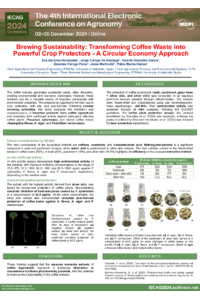
Abstract
The coffee industry generates substantial waste, which is often discarded, creating environmental and economic challenges. However, these residues can be a valuable source of bioactive compounds with antimicrobial properties, presenting an opportunity for their use in crop protection, both pre- and post-harvest. Following circular economy principles, this study proposes the extraction and characterization of bioactive products from coffee byproducts and evaluates their antifungal activity against pathogens affecting coffee plants and/or stored coffee beans. The proposed method for recovering coffee residues (extraction in aqueous ammonia medium followed by freeze-drying) has proven cost-effective for caffeine production and competitive with current methods. In vitro activity assays demonstrated the high antimicrobial activity of the extracts against Fusarium xylarioides, Aspergillus flavus, A. niger, and Penicillium verrucosum. The minimum inhibitory concentrations ranged from 15.6 to 375, 31.2 to 1000, 62.5 to 1000, and 62.5 to 1500 μg/mL, respectively, depending on the residue used. The extract with the highest activity, derived from silver skin, was tested for the pre-harvest protection of coffee plants and the post-harvest protection of coffee beans. At a concentration of 62.5 μg/mL, it demonstrated complete control of tracheomycosis caused by F. xylarioides in coffee plants and full protection of coffee beans against A. flavus, A. niger, and P. verrucosum. These findings suggest that aqueous ammonia extracts of coffee byproducts represent a promising alternative to conventional synthetic phytosanitary products, with the potential to improve the sustainability of the coffee industry.
Keywords
antifungal activity
biorationals
gas chromatography/mass spectrometry
circular economy
infrared spectroscopy
ammonia extract
silver skin
postharvest protection
Poster
sciforum-106944.pdf
The role of Opuntia ficus-indica in mitigating climate change impacts on vineyards: a physiological and molecular approach
Evaluation of Coco Peat-Based, Plant Growth-Promoting Rhizobacteria Formulation for Drought Stress Management and Sustainable Agriculture