Event submissions
Published
This submission belongs to the session S5. Biostimulation and Biocontrol Microbial-Based Strategies of the event The 4th International Electronic Conference on Agronomy
Published date
02 Dec, 2024
Academic Editor
'%3e%3cpath%20d='M12.6657%2010.9104C12.4185%2010.325%2012.0599%209.79327%2011.6097%209.34482C11.1609%208.89508%2010.6293%208.5365%2010.0442%208.28888C10.0389%208.28626%2010.0337%208.28495%2010.0285%208.28233C10.8446%207.69279%2011.3752%206.73249%2011.3752%205.64904C11.3752%203.8542%209.92103%202.39999%208.1262%202.39999C6.33136%202.39999%204.87715%203.8542%204.87715%205.64904C4.87715%206.73249%205.40774%207.69279%206.22393%208.28364C6.21869%208.28626%206.21345%208.28757%206.20821%208.29019C5.62129%208.5378%205.09463%208.89284%204.64265%209.34613C4.1929%209.79493%203.83432%2010.3266%203.58671%2010.9117C3.34345%2011.4845%203.21226%2012.0987%203.20023%2012.7209C3.19988%2012.7349%203.20233%2012.7488%203.20744%2012.7619C3.21255%2012.7749%203.22022%2012.7867%203.22998%2012.7968C3.23975%2012.8068%203.25142%2012.8147%203.26431%2012.8202C3.2772%2012.8256%203.29105%2012.8284%203.30504%2012.8284H4.09109C4.14874%2012.8284%204.19459%2012.7825%204.1959%2012.7262C4.2221%2011.7148%204.62823%2010.7676%205.34617%2010.0497C6.08899%209.30683%207.0755%208.89808%208.1262%208.89808C9.17689%208.89808%2010.1634%209.30683%2010.9062%2010.0497C11.6242%2010.7676%2012.0303%2011.7148%2012.0565%2012.7262C12.0578%2012.7838%2012.1037%2012.8284%2012.1613%2012.8284H12.9474C12.9613%2012.8284%2012.9752%2012.8256%2012.9881%2012.8202C13.001%2012.8147%2013.0126%2012.8068%2013.0224%2012.7968C13.0322%2012.7867%2013.0398%2012.7749%2013.0449%2012.7619C13.0501%2012.7488%2013.0525%2012.7349%2013.0522%2012.7209C13.0391%2012.0947%2012.9094%2011.4855%2012.6657%2010.9104ZM8.1262%207.9024C7.52486%207.9024%206.9589%207.6679%206.53312%207.24211C6.10733%206.81633%205.87283%206.25037%205.87283%205.64904C5.87283%205.0477%206.10733%204.48174%206.53312%204.05596C6.9589%203.63018%207.52486%203.39567%208.1262%203.39567C8.72753%203.39567%209.29349%203.63018%209.71927%204.05596C10.1451%204.48174%2010.3796%205.0477%2010.3796%205.64904C10.3796%206.25037%2010.1451%206.81633%209.71927%207.24211C9.29349%207.6679%208.72753%207.9024%208.1262%207.9024Z'%20fill='%235D1EE1'/%3e%3c/g%3e%3c/svg%3e) Mariateresa Cardarelli
Mariateresa CardarelliCitation
Riccardo Fontana, Eva Sanchez Hernandez, Peggy Marconi, Mariaconcetta Sicurella, Jesus Martìn Gil, Pablo Martin Ramos, From Ornamental to Defender: Camellia japonica Flower Extracts Control Erwinia amylovora in Pear Orchards, in Proceedings of The 4th International Electronic Conference on Agronomy, 2 December–5 December 2024, MDPI: Basel, Switzerland
Share
Email
Facebook
Twitter
LinkedIn
From Ornamental to Defender: Camellia japonica Flower Extracts Control Erwinia amylovora in Pear Orchards

Riccardo Fontana 1
'%3e%3cpath%20d='M12.6647%2010.9104C12.4176%2010.325%2012.0589%209.7933%2011.6088%209.34485C11.16%208.89511%2010.6283%208.53653%2010.0432%208.28891C10.038%208.28629%2010.0327%208.28498%2010.0275%208.28236C10.8437%207.69282%2011.3743%206.73252%2011.3743%205.64907C11.3743%203.85423%209.92005%202.40002%208.12522%202.40002C6.33038%202.40002%204.87618%203.85423%204.87618%205.64907C4.87618%206.73252%205.40677%207.69282%206.22296%208.28367C6.21772%208.28629%206.21248%208.2876%206.20724%208.29022C5.62031%208.53783%205.09365%208.89287%204.64167%209.34616C4.19192%209.79496%203.83334%2010.3266%203.58573%2010.9117C3.34247%2011.4846%203.21128%2012.0987%203.19925%2012.721C3.1989%2012.735%203.20135%2012.7489%203.20646%2012.7619C3.21157%2012.7749%203.21924%2012.7868%203.22901%2012.7968C3.23877%2012.8068%203.25045%2012.8148%203.26334%2012.8202C3.27623%2012.8256%203.29007%2012.8284%203.30406%2012.8284H4.09012C4.14776%2012.8284%204.19362%2012.7825%204.19493%2012.7262C4.22113%2011.7148%204.62726%2010.7676%205.34519%2010.0497C6.08802%209.30686%207.07452%208.89811%208.12522%208.89811C9.17592%208.89811%2010.1624%209.30686%2010.9052%2010.0497C11.6232%2010.7676%2012.0293%2011.7148%2012.0555%2012.7262C12.0568%2012.7839%2012.1027%2012.8284%2012.1603%2012.8284H12.9464C12.9604%2012.8284%2012.9742%2012.8256%2012.9871%2012.8202C13%2012.8148%2013.0117%2012.8068%2013.0214%2012.7968C13.0312%2012.7868%2013.0389%2012.7749%2013.044%2012.7619C13.0491%2012.7489%2013.0515%2012.735%2013.0512%2012.721C13.0381%2012.0947%2012.9084%2011.4856%2012.6647%2010.9104ZM8.12522%207.90243C7.52388%207.90243%206.95792%207.66793%206.53214%207.24215C6.10636%206.81636%205.87185%206.2504%205.87185%205.64907C5.87185%205.04773%206.10636%204.48177%206.53214%204.05599C6.95792%203.63021%207.52388%203.3957%208.12522%203.3957C8.72655%203.3957%209.29252%203.63021%209.7183%204.05599C10.1441%204.48177%2010.3786%205.04773%2010.3786%205.64907C10.3786%206.2504%2010.1441%206.81636%209.7183%207.24215C9.29252%207.66793%208.72655%207.90243%208.12522%207.90243Z'%20fill='%235D1EE1'/%3e%3c/g%3e%3c/svg%3e)
Eva Sanchez Hernandez 2

Peggy Marconi 3,4
Mariaconcetta Sicurella 5

Jesus Martìn Gil 2

Pablo Martin Ramos 2
1. University of Ferrara - Department of Chemical, Pharmaceutical and Agricultural Sciences
2. Department of Agricultural and Forestry Engineering, ETSIIAA, Universidad de Valladolid,
34004 Palencia, Spain
3. Department of Chemical, Pharmaceutical and Agricultural Sciences, University of Ferrara, 44121 Ferrara, Italy
4. Technopole of Ferrara, LTTA Laboratory for Advanced Therapies, Ferrara 44121, Italy
5. Department of Environmental and Prevention Sciences, University of Ferrara, 44121 Ferrara, Italy
Abstract
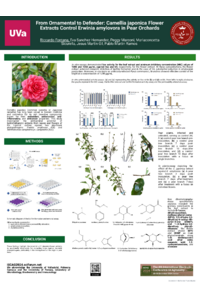
Camellia japonica (common camellia or Japanese camellia) has long been valued in Eastern medicine and cosmetics for its rich bioactive compounds, known for their antioxidant, antimicrobial, anti-inflammatory, and anticancer properties. This study investigated the antibacterial potential of hydromethanolic extracts from leaves and flowers of the 'Lipstick' cultivar against two significant phytopathogens: Erwinia amylovora (EA) and Xanthomonas campestris pv. campestris (Xcc). Gas chromatography-mass spectrometry analysis revealed the primary constituents in the leaf extract to include D-fucose, dihydroxyacetone, methoxy-phenyl-oxime (MPO), 2,3-dihydro-3,5-dihydroxy-6-methyl-4H-pyran-4-one (DDMP), and 1-(4-hydroxy-3,5-dimethoxy phenyl)-ethanone. The flower extract shared MPO and DDMP as main phytochemicals, along with diethoxyacetic acid ethyl ester, nonanoic acid, 1,2-cyclopentanedione, and eicosane. In vitro assays demonstrated low activity for the leaf extract and minimum inhibitory concentration (MIC) values of 1000 and 1250 μg/mL against Xcc and EA, respectively, for the flower extract. At these concentrations, the flower extract achieved complete inhibition of biofilm formation and, in the case of EA, substantial reduction in amylovoran production. Moreover, in vivo tests on artificially-infected Pyrus communis L. branches showed effective control of fire blight at a concentration of 1250 μg/mL. These findings highlight the potential of C. japonica flower extracts as eco-friendly biorationals for protecting crops against bacterial phytopathogens, particularly in the management of fire blight in pear trees.
Keywords
amylovoran inhibition
antibacterial
biorational
bacterial canker
black rot disease
fire blight
Japanese camellia
pear tree protection
Poster
Poster camellia japonica (1).pdf
Estimating Leaf Area Index of Wheat using UAV Hyperspectral Remote Sensing and Machine Learning
Drone-based Multispectral Imaging for Precision Monitoring of Crop Growth Variables