Event submissions
Published
This submission belongs to the session S5. Biostimulation and Biocontrol Microbial-Based Strategies of the event The 4th International Electronic Conference on Agronomy
Published date
02 Dec, 2024
Academic Editor
'%3e%3cpath%20d='M12.6657%2010.9104C12.4185%2010.325%2012.0599%209.79327%2011.6097%209.34482C11.1609%208.89508%2010.6293%208.5365%2010.0442%208.28888C10.0389%208.28626%2010.0337%208.28495%2010.0285%208.28233C10.8446%207.69279%2011.3752%206.73249%2011.3752%205.64904C11.3752%203.8542%209.92103%202.39999%208.1262%202.39999C6.33136%202.39999%204.87715%203.8542%204.87715%205.64904C4.87715%206.73249%205.40774%207.69279%206.22393%208.28364C6.21869%208.28626%206.21345%208.28757%206.20821%208.29019C5.62129%208.5378%205.09463%208.89284%204.64265%209.34613C4.1929%209.79493%203.83432%2010.3266%203.58671%2010.9117C3.34345%2011.4845%203.21226%2012.0987%203.20023%2012.7209C3.19988%2012.7349%203.20233%2012.7488%203.20744%2012.7619C3.21255%2012.7749%203.22022%2012.7867%203.22998%2012.7968C3.23975%2012.8068%203.25142%2012.8147%203.26431%2012.8202C3.2772%2012.8256%203.29105%2012.8284%203.30504%2012.8284H4.09109C4.14874%2012.8284%204.19459%2012.7825%204.1959%2012.7262C4.2221%2011.7148%204.62823%2010.7676%205.34617%2010.0497C6.08899%209.30683%207.0755%208.89808%208.1262%208.89808C9.17689%208.89808%2010.1634%209.30683%2010.9062%2010.0497C11.6242%2010.7676%2012.0303%2011.7148%2012.0565%2012.7262C12.0578%2012.7838%2012.1037%2012.8284%2012.1613%2012.8284H12.9474C12.9613%2012.8284%2012.9752%2012.8256%2012.9881%2012.8202C13.001%2012.8147%2013.0126%2012.8068%2013.0224%2012.7968C13.0322%2012.7867%2013.0398%2012.7749%2013.0449%2012.7619C13.0501%2012.7488%2013.0525%2012.7349%2013.0522%2012.7209C13.0391%2012.0947%2012.9094%2011.4855%2012.6657%2010.9104ZM8.1262%207.9024C7.52486%207.9024%206.9589%207.6679%206.53312%207.24211C6.10733%206.81633%205.87283%206.25037%205.87283%205.64904C5.87283%205.0477%206.10733%204.48174%206.53312%204.05596C6.9589%203.63018%207.52486%203.39567%208.1262%203.39567C8.72753%203.39567%209.29349%203.63018%209.71927%204.05596C10.1451%204.48174%2010.3796%205.0477%2010.3796%205.64904C10.3796%206.25037%2010.1451%206.81633%209.71927%207.24211C9.29349%207.6679%208.72753%207.9024%208.1262%207.9024Z'%20fill='%235D1EE1'/%3e%3c/g%3e%3c/svg%3e) J.D. Flores-Félix
J.D. Flores-FélixCitation
Shireen Khatri, DP Sharma, Rahul Sharma, Plant metabolite role in developing abiotic stress resilience in plants: Evaluating the Effects of Melatonin and Myoinositol on the photosynthetic efficiency of apple rootstocks in the western Himalayan region., in Proceedings of The 4th International Electronic Conference on Agronomy, 2 December–5 December 2024, MDPI: Basel, Switzerland
Share
Email
Facebook
Twitter
LinkedIn
Plant metabolite role in developing abiotic stress resilience in plants: Evaluating the Effects of Melatonin and Myoinositol on the photosynthetic efficiency of apple rootstocks in the western Himalayan region.
'%3e%3cpath%20d='M12.6647%2010.9104C12.4176%2010.325%2012.0589%209.7933%2011.6088%209.34485C11.16%208.89511%2010.6283%208.53653%2010.0432%208.28891C10.038%208.28629%2010.0327%208.28498%2010.0275%208.28236C10.8437%207.69282%2011.3743%206.73252%2011.3743%205.64907C11.3743%203.85423%209.92005%202.40002%208.12522%202.40002C6.33038%202.40002%204.87618%203.85423%204.87618%205.64907C4.87618%206.73252%205.40677%207.69282%206.22296%208.28367C6.21772%208.28629%206.21248%208.2876%206.20724%208.29022C5.62031%208.53783%205.09365%208.89287%204.64167%209.34616C4.19192%209.79496%203.83334%2010.3266%203.58573%2010.9117C3.34247%2011.4846%203.21128%2012.0987%203.19925%2012.721C3.1989%2012.735%203.20135%2012.7489%203.20646%2012.7619C3.21157%2012.7749%203.21924%2012.7868%203.22901%2012.7968C3.23877%2012.8068%203.25045%2012.8148%203.26334%2012.8202C3.27623%2012.8256%203.29007%2012.8284%203.30406%2012.8284H4.09012C4.14776%2012.8284%204.19362%2012.7825%204.19493%2012.7262C4.22113%2011.7148%204.62726%2010.7676%205.34519%2010.0497C6.08802%209.30686%207.07452%208.89811%208.12522%208.89811C9.17592%208.89811%2010.1624%209.30686%2010.9052%2010.0497C11.6232%2010.7676%2012.0293%2011.7148%2012.0555%2012.7262C12.0568%2012.7839%2012.1027%2012.8284%2012.1603%2012.8284H12.9464C12.9604%2012.8284%2012.9742%2012.8256%2012.9871%2012.8202C13%2012.8148%2013.0117%2012.8068%2013.0214%2012.7968C13.0312%2012.7868%2013.0389%2012.7749%2013.044%2012.7619C13.0491%2012.7489%2013.0515%2012.735%2013.0512%2012.721C13.0381%2012.0947%2012.9084%2011.4856%2012.6647%2010.9104ZM8.12522%207.90243C7.52388%207.90243%206.95792%207.66793%206.53214%207.24215C6.10636%206.81636%205.87185%206.2504%205.87185%205.64907C5.87185%205.04773%206.10636%204.48177%206.53214%204.05599C6.95792%203.63021%207.52388%203.3957%208.12522%203.3957C8.72655%203.3957%209.29252%203.63021%209.7183%204.05599C10.1441%204.48177%2010.3786%205.04773%2010.3786%205.64907C10.3786%206.2504%2010.1441%206.81636%209.7183%207.24215C9.29252%207.66793%208.72655%207.90243%208.12522%207.90243Z'%20fill='%235D1EE1'/%3e%3c/g%3e%3c/svg%3e)
Shireen Khatri 1
DP Sharma 1
Rahul Sharma 1
1. Department-Fruit science, College of Horticulture, Dr Yashwant Singh Parmar university of horticulture and forestry, Solan Nauni, 173230, India
Abstract
Abiotic stress, primarily drought, is a major threat to crop production and food security. Plant metabolites like melatonin and myoinositol enhance stress resistance, improve growth, and promote sustainability without harming biodiversity or human health. Apple farming is crucial to the Himalayan region's economy in India. Despite using High-Density Planting (HDP) with dwarf rootstocks for better yields, these rootstocks are still sensitive to drought, impacting fruit quality and production. To address these challenges, the experiment applied exogenous melatonin (100 µM) and myoinositol (20 µM, 50 µM, 100 µM, 150 µM, 200 µM) to determine optimal doses for biochemical, morphological, and molecular studies. Five apple rootstocks were grown under polycarbonate conditions at 100% and 50% field capacities. Five treatment combinations were tested at 50% F.C., with one control at 100% F.C. Data were collected on the 5th, 10th, and 15th days of drought. The best treatment was melatonin (100 µM) + myoinositol (150 µM) (T4) at 50% F.C., showing the highest net photosynthetic rate (Pn), transpiration rate (Tr), stomatal conductance (Gs) and intercellular CO2 (Ci) at the 5th , 10th and 15th day of drought for rootstock M111 (15.55, 14.44, 12.65 Pn), (0.21, 0.18 ,0.16 Gs), (267, 278, 287 Ci), M106 (12.81 ,11.96 ,10.86 Pn), (0.17, 0.15, 0.14 Gs), (280, 298, 310 Ci), M9 (10.45 ,9.87 ,8.56 Pn) , (0.17, 0.15 ,0.13 Gs), (327, 332, 339 Ci), Bud 118 (16.78, 14.15, 13.98 Pn), (.26, .24, .23 Gs), (279, 282, 287 Ci), and M116 (13.23, 12.55, 11.53 Pn) , (.21, .19, .18 Gs), (299 ,308, 318 Ci ). Hence, the best treatment combination effectively counteracts drought-related photosynthesis inhibition.
Keywords
Melatonin
Myo-inositol
Plant stress
Phyto-stimulants
Apple
Rootstocks and Quality production.
Poster
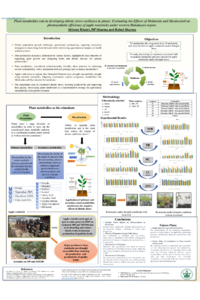
Shireen final poster Final SCI FORUMS.pdf
Drone-based Multispectral Imaging for Precision Monitoring of Crop Growth Variables
Nanoengineered Plant Protection: Cercospora beticola Control in Sugar Beet with Encapsulated Phytoextracts