Event submissions
Published
This submission belongs to the session S5. Biostimulation and Biocontrol Microbial-Based Strategies of the event The 4th International Electronic Conference on Agronomy
Published date
02 Dec, 2024
Academic Editor
'%3e%3cpath%20d='M12.6657%2010.9104C12.4185%2010.325%2012.0599%209.79327%2011.6097%209.34482C11.1609%208.89508%2010.6293%208.5365%2010.0442%208.28888C10.0389%208.28626%2010.0337%208.28495%2010.0285%208.28233C10.8446%207.69279%2011.3752%206.73249%2011.3752%205.64904C11.3752%203.8542%209.92103%202.39999%208.1262%202.39999C6.33136%202.39999%204.87715%203.8542%204.87715%205.64904C4.87715%206.73249%205.40774%207.69279%206.22393%208.28364C6.21869%208.28626%206.21345%208.28757%206.20821%208.29019C5.62129%208.5378%205.09463%208.89284%204.64265%209.34613C4.1929%209.79493%203.83432%2010.3266%203.58671%2010.9117C3.34345%2011.4845%203.21226%2012.0987%203.20023%2012.7209C3.19988%2012.7349%203.20233%2012.7488%203.20744%2012.7619C3.21255%2012.7749%203.22022%2012.7867%203.22998%2012.7968C3.23975%2012.8068%203.25142%2012.8147%203.26431%2012.8202C3.2772%2012.8256%203.29105%2012.8284%203.30504%2012.8284H4.09109C4.14874%2012.8284%204.19459%2012.7825%204.1959%2012.7262C4.2221%2011.7148%204.62823%2010.7676%205.34617%2010.0497C6.08899%209.30683%207.0755%208.89808%208.1262%208.89808C9.17689%208.89808%2010.1634%209.30683%2010.9062%2010.0497C11.6242%2010.7676%2012.0303%2011.7148%2012.0565%2012.7262C12.0578%2012.7838%2012.1037%2012.8284%2012.1613%2012.8284H12.9474C12.9613%2012.8284%2012.9752%2012.8256%2012.9881%2012.8202C13.001%2012.8147%2013.0126%2012.8068%2013.0224%2012.7968C13.0322%2012.7867%2013.0398%2012.7749%2013.0449%2012.7619C13.0501%2012.7488%2013.0525%2012.7349%2013.0522%2012.7209C13.0391%2012.0947%2012.9094%2011.4855%2012.6657%2010.9104ZM8.1262%207.9024C7.52486%207.9024%206.9589%207.6679%206.53312%207.24211C6.10733%206.81633%205.87283%206.25037%205.87283%205.64904C5.87283%205.0477%206.10733%204.48174%206.53312%204.05596C6.9589%203.63018%207.52486%203.39567%208.1262%203.39567C8.72753%203.39567%209.29349%203.63018%209.71927%204.05596C10.1451%204.48174%2010.3796%205.0477%2010.3796%205.64904C10.3796%206.25037%2010.1451%206.81633%209.71927%207.24211C9.29349%207.6679%208.72753%207.9024%208.1262%207.9024Z'%20fill='%235D1EE1'/%3e%3c/g%3e%3c/svg%3e) J.D. Flores-Félix
J.D. Flores-FélixCitation
Eva Sánchez-Hernández, Rubén Celada-Caminero, Alberto Santiago-Aliste, Jesús Martín-Gil, José Luis Marcos-Robles, Vicente González-García, Pablo Martín-Ramos, Nanoengineered Plant Protection: Cercospora beticola Control in Sugar Beet with Encapsulated Phytoextracts, in Proceedings of The 4th International Electronic Conference on Agronomy, 2 December–5 December 2024, MDPI: Basel, Switzerland
Share
Email
Facebook
Twitter
LinkedIn
Nanoengineered Plant Protection: Cercospora beticola Control in Sugar Beet with Encapsulated Phytoextracts

Eva Sánchez-Hernández 1
'%3e%3cpath%20d='M12.6647%2010.9104C12.4176%2010.325%2012.0589%209.7933%2011.6088%209.34485C11.16%208.89511%2010.6283%208.53653%2010.0432%208.28891C10.038%208.28629%2010.0327%208.28498%2010.0275%208.28236C10.8437%207.69282%2011.3743%206.73252%2011.3743%205.64907C11.3743%203.85423%209.92005%202.40002%208.12522%202.40002C6.33038%202.40002%204.87618%203.85423%204.87618%205.64907C4.87618%206.73252%205.40677%207.69282%206.22296%208.28367C6.21772%208.28629%206.21248%208.2876%206.20724%208.29022C5.62031%208.53783%205.09365%208.89287%204.64167%209.34616C4.19192%209.79496%203.83334%2010.3266%203.58573%2010.9117C3.34247%2011.4846%203.21128%2012.0987%203.19925%2012.721C3.1989%2012.735%203.20135%2012.7489%203.20646%2012.7619C3.21157%2012.7749%203.21924%2012.7868%203.22901%2012.7968C3.23877%2012.8068%203.25045%2012.8148%203.26334%2012.8202C3.27623%2012.8256%203.29007%2012.8284%203.30406%2012.8284H4.09012C4.14776%2012.8284%204.19362%2012.7825%204.19493%2012.7262C4.22113%2011.7148%204.62726%2010.7676%205.34519%2010.0497C6.08802%209.30686%207.07452%208.89811%208.12522%208.89811C9.17592%208.89811%2010.1624%209.30686%2010.9052%2010.0497C11.6232%2010.7676%2012.0293%2011.7148%2012.0555%2012.7262C12.0568%2012.7839%2012.1027%2012.8284%2012.1603%2012.8284H12.9464C12.9604%2012.8284%2012.9742%2012.8256%2012.9871%2012.8202C13%2012.8148%2013.0117%2012.8068%2013.0214%2012.7968C13.0312%2012.7868%2013.0389%2012.7749%2013.044%2012.7619C13.0491%2012.7489%2013.0515%2012.735%2013.0512%2012.721C13.0381%2012.0947%2012.9084%2011.4856%2012.6647%2010.9104ZM8.12522%207.90243C7.52388%207.90243%206.95792%207.66793%206.53214%207.24215C6.10636%206.81636%205.87185%206.2504%205.87185%205.64907C5.87185%205.04773%206.10636%204.48177%206.53214%204.05599C6.95792%203.63021%207.52388%203.3957%208.12522%203.3957C8.72655%203.3957%209.29252%203.63021%209.7183%204.05599C10.1441%204.48177%2010.3786%205.04773%2010.3786%205.64907C10.3786%206.2504%2010.1441%206.81636%209.7183%207.24215C9.29252%207.66793%208.72655%207.90243%208.12522%207.90243Z'%20fill='%235D1EE1'/%3e%3c/g%3e%3c/svg%3e)
Rubén Celada-Caminero 1,2
Alberto Santiago-Aliste 3

Jesús Martín-Gil 1
José Luis Marcos-Robles 4
Vicente González-García 5

Pablo Martín-Ramos 1
1. Department of Agricultural and Forestry Engineering, ETSIIAA, University of Valladolid, Avenida de Madrid 44, 34004 Palencia, Spain
2. AIMCRA, Association for the Improvement of Sugar Beet Cultivation, Calle de Villabañez 201, 47017 Valladolid, Spain
3. Department of Construction and Agronomy, E. Politécnica Superior de Zamora, University of Salamanca, Av. de Requejo 33, 49029 Zamora, Spain
4. Department of Materials Science and Metallurgical Engineering, Graphic Engineering, Cartographic Engineering, Geodesy and Photogrammetry, Mechanical Engineering, and Manufacturing Process Engineering, ETSIIAA, University of Valladolid, Avenida de Madrid 4
5. Department of Agricultural, Forestry, and Environmental Systems, Center for Agri-Food Research and Technology of Aragón, Aragón Agri-Food Institute—IA2 (CITA-University of Zaragoza), Avda. Montañana 930, 50059 Zaragoza, Spain
Abstract
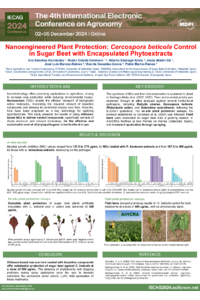
Nanotechnology offers promising applications in agriculture, aiming to increase crop production while reducing environmental impact. Nanocarriers (NCs) enable the efficient transport of biologically active molecules, minimizing the required amount of bioactive compounds and allowing for controlled release over time. Recently, NCs have been proposed as a key technology for applying agrochemicals via unmanned aerial vehicles (UAVs). This study presents the results of using chitosan-based NCs to deliver and release natural compounds in a controlled manner, specifically extracts of Rubia tinctorum and Uncaria tomentosa, for the effective and sustainable control of phytopathogens in horticultural crops. The efficacy of NC-based treatments was demonstrated in vitro and ex situ against horticultural pathogens Botrytis cinerea, Cercospora beticola, Rhizoctonia solani, and Sclerotinia sclerotiorum. Mycelial growth inhibition values ranged from 187.5 to 375 µg/mL for NCs loaded with R. tinctorum extracts and 187.5‒500 µg/mL for those with U. tomentosa extracts. Complete plant protection of artificially inoculated sugar beet and carrot plants was achieved at doses ranging from 187.5 to 500 µg/mL, depending on the pathogen. Field tests conducted on sugar beet during the 2024 growing season yielded promising results for Cercospora beticola control. The absence of phytotoxicity and clogging problems during spray application represents a significant step towards optimizing the UAV field application of these treatments.
Keywords
horticultural crops
nanotechnology
natural products
sugar beet
carrot
Poster
sciforum-106937.pdf
Plant metabolite role in developing abiotic stress resilience in plants: Evaluating the Effects of Melatonin and Myoinositol on the photosynthetic efficiency of apple rootstocks in the western Himalayan region.
Patenting Trends in AI Applications for Agriculture: A Comprehensive Analysis