Event submissions
Published
This submission belongs to the session S4. Precision and Digital Agriculture of the event The 4th International Electronic Conference on Agronomy
Published date
02 Dec, 2024
Academic Editor
'%3e%3cpath%20d='M12.6657%2010.9104C12.4185%2010.325%2012.0599%209.79327%2011.6097%209.34482C11.1609%208.89508%2010.6293%208.5365%2010.0442%208.28888C10.0389%208.28626%2010.0337%208.28495%2010.0285%208.28233C10.8446%207.69279%2011.3752%206.73249%2011.3752%205.64904C11.3752%203.8542%209.92103%202.39999%208.1262%202.39999C6.33136%202.39999%204.87715%203.8542%204.87715%205.64904C4.87715%206.73249%205.40774%207.69279%206.22393%208.28364C6.21869%208.28626%206.21345%208.28757%206.20821%208.29019C5.62129%208.5378%205.09463%208.89284%204.64265%209.34613C4.1929%209.79493%203.83432%2010.3266%203.58671%2010.9117C3.34345%2011.4845%203.21226%2012.0987%203.20023%2012.7209C3.19988%2012.7349%203.20233%2012.7488%203.20744%2012.7619C3.21255%2012.7749%203.22022%2012.7867%203.22998%2012.7968C3.23975%2012.8068%203.25142%2012.8147%203.26431%2012.8202C3.2772%2012.8256%203.29105%2012.8284%203.30504%2012.8284H4.09109C4.14874%2012.8284%204.19459%2012.7825%204.1959%2012.7262C4.2221%2011.7148%204.62823%2010.7676%205.34617%2010.0497C6.08899%209.30683%207.0755%208.89808%208.1262%208.89808C9.17689%208.89808%2010.1634%209.30683%2010.9062%2010.0497C11.6242%2010.7676%2012.0303%2011.7148%2012.0565%2012.7262C12.0578%2012.7838%2012.1037%2012.8284%2012.1613%2012.8284H12.9474C12.9613%2012.8284%2012.9752%2012.8256%2012.9881%2012.8202C13.001%2012.8147%2013.0126%2012.8068%2013.0224%2012.7968C13.0322%2012.7867%2013.0398%2012.7749%2013.0449%2012.7619C13.0501%2012.7488%2013.0525%2012.7349%2013.0522%2012.7209C13.0391%2012.0947%2012.9094%2011.4855%2012.6657%2010.9104ZM8.1262%207.9024C7.52486%207.9024%206.9589%207.6679%206.53312%207.24211C6.10733%206.81633%205.87283%206.25037%205.87283%205.64904C5.87283%205.0477%206.10733%204.48174%206.53312%204.05596C6.9589%203.63018%207.52486%203.39567%208.1262%203.39567C8.72753%203.39567%209.29349%203.63018%209.71927%204.05596C10.1451%204.48174%2010.3796%205.0477%2010.3796%205.64904C10.3796%206.25037%2010.1451%206.81633%209.71927%207.24211C9.29349%207.6679%208.72753%207.9024%208.1262%207.9024Z'%20fill='%235D1EE1'/%3e%3c/g%3e%3c/svg%3e) Mario Cunha
Mario CunhaCitation
Shreya Singh, Sudhanand Prasad Lal, Advancements in Precision Agriculture and Digital farming in India: A Strategic Analysis, in Proceedings of The 4th International Electronic Conference on Agronomy, 2 December–5 December 2024, MDPI: Basel, Switzerland
Share
Email
Facebook
Twitter
LinkedIn
Advancements in Precision Agriculture and Digital farming in India: A Strategic Analysis

Shreya Singh 1
'%3e%3cpath%20d='M12.6647%2010.9104C12.4176%2010.325%2012.0589%209.7933%2011.6088%209.34485C11.16%208.89511%2010.6283%208.53653%2010.0432%208.28891C10.038%208.28629%2010.0327%208.28498%2010.0275%208.28236C10.8437%207.69282%2011.3743%206.73252%2011.3743%205.64907C11.3743%203.85423%209.92005%202.40002%208.12522%202.40002C6.33038%202.40002%204.87618%203.85423%204.87618%205.64907C4.87618%206.73252%205.40677%207.69282%206.22296%208.28367C6.21772%208.28629%206.21248%208.2876%206.20724%208.29022C5.62031%208.53783%205.09365%208.89287%204.64167%209.34616C4.19192%209.79496%203.83334%2010.3266%203.58573%2010.9117C3.34247%2011.4846%203.21128%2012.0987%203.19925%2012.721C3.1989%2012.735%203.20135%2012.7489%203.20646%2012.7619C3.21157%2012.7749%203.21924%2012.7868%203.22901%2012.7968C3.23877%2012.8068%203.25045%2012.8148%203.26334%2012.8202C3.27623%2012.8256%203.29007%2012.8284%203.30406%2012.8284H4.09012C4.14776%2012.8284%204.19362%2012.7825%204.19493%2012.7262C4.22113%2011.7148%204.62726%2010.7676%205.34519%2010.0497C6.08802%209.30686%207.07452%208.89811%208.12522%208.89811C9.17592%208.89811%2010.1624%209.30686%2010.9052%2010.0497C11.6232%2010.7676%2012.0293%2011.7148%2012.0555%2012.7262C12.0568%2012.7839%2012.1027%2012.8284%2012.1603%2012.8284H12.9464C12.9604%2012.8284%2012.9742%2012.8256%2012.9871%2012.8202C13%2012.8148%2013.0117%2012.8068%2013.0214%2012.7968C13.0312%2012.7868%2013.0389%2012.7749%2013.044%2012.7619C13.0491%2012.7489%2013.0515%2012.735%2013.0512%2012.721C13.0381%2012.0947%2012.9084%2011.4856%2012.6647%2010.9104ZM8.12522%207.90243C7.52388%207.90243%206.95792%207.66793%206.53214%207.24215C6.10636%206.81636%205.87185%206.2504%205.87185%205.64907C5.87185%205.04773%206.10636%204.48177%206.53214%204.05599C6.95792%203.63021%207.52388%203.3957%208.12522%203.3957C8.72655%203.3957%209.29252%203.63021%209.7183%204.05599C10.1441%204.48177%2010.3786%205.04773%2010.3786%205.64907C10.3786%206.2504%2010.1441%206.81636%209.7183%207.24215C9.29252%207.66793%208.72655%207.90243%208.12522%207.90243Z'%20fill='%235D1EE1'/%3e%3c/g%3e%3c/svg%3e)
Sudhanand Prasad Lal 2
1. Department of Agriculture,Ramlalit Singh Mahavidyalaya, Kailhat, Chunar, Mirzapur, Uttar Pradesh, India
2. Assistant Professor cum-Scientist & Co-PI AICRP-WIA, Department of Agricultural Extension Education, Dr. Rajendra Prasad Central Agricultural University, Pusa, Samastipur, Bihar, India
Abstract
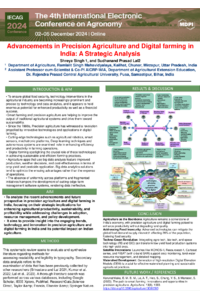
Since the 1990s, precision farming has introduced a revolution in agricultural practices and has evolved significantly in terms of the application of GPS, GIS, and yield monitors. Such technologies have substantially contributed to the Indian agriculture sector over the past two decades by increasing productivity, resource management, and decision-making along with reducing environmental impact. The current global precision farming market was valued at USD 10.50 billion in 2023, and is expected to grow at a compound annual growth rate (CAGR) of 12.8% between 2024 and 2030. The analysis of data that has already been acquired by others is referred to as secondary data analysis. Developing advanced technologies such as AI, ML, IoT, and agricultural robotics plays a crucial role in data-driven digital farming by improving efficiency and sustainability. Precision seeding, utilizing variable-rate technologies, has shown 10% to 30% greater efficiency compared to conventional methods. IoT has increased agricultural productivity by 70%, aligning with the future scope for 2050. The Digital Agriculture Mission 2021–2025 and the 'India Digital Ecosystem of Agriculture,' centered on 'AgriStack,' are pivotal in driving sector digitalization and increasing farmers’ income. Several modern applications, including Soil Health Card, Plantix, Meghdoot, and mKisan, are enhancing areas like soil health, fertilizer recommendations, irrigation scheduling, and pest management. Future developments like Deep Leaf, which uses deep learning to enhance measurement accuracy with average errors as low as 4.6% for leaf length and 5.7% for leaf width, will further streamline agricultural processes. However, the adoption rate of precision agriculture is expected to stabilize post-2030. Continuous advancements in AI, ML, and IoT are anticipated to further propel productivity, profitability, and sustainability in agriculture, ensuring effective land resource protection and minimizing environmental impact.
Keywords
Artificial Intelligence
Internet of Things (IoT)
Precision Agriculture
Robotics
Sustainable Practices.
Poster
79516cda683361cd45c82ee1019227ed.pdf
Normalized Difference Vegetation Index and Normalized Difference Red Edge could be useful tools for optimising grazing management in mixed pastures.
ISOLATION AND CHARACTERIZATION OF MULTI-TRAIT PLANT GROWTH-PROMOTING RHIZOBACTERIA TO IMPROVE PHOSPHOROUS NUTRIENT AND MAIZE GROWTH OPTIMIZATION