Event submissions
Published
This submission belongs to the session S8. Applied Physical Science of the event The 5th International Electronic Conference on Applied Sciences
Published date
02 Dec, 2024
Academic Editor
'%3e%3cpath%20d='M12.6657%2010.9104C12.4185%2010.325%2012.0599%209.79327%2011.6097%209.34482C11.1609%208.89508%2010.6293%208.5365%2010.0442%208.28888C10.0389%208.28626%2010.0337%208.28495%2010.0285%208.28233C10.8446%207.69279%2011.3752%206.73249%2011.3752%205.64904C11.3752%203.8542%209.92103%202.39999%208.1262%202.39999C6.33136%202.39999%204.87715%203.8542%204.87715%205.64904C4.87715%206.73249%205.40774%207.69279%206.22393%208.28364C6.21869%208.28626%206.21345%208.28757%206.20821%208.29019C5.62129%208.5378%205.09463%208.89284%204.64265%209.34613C4.1929%209.79493%203.83432%2010.3266%203.58671%2010.9117C3.34345%2011.4845%203.21226%2012.0987%203.20023%2012.7209C3.19988%2012.7349%203.20233%2012.7488%203.20744%2012.7619C3.21255%2012.7749%203.22022%2012.7867%203.22998%2012.7968C3.23975%2012.8068%203.25142%2012.8147%203.26431%2012.8202C3.2772%2012.8256%203.29105%2012.8284%203.30504%2012.8284H4.09109C4.14874%2012.8284%204.19459%2012.7825%204.1959%2012.7262C4.2221%2011.7148%204.62823%2010.7676%205.34617%2010.0497C6.08899%209.30683%207.0755%208.89808%208.1262%208.89808C9.17689%208.89808%2010.1634%209.30683%2010.9062%2010.0497C11.6242%2010.7676%2012.0303%2011.7148%2012.0565%2012.7262C12.0578%2012.7838%2012.1037%2012.8284%2012.1613%2012.8284H12.9474C12.9613%2012.8284%2012.9752%2012.8256%2012.9881%2012.8202C13.001%2012.8147%2013.0126%2012.8068%2013.0224%2012.7968C13.0322%2012.7867%2013.0398%2012.7749%2013.0449%2012.7619C13.0501%2012.7488%2013.0525%2012.7349%2013.0522%2012.7209C13.0391%2012.0947%2012.9094%2011.4855%2012.6657%2010.9104ZM8.1262%207.9024C7.52486%207.9024%206.9589%207.6679%206.53312%207.24211C6.10733%206.81633%205.87283%206.25037%205.87283%205.64904C5.87283%205.0477%206.10733%204.48174%206.53312%204.05596C6.9589%203.63018%207.52486%203.39567%208.1262%203.39567C8.72753%203.39567%209.29349%203.63018%209.71927%204.05596C10.1451%204.48174%2010.3796%205.0477%2010.3796%205.64904C10.3796%206.25037%2010.1451%206.81633%209.71927%207.24211C9.29349%207.6679%208.72753%207.9024%208.1262%207.9024Z'%20fill='%235D1EE1'/%3e%3c/g%3e%3c/svg%3e) Ali Belarouci
Ali BelarouciCitation
Ruth K. Delgadillo-González, Nailea Mar-Abundis, Rene Fernando Domínguez-Cruz, Yadira A. Fuentes-Rubio, Federico Ampudia-Ramirez, José Rafael Guzmán-Sepúlveda, Thermo-optic discrimination of aqueous solution composition using a multimodal interference fiber optic sensor, in Proceedings of The 5th International Electronic Conference on Applied Sciences, 4 December–6 December 2024, MDPI: Basel, Switzerland
Share
Email
Facebook
Twitter
LinkedIn
Thermo-optic discrimination of aqueous solution composition using a multimodal interference fiber optic sensor

Ruth K. Delgadillo-González 1

Nailea Mar-Abundis 1

Rene Fernando Domínguez-Cruz 1

Yadira A. Fuentes-Rubio 1
'%3e%3cpath%20d='M12.6647%2010.9104C12.4176%2010.325%2012.0589%209.7933%2011.6088%209.34485C11.16%208.89511%2010.6283%208.53653%2010.0432%208.28891C10.038%208.28629%2010.0327%208.28498%2010.0275%208.28236C10.8437%207.69282%2011.3743%206.73252%2011.3743%205.64907C11.3743%203.85423%209.92005%202.40002%208.12522%202.40002C6.33038%202.40002%204.87618%203.85423%204.87618%205.64907C4.87618%206.73252%205.40677%207.69282%206.22296%208.28367C6.21772%208.28629%206.21248%208.2876%206.20724%208.29022C5.62031%208.53783%205.09365%208.89287%204.64167%209.34616C4.19192%209.79496%203.83334%2010.3266%203.58573%2010.9117C3.34247%2011.4846%203.21128%2012.0987%203.19925%2012.721C3.1989%2012.735%203.20135%2012.7489%203.20646%2012.7619C3.21157%2012.7749%203.21924%2012.7868%203.22901%2012.7968C3.23877%2012.8068%203.25045%2012.8148%203.26334%2012.8202C3.27623%2012.8256%203.29007%2012.8284%203.30406%2012.8284H4.09012C4.14776%2012.8284%204.19362%2012.7825%204.19493%2012.7262C4.22113%2011.7148%204.62726%2010.7676%205.34519%2010.0497C6.08802%209.30686%207.07452%208.89811%208.12522%208.89811C9.17592%208.89811%2010.1624%209.30686%2010.9052%2010.0497C11.6232%2010.7676%2012.0293%2011.7148%2012.0555%2012.7262C12.0568%2012.7839%2012.1027%2012.8284%2012.1603%2012.8284H12.9464C12.9604%2012.8284%2012.9742%2012.8256%2012.9871%2012.8202C13%2012.8148%2013.0117%2012.8068%2013.0214%2012.7968C13.0312%2012.7868%2013.0389%2012.7749%2013.044%2012.7619C13.0491%2012.7489%2013.0515%2012.735%2013.0512%2012.721C13.0381%2012.0947%2012.9084%2011.4856%2012.6647%2010.9104ZM8.12522%207.90243C7.52388%207.90243%206.95792%207.66793%206.53214%207.24215C6.10636%206.81636%205.87185%206.2504%205.87185%205.64907C5.87185%205.04773%206.10636%204.48177%206.53214%204.05599C6.95792%203.63021%207.52388%203.3957%208.12522%203.3957C8.72655%203.3957%209.29252%203.63021%209.7183%204.05599C10.1441%204.48177%2010.3786%205.04773%2010.3786%205.64907C10.3786%206.2504%2010.1441%206.81636%209.7183%207.24215C9.29252%207.66793%208.72655%207.90243%208.12522%207.90243Z'%20fill='%235D1EE1'/%3e%3c/g%3e%3c/svg%3e)
Federico Ampudia-Ramirez 1

José Rafael Guzmán-Sepúlveda 2
1. Universidad Autónoma de Tamaulipas. Carr. a San Fernando Cruce con Canal Rodhe S/N. Col Arcoiris, 88779, Mexico
2. CINVESTAV Unidad Monterrey. Vía del Conocimiento 201, Parque de Investigación e Innovación Tecnológica km 9.5 de la Autopista Nueva al Aeropuerto, 66600. Apodaca NL, México
Abstract
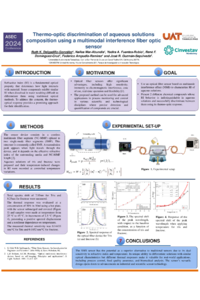
The precise optical identification of aqueous solutions with different compositions is challenging for samples that have a similar refractive index at a certain temperature. However, their thermo-optic response, which describes how the refractive index varies with temperature, provides simple means for discrimination. We report on the use of a conventional fiber optic sensor based on multimodal interference to distinguish aqueous solutions of Tris and fructose based on thermo-optic effects. At room temperature, aqueous solutions of these components have indistinguishable properties. In fact, our sensor exhibited a linear dependence on concentration in both cases, with similar sensitivities of 0.2179 nm/% for Tris and 0.2264 nm/% for fructose, indicating that their discrimination is hindered based on concentration. On the other hand, by changing the temperature controllably, from 25°C to 45°C in increments of 2.5°C, we were able to change the refractive index enough to clearly discriminate between the samples at the same concentration. The thermal sensitivity measured was 0.14433 nm/°C for Tris and 0.1852 nm/°C for fructose, allowing for evident differentiation among samples in the range of35°C to 45°C. Our findings demonstrate that the proposed thermo-optic discrimination approach is effective and offers a promising practical solution; the optical fibers do not need to be prepared in a special way and the temperature control can be carried out with general-purpose laboratory equipment, like a hot plate, over a temperature range that is easily attainable. Overall, the results presented are relevant to industrial and research applications involving advanced monitoring and fine processing control.
Keywords
Thermo-optic
fiber optic sensor
multimodal interference
SMS
Poster
sciforum-104458.pdf
Optimizing Brain Tumor Classification: Integrating Deep Learning and Machine Learning with Hyperparameter Tuning
Using machine learning (ML) algorithms based on voice disorders to identify Parkinson's disease