Event submissions
Published
This submission belongs to the session S5. Biostimulation and Biocontrol Microbial-Based Strategies of the event The 4th International Electronic Conference on Agronomy
Published date
02 Dec, 2024
Academic Editor
'%3e%3cpath%20d='M12.6657%2010.9104C12.4185%2010.325%2012.0599%209.79327%2011.6097%209.34482C11.1609%208.89508%2010.6293%208.5365%2010.0442%208.28888C10.0389%208.28626%2010.0337%208.28495%2010.0285%208.28233C10.8446%207.69279%2011.3752%206.73249%2011.3752%205.64904C11.3752%203.8542%209.92103%202.39999%208.1262%202.39999C6.33136%202.39999%204.87715%203.8542%204.87715%205.64904C4.87715%206.73249%205.40774%207.69279%206.22393%208.28364C6.21869%208.28626%206.21345%208.28757%206.20821%208.29019C5.62129%208.5378%205.09463%208.89284%204.64265%209.34613C4.1929%209.79493%203.83432%2010.3266%203.58671%2010.9117C3.34345%2011.4845%203.21226%2012.0987%203.20023%2012.7209C3.19988%2012.7349%203.20233%2012.7488%203.20744%2012.7619C3.21255%2012.7749%203.22022%2012.7867%203.22998%2012.7968C3.23975%2012.8068%203.25142%2012.8147%203.26431%2012.8202C3.2772%2012.8256%203.29105%2012.8284%203.30504%2012.8284H4.09109C4.14874%2012.8284%204.19459%2012.7825%204.1959%2012.7262C4.2221%2011.7148%204.62823%2010.7676%205.34617%2010.0497C6.08899%209.30683%207.0755%208.89808%208.1262%208.89808C9.17689%208.89808%2010.1634%209.30683%2010.9062%2010.0497C11.6242%2010.7676%2012.0303%2011.7148%2012.0565%2012.7262C12.0578%2012.7838%2012.1037%2012.8284%2012.1613%2012.8284H12.9474C12.9613%2012.8284%2012.9752%2012.8256%2012.9881%2012.8202C13.001%2012.8147%2013.0126%2012.8068%2013.0224%2012.7968C13.0322%2012.7867%2013.0398%2012.7749%2013.0449%2012.7619C13.0501%2012.7488%2013.0525%2012.7349%2013.0522%2012.7209C13.0391%2012.0947%2012.9094%2011.4855%2012.6657%2010.9104ZM8.1262%207.9024C7.52486%207.9024%206.9589%207.6679%206.53312%207.24211C6.10733%206.81633%205.87283%206.25037%205.87283%205.64904C5.87283%205.0477%206.10733%204.48174%206.53312%204.05596C6.9589%203.63018%207.52486%203.39567%208.1262%203.39567C8.72753%203.39567%209.29349%203.63018%209.71927%204.05596C10.1451%204.48174%2010.3796%205.0477%2010.3796%205.64904C10.3796%206.25037%2010.1451%206.81633%209.71927%207.24211C9.29349%207.6679%208.72753%207.9024%208.1262%207.9024Z'%20fill='%235D1EE1'/%3e%3c/g%3e%3c/svg%3e) J.D. Flores-Félix
J.D. Flores-FélixCitation
Svetlana Kamzolova, Olga N. Shemshura, Antagonistic and nematocide activity of carboxylic acids of microbial origin, in Proceedings of The 4th International Electronic Conference on Agronomy, 2 December–5 December 2024, MDPI: Basel, Switzerland
Share
Email
Facebook
Twitter
LinkedIn
Antagonistic and nematocide activity of carboxylic acids of microbial origin
'%3e%3cpath%20d='M12.6647%2010.9104C12.4176%2010.325%2012.0589%209.7933%2011.6088%209.34485C11.16%208.89511%2010.6283%208.53653%2010.0432%208.28891C10.038%208.28629%2010.0327%208.28498%2010.0275%208.28236C10.8437%207.69282%2011.3743%206.73252%2011.3743%205.64907C11.3743%203.85423%209.92005%202.40002%208.12522%202.40002C6.33038%202.40002%204.87618%203.85423%204.87618%205.64907C4.87618%206.73252%205.40677%207.69282%206.22296%208.28367C6.21772%208.28629%206.21248%208.2876%206.20724%208.29022C5.62031%208.53783%205.09365%208.89287%204.64167%209.34616C4.19192%209.79496%203.83334%2010.3266%203.58573%2010.9117C3.34247%2011.4846%203.21128%2012.0987%203.19925%2012.721C3.1989%2012.735%203.20135%2012.7489%203.20646%2012.7619C3.21157%2012.7749%203.21924%2012.7868%203.22901%2012.7968C3.23877%2012.8068%203.25045%2012.8148%203.26334%2012.8202C3.27623%2012.8256%203.29007%2012.8284%203.30406%2012.8284H4.09012C4.14776%2012.8284%204.19362%2012.7825%204.19493%2012.7262C4.22113%2011.7148%204.62726%2010.7676%205.34519%2010.0497C6.08802%209.30686%207.07452%208.89811%208.12522%208.89811C9.17592%208.89811%2010.1624%209.30686%2010.9052%2010.0497C11.6232%2010.7676%2012.0293%2011.7148%2012.0555%2012.7262C12.0568%2012.7839%2012.1027%2012.8284%2012.1603%2012.8284H12.9464C12.9604%2012.8284%2012.9742%2012.8256%2012.9871%2012.8202C13%2012.8148%2013.0117%2012.8068%2013.0214%2012.7968C13.0312%2012.7868%2013.0389%2012.7749%2013.044%2012.7619C13.0491%2012.7489%2013.0515%2012.735%2013.0512%2012.721C13.0381%2012.0947%2012.9084%2011.4856%2012.6647%2010.9104ZM8.12522%207.90243C7.52388%207.90243%206.95792%207.66793%206.53214%207.24215C6.10636%206.81636%205.87185%206.2504%205.87185%205.64907C5.87185%205.04773%206.10636%204.48177%206.53214%204.05599C6.95792%203.63021%207.52388%203.3957%208.12522%203.3957C8.72655%203.3957%209.29252%203.63021%209.7183%204.05599C10.1441%204.48177%2010.3786%205.04773%2010.3786%205.64907C10.3786%206.2504%2010.1441%206.81636%209.7183%207.24215C9.29252%207.66793%208.72655%207.90243%208.12522%207.90243Z'%20fill='%235D1EE1'/%3e%3c/g%3e%3c/svg%3e)
Svetlana Kamzolova 1
Olga N. Shemshura 2
1. Laboratory of physiology of microorganisms, Federal Research Center “Pushchino Scientific Center for Biological Research of the Russian Academy of Sciences”, Skryabin Institute of Biochemistry and Physiology of Microorganisms RAS, Pushchino, pr-t Nauki 5,
2. Laboratory of Environmental and Agricultural Microbiology Research and Production Center of Microbiology and Virology, Almaty, Bogenbai batyr str., 105, Kazakhstan
Abstract
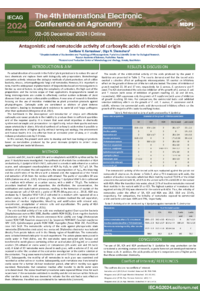
Introduction: The field of experimental microbiology allows for the creation of new avenues of biotechnology with the aim of facilitating the extensive utilization of microbial synthesis products in agriculture as plant protection agents. The most prevalent biological substances are antibiotics, alkaloids, peptides, phenolic compounds, lipids, terpenoids, polysaccharides, organic acids, and others. The objective of this study was to assess the fungicidal, bactericidal, and nematocidal activity of carboxylic acids produced by the yeast Yarrowia lipolytica.
Methods: Succinic acid (SA), isocitric acid monopotassium salt (ICA), and α-ketoglutaric acid monopotassium salt (KGA) were synthesized under specific conditions using Y. lipolytica, and subsequently isolated from the culture liquid in crystalline form with 99.9% purity. The fungicidal and bactericidal activities of carboxylic acids were determined by the agar diffusion method. The phytopathogenic bacteria Erwinia carotovora and the fungi Trichothecium roseum, Cylindrocarpon, Aspergillus flavus, Fusarium oxysporum, F. napiforme, and Penicillium casei were employed as test microorganisms. The nematocidal activity of carboxylic acids was investigated against the phytoparasitic stem nematode Ditylenchus destructor.
Results: The selective antimicrobial activity of carboxylic acids produced by Y. lipolytica has been demonstrated. The acids were subjected to testing against six test microorganisms, with four being inhibited. Moreover, it was demonstrated that all acids were capable of inactivating the nematode D. destructor. The nematostatic activity ranged from 13 to 37.6%, while the nematocidal activity ranged from 22.4 to 58.3%. The highest nematocidal activity was observed with SA.
Conclusions: The utilization of SA, ICA, and KGA produced by Y. lipolytica for the purpose of plant protection may be regarded as a highly promising avenue of research, given that pests have not yet developed resistance to these acids. Furthermore, the acids produced by microorganisms are of a higher purity than those that are chemically synthesized.
Keywords
microbial synthesis
carboxylic acids
plant protection
yeast Yarrowia lipolytica
biocontrol microbial-based strategy
Poster
Kamzolova_Shemshura_Poster.pdf
Antifungal activity of Achilléa millefólium extract against pathogens of plant root rot
Biochemical responses induced by SiO2-ZnO nanoparticles in Zea mays plants under water deficit conditions