Event submissions
Published
This submission belongs to the session S3. Sustainable Soil Management and Farming Systems of the event The 4th International Electronic Conference on Agronomy
Published date
02 Dec, 2024
Academic Editor
'%3e%3cpath%20d='M12.6657%2010.9104C12.4185%2010.325%2012.0599%209.79327%2011.6097%209.34482C11.1609%208.89508%2010.6293%208.5365%2010.0442%208.28888C10.0389%208.28626%2010.0337%208.28495%2010.0285%208.28233C10.8446%207.69279%2011.3752%206.73249%2011.3752%205.64904C11.3752%203.8542%209.92103%202.39999%208.1262%202.39999C6.33136%202.39999%204.87715%203.8542%204.87715%205.64904C4.87715%206.73249%205.40774%207.69279%206.22393%208.28364C6.21869%208.28626%206.21345%208.28757%206.20821%208.29019C5.62129%208.5378%205.09463%208.89284%204.64265%209.34613C4.1929%209.79493%203.83432%2010.3266%203.58671%2010.9117C3.34345%2011.4845%203.21226%2012.0987%203.20023%2012.7209C3.19988%2012.7349%203.20233%2012.7488%203.20744%2012.7619C3.21255%2012.7749%203.22022%2012.7867%203.22998%2012.7968C3.23975%2012.8068%203.25142%2012.8147%203.26431%2012.8202C3.2772%2012.8256%203.29105%2012.8284%203.30504%2012.8284H4.09109C4.14874%2012.8284%204.19459%2012.7825%204.1959%2012.7262C4.2221%2011.7148%204.62823%2010.7676%205.34617%2010.0497C6.08899%209.30683%207.0755%208.89808%208.1262%208.89808C9.17689%208.89808%2010.1634%209.30683%2010.9062%2010.0497C11.6242%2010.7676%2012.0303%2011.7148%2012.0565%2012.7262C12.0578%2012.7838%2012.1037%2012.8284%2012.1613%2012.8284H12.9474C12.9613%2012.8284%2012.9752%2012.8256%2012.9881%2012.8202C13.001%2012.8147%2013.0126%2012.8068%2013.0224%2012.7968C13.0322%2012.7867%2013.0398%2012.7749%2013.0449%2012.7619C13.0501%2012.7488%2013.0525%2012.7349%2013.0522%2012.7209C13.0391%2012.0947%2012.9094%2011.4855%2012.6657%2010.9104ZM8.1262%207.9024C7.52486%207.9024%206.9589%207.6679%206.53312%207.24211C6.10733%206.81633%205.87283%206.25037%205.87283%205.64904C5.87283%205.0477%206.10733%204.48174%206.53312%204.05596C6.9589%203.63018%207.52486%203.39567%208.1262%203.39567C8.72753%203.39567%209.29349%203.63018%209.71927%204.05596C10.1451%204.48174%2010.3796%205.0477%2010.3796%205.64904C10.3796%206.25037%2010.1451%206.81633%209.71927%207.24211C9.29349%207.6679%208.72753%207.9024%208.1262%207.9024Z'%20fill='%235D1EE1'/%3e%3c/g%3e%3c/svg%3e) Mirza Hasanuzzaman
Mirza HasanuzzamanCitation
Audberto Reyes-Rosas, Francisco Marcelo Lara-Viveros, Janet Laureano-Ricardo, Prócoro Gamero-Melo, Alejandro Zermeño-González, Sasirot Khamkure, Effect of ammonium-clinoptilolite zeolite as a slow-release fertilizer on the growth of bell pepper seedlings (Capsicum annuum L.), in Proceedings of The 4th International Electronic Conference on Agronomy, 2 December–5 December 2024, MDPI: Basel, Switzerland
Share
Email
Facebook
Twitter
LinkedIn
Effect of ammonium-clinoptilolite zeolite as a slow-release fertilizer on the growth of bell pepper seedlings (Capsicum annuum L.)
'%3e%3cpath%20d='M12.6647%2010.9104C12.4176%2010.325%2012.0589%209.7933%2011.6088%209.34485C11.16%208.89511%2010.6283%208.53653%2010.0432%208.28891C10.038%208.28629%2010.0327%208.28498%2010.0275%208.28236C10.8437%207.69282%2011.3743%206.73252%2011.3743%205.64907C11.3743%203.85423%209.92005%202.40002%208.12522%202.40002C6.33038%202.40002%204.87618%203.85423%204.87618%205.64907C4.87618%206.73252%205.40677%207.69282%206.22296%208.28367C6.21772%208.28629%206.21248%208.2876%206.20724%208.29022C5.62031%208.53783%205.09365%208.89287%204.64167%209.34616C4.19192%209.79496%203.83334%2010.3266%203.58573%2010.9117C3.34247%2011.4846%203.21128%2012.0987%203.19925%2012.721C3.1989%2012.735%203.20135%2012.7489%203.20646%2012.7619C3.21157%2012.7749%203.21924%2012.7868%203.22901%2012.7968C3.23877%2012.8068%203.25045%2012.8148%203.26334%2012.8202C3.27623%2012.8256%203.29007%2012.8284%203.30406%2012.8284H4.09012C4.14776%2012.8284%204.19362%2012.7825%204.19493%2012.7262C4.22113%2011.7148%204.62726%2010.7676%205.34519%2010.0497C6.08802%209.30686%207.07452%208.89811%208.12522%208.89811C9.17592%208.89811%2010.1624%209.30686%2010.9052%2010.0497C11.6232%2010.7676%2012.0293%2011.7148%2012.0555%2012.7262C12.0568%2012.7839%2012.1027%2012.8284%2012.1603%2012.8284H12.9464C12.9604%2012.8284%2012.9742%2012.8256%2012.9871%2012.8202C13%2012.8148%2013.0117%2012.8068%2013.0214%2012.7968C13.0312%2012.7868%2013.0389%2012.7749%2013.044%2012.7619C13.0491%2012.7489%2013.0515%2012.735%2013.0512%2012.721C13.0381%2012.0947%2012.9084%2011.4856%2012.6647%2010.9104ZM8.12522%207.90243C7.52388%207.90243%206.95792%207.66793%206.53214%207.24215C6.10636%206.81636%205.87185%206.2504%205.87185%205.64907C5.87185%205.04773%206.10636%204.48177%206.53214%204.05599C6.95792%203.63021%207.52388%203.3957%208.12522%203.3957C8.72655%203.3957%209.29252%203.63021%209.7183%204.05599C10.1441%204.48177%2010.3786%205.04773%2010.3786%205.64907C10.3786%206.2504%2010.1441%206.81636%209.7183%207.24215C9.29252%207.66793%208.72655%207.90243%208.12522%207.90243Z'%20fill='%235D1EE1'/%3e%3c/g%3e%3c/svg%3e)
Audberto Reyes-Rosas 1
Francisco Marcelo Lara-Viveros 1
Janet Laureano-Ricardo 2
Prócoro Gamero-Melo 3
Alejandro Zermeño-González 4
Sasirot Khamkure 5
1. Department of Bioscience and Agrotechnology, Centro de Investigación en Química Aplicada, Saltillo, 25294 Coahuila, México
2. Irrigation and Drainage Department, Universidad Autónoma Agraria Antonio Narro, Saltillo, 25315 Coahuila, Mexico
3. Sustainability of Natural Resources and Energy, Centro de Investigación y de Estudios Avanzados del Instituto Politécnico Nacional, Saltillo, 25900 Coahuila, Mexico
4. Irrigation and Drainage Department, Universidad Autónoma Agraria Antonio Narro, Saltillo, 25315 Coahuila, Mexico
5. CONAHCYT-Universidad Autónoma Agraria Antonio Narro
Abstract
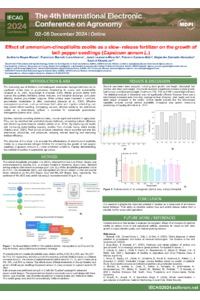
Excessive nitrate in groundwater, caused by fertilizer overuse and poor wastewater management, poses a significant threat to its quality and long-term sustainability. Zeolite, a low-cost mineral, has positive effects on agricultural soil, plant growth, and groundwater. This study evaluated ammonium-clinoptilolite zeolite as a slow-release nitrogen fertilizer for agriculture. The clinoptilolite zeolite (NCC) was prepared in chip (NH4-ICC) and powder (NH4-ICP) forms using an impregnation method and microwave reactor treatment (NH4-ECC). The additional treatment was used as the control (T4) using just natural zeolite as the growing substrate. The zeolite-clinoptilolite/natural zeolite ratio levels for treatments T1, T2, and T3 were 5, 15, and 25%, respectively in terms of volume. The effectiveness of these zeolites in promoting the germination and growth of bell pepper seedlings (Capsicum annuum L.) was assessed under greenhouse conditions for 23 days. The data were analyzed with the statistical software R v4.2. The experiment had a completely randomized design based on the combination of two factors: the type of zeolite and the level of zeolite-clinoptilolite/natural zeolite proportion. All the treatments were irrigated using just water without any fertilizer. Several parameters were analyzed, including plant growth, root length, chlorophyll, leaf number, and dried plant weight. The results showed significantly higher plant growth, leaf number, and dried plant weight. T1C, T1P, and T2P had high leaf area. There was no statistically significant difference in chlorophyll. However, there was a trend towards increased stem thickness, plant height, and dried plant weight compared to the control. This research highlights the important potential of zeolites as a component of ammonium-based fertilizers. Their ability to minimize nutrient loss and control release makes them a valuable tool for sustainable agriculture.
Keywords
Ammonium
Clinoptilolite zeolite
Impregnation
Microwave reactor
Seedling Growth
Slow release fertilizer
Poster
Poster IECAG mdpi nov 2024.pdf
Towards geospatial recommendations for restoring site-specific depletion of soil organic matter in a Moroccan semi-arid region
Sustainable management of pests and improved yield in Chinese cabbage (Brassica rapa subsp. chinensis) by Black soldier fly frass and Desmodium under Wonder multistory gardens