Event submissions
Published
This submission belongs to the session S3. Computing and Artificial Intelligence of the event The 5th International Electronic Conference on Applied Sciences
Published date
02 Dec, 2024
Academic Editor
'%3e%3cpath%20d='M12.6657%2010.9104C12.4185%2010.325%2012.0599%209.79327%2011.6097%209.34482C11.1609%208.89508%2010.6293%208.5365%2010.0442%208.28888C10.0389%208.28626%2010.0337%208.28495%2010.0285%208.28233C10.8446%207.69279%2011.3752%206.73249%2011.3752%205.64904C11.3752%203.8542%209.92103%202.39999%208.1262%202.39999C6.33136%202.39999%204.87715%203.8542%204.87715%205.64904C4.87715%206.73249%205.40774%207.69279%206.22393%208.28364C6.21869%208.28626%206.21345%208.28757%206.20821%208.29019C5.62129%208.5378%205.09463%208.89284%204.64265%209.34613C4.1929%209.79493%203.83432%2010.3266%203.58671%2010.9117C3.34345%2011.4845%203.21226%2012.0987%203.20023%2012.7209C3.19988%2012.7349%203.20233%2012.7488%203.20744%2012.7619C3.21255%2012.7749%203.22022%2012.7867%203.22998%2012.7968C3.23975%2012.8068%203.25142%2012.8147%203.26431%2012.8202C3.2772%2012.8256%203.29105%2012.8284%203.30504%2012.8284H4.09109C4.14874%2012.8284%204.19459%2012.7825%204.1959%2012.7262C4.2221%2011.7148%204.62823%2010.7676%205.34617%2010.0497C6.08899%209.30683%207.0755%208.89808%208.1262%208.89808C9.17689%208.89808%2010.1634%209.30683%2010.9062%2010.0497C11.6242%2010.7676%2012.0303%2011.7148%2012.0565%2012.7262C12.0578%2012.7838%2012.1037%2012.8284%2012.1613%2012.8284H12.9474C12.9613%2012.8284%2012.9752%2012.8256%2012.9881%2012.8202C13.001%2012.8147%2013.0126%2012.8068%2013.0224%2012.7968C13.0322%2012.7867%2013.0398%2012.7749%2013.0449%2012.7619C13.0501%2012.7488%2013.0525%2012.7349%2013.0522%2012.7209C13.0391%2012.0947%2012.9094%2011.4855%2012.6657%2010.9104ZM8.1262%207.9024C7.52486%207.9024%206.9589%207.6679%206.53312%207.24211C6.10733%206.81633%205.87283%206.25037%205.87283%205.64904C5.87283%205.0477%206.10733%204.48174%206.53312%204.05596C6.9589%203.63018%207.52486%203.39567%208.1262%203.39567C8.72753%203.39567%209.29349%203.63018%209.71927%204.05596C10.1451%204.48174%2010.3796%205.0477%2010.3796%205.64904C10.3796%206.25037%2010.1451%206.81633%209.71927%207.24211C9.29349%207.6679%208.72753%207.9024%208.1262%207.9024Z'%20fill='%235D1EE1'/%3e%3c/g%3e%3c/svg%3e) Eugenio Vocaturo
Eugenio VocaturoCitation
Krishna Dharavathu, Dr M Ranga Rao, Sankara chinmai sri padma, Dinesh Reddy Rikka, Lakshmi Priya Kuruhuri, Meghana Addagarla, Using machine learning (ML) algorithms based on voice disorders to identify Parkinson's disease, in Proceedings of The 5th International Electronic Conference on Applied Sciences, 4 December–6 December 2024, MDPI: Basel, Switzerland
Share
Email
Facebook
Twitter
LinkedIn
Using machine learning (ML) algorithms based on voice disorders to identify Parkinson's disease
'%3e%3cpath%20d='M12.6647%2010.9104C12.4176%2010.325%2012.0589%209.7933%2011.6088%209.34485C11.16%208.89511%2010.6283%208.53653%2010.0432%208.28891C10.038%208.28629%2010.0327%208.28498%2010.0275%208.28236C10.8437%207.69282%2011.3743%206.73252%2011.3743%205.64907C11.3743%203.85423%209.92005%202.40002%208.12522%202.40002C6.33038%202.40002%204.87618%203.85423%204.87618%205.64907C4.87618%206.73252%205.40677%207.69282%206.22296%208.28367C6.21772%208.28629%206.21248%208.2876%206.20724%208.29022C5.62031%208.53783%205.09365%208.89287%204.64167%209.34616C4.19192%209.79496%203.83334%2010.3266%203.58573%2010.9117C3.34247%2011.4846%203.21128%2012.0987%203.19925%2012.721C3.1989%2012.735%203.20135%2012.7489%203.20646%2012.7619C3.21157%2012.7749%203.21924%2012.7868%203.22901%2012.7968C3.23877%2012.8068%203.25045%2012.8148%203.26334%2012.8202C3.27623%2012.8256%203.29007%2012.8284%203.30406%2012.8284H4.09012C4.14776%2012.8284%204.19362%2012.7825%204.19493%2012.7262C4.22113%2011.7148%204.62726%2010.7676%205.34519%2010.0497C6.08802%209.30686%207.07452%208.89811%208.12522%208.89811C9.17592%208.89811%2010.1624%209.30686%2010.9052%2010.0497C11.6232%2010.7676%2012.0293%2011.7148%2012.0555%2012.7262C12.0568%2012.7839%2012.1027%2012.8284%2012.1603%2012.8284H12.9464C12.9604%2012.8284%2012.9742%2012.8256%2012.9871%2012.8202C13%2012.8148%2013.0117%2012.8068%2013.0214%2012.7968C13.0312%2012.7868%2013.0389%2012.7749%2013.044%2012.7619C13.0491%2012.7489%2013.0515%2012.735%2013.0512%2012.721C13.0381%2012.0947%2012.9084%2011.4856%2012.6647%2010.9104ZM8.12522%207.90243C7.52388%207.90243%206.95792%207.66793%206.53214%207.24215C6.10636%206.81636%205.87185%206.2504%205.87185%205.64907C5.87185%205.04773%206.10636%204.48177%206.53214%204.05599C6.95792%203.63021%207.52388%203.3957%208.12522%203.3957C8.72655%203.3957%209.29252%203.63021%209.7183%204.05599C10.1441%204.48177%2010.3786%205.04773%2010.3786%205.64907C10.3786%206.2504%2010.1441%206.81636%209.7183%207.24215C9.29252%207.66793%208.72655%207.90243%208.12522%207.90243Z'%20fill='%235D1EE1'/%3e%3c/g%3e%3c/svg%3e)
Krishna Dharavathu 1
Dr M Ranga Rao 1
Sankara chinmai sri padma 1
Dinesh Reddy Rikka 1
Lakshmi Priya Kuruhuri 1
Meghana Addagarla 1
1. Department of Electronics and Communication Engineering, Potti Sriramulu Chalavadi Mallikarjuna Rao College of Engineering and Technology (Autonomous)
Abstract
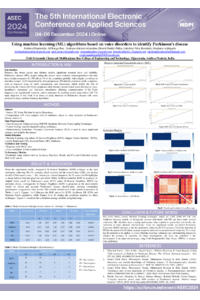
Parkinson’s disease, described by James Parkinson, is a neurological syndrome affecting the central nervous system, leading to issues such as speech difficulties, tremors, and impaired movement. It is a prevalent neurological condition characterized by motor and cognitive impairments, affecting approximately 10 million people globally, according to WHO. Early diagnosis is critical, as delayed detection may lead to irreversible damage. Speech, being affected by motor control depletion, serves as a valuable tool for diagnosing Parkinson’s disease. This work presents a machine learning-based approach for the systematic detection of Parkinson’s disease using speech features. The dataset, obtained from the UCI Machine Learning Repository, consisting of biomedical voice measurements derived from speech recordings, and including data from 195 individuals (147 with Parkinson’s and 48 healthy controls), was analyzed, incorporating 21 features derived from speech recordings. In this work, several classification algorithms in machine learning were utilized. Specifically, K-Nearest Neighbors (KNN), Support Vector Machine (SVM), Logistic Regression, AdaBoost, and Random Forest were implemented and evaluated using metrics such as accuracy, precision, recall, F1-score, and ROC-AUC curves. From the experiment results, K-Nearest Neighbors (KNN) emerged as the best performer, achieving 98.31% accuracy, ideal precision for the normal class (1.00), and ideal recall for Parkinson’s cases (1.00), ensuring no missed diagnoses. Its F1-score of 0.98 highlights a strong balance between precision and recall. While AdaBoost matched KNN in accuracy, its slightly lower recall for Parkinson’s cases (0.97) makes K-Nearest Neighbors (KNN) the preferred choice. Consequently, K-Nearest Neighbors (KNN) is proposed as the most reliable model for robust and accurate Parkinson’s disease classification, showing outstanding performance compared to other models.
Keywords
Parkinson’s Disease
Speech Recordings
Machine Learning
K-Nearest Neighbors (KNN)
AdaBoost
Dysphonia.
Poster
main poster conference-1.pdf
Thermo-optic discrimination of aqueous solution composition using a multimodal interference fiber optic sensor
Unveiling the Binding Dynamics of two organic compounds with Human Serum Albumin: Integrating Computational, Spectroscopic, and Preliminary Single-Crystal X-ray Diffraction (SCXRD) Insights