Event submissions
Published
This submission belongs to the session S3. Sustainable Soil Management and Farming Systems of the event The 4th International Electronic Conference on Agronomy
Published date
02 Dec, 2024
Academic Editor
'%3e%3cpath%20d='M12.6657%2010.9104C12.4185%2010.325%2012.0599%209.79327%2011.6097%209.34482C11.1609%208.89508%2010.6293%208.5365%2010.0442%208.28888C10.0389%208.28626%2010.0337%208.28495%2010.0285%208.28233C10.8446%207.69279%2011.3752%206.73249%2011.3752%205.64904C11.3752%203.8542%209.92103%202.39999%208.1262%202.39999C6.33136%202.39999%204.87715%203.8542%204.87715%205.64904C4.87715%206.73249%205.40774%207.69279%206.22393%208.28364C6.21869%208.28626%206.21345%208.28757%206.20821%208.29019C5.62129%208.5378%205.09463%208.89284%204.64265%209.34613C4.1929%209.79493%203.83432%2010.3266%203.58671%2010.9117C3.34345%2011.4845%203.21226%2012.0987%203.20023%2012.7209C3.19988%2012.7349%203.20233%2012.7488%203.20744%2012.7619C3.21255%2012.7749%203.22022%2012.7867%203.22998%2012.7968C3.23975%2012.8068%203.25142%2012.8147%203.26431%2012.8202C3.2772%2012.8256%203.29105%2012.8284%203.30504%2012.8284H4.09109C4.14874%2012.8284%204.19459%2012.7825%204.1959%2012.7262C4.2221%2011.7148%204.62823%2010.7676%205.34617%2010.0497C6.08899%209.30683%207.0755%208.89808%208.1262%208.89808C9.17689%208.89808%2010.1634%209.30683%2010.9062%2010.0497C11.6242%2010.7676%2012.0303%2011.7148%2012.0565%2012.7262C12.0578%2012.7838%2012.1037%2012.8284%2012.1613%2012.8284H12.9474C12.9613%2012.8284%2012.9752%2012.8256%2012.9881%2012.8202C13.001%2012.8147%2013.0126%2012.8068%2013.0224%2012.7968C13.0322%2012.7867%2013.0398%2012.7749%2013.0449%2012.7619C13.0501%2012.7488%2013.0525%2012.7349%2013.0522%2012.7209C13.0391%2012.0947%2012.9094%2011.4855%2012.6657%2010.9104ZM8.1262%207.9024C7.52486%207.9024%206.9589%207.6679%206.53312%207.24211C6.10733%206.81633%205.87283%206.25037%205.87283%205.64904C5.87283%205.0477%206.10733%204.48174%206.53312%204.05596C6.9589%203.63018%207.52486%203.39567%208.1262%203.39567C8.72753%203.39567%209.29349%203.63018%209.71927%204.05596C10.1451%204.48174%2010.3796%205.0477%2010.3796%205.64904C10.3796%206.25037%2010.1451%206.81633%209.71927%207.24211C9.29349%207.6679%208.72753%207.9024%208.1262%207.9024Z'%20fill='%235D1EE1'/%3e%3c/g%3e%3c/svg%3e) Mirza Hasanuzzaman
Mirza HasanuzzamanCitation
Jung-Hsiu Tsuai, Yu-Ming Wang, PEICHUN CHANG, The effect of plant growth-promoting rhizobacteria (PGPR) on the growth and yield of cucumber (Cucumis sativus) in differently colored polyethylene greenhouses, in Proceedings of The 4th International Electronic Conference on Agronomy, 2 December–5 December 2024, MDPI: Basel, Switzerland
Share
Email
Facebook
Twitter
LinkedIn
The effect of plant growth-promoting rhizobacteria (PGPR) on the growth and yield of cucumber (Cucumis sativus) in differently colored polyethylene greenhouses
'%3e%3cpath%20d='M12.6647%2010.9104C12.4176%2010.325%2012.0589%209.7933%2011.6088%209.34485C11.16%208.89511%2010.6283%208.53653%2010.0432%208.28891C10.038%208.28629%2010.0327%208.28498%2010.0275%208.28236C10.8437%207.69282%2011.3743%206.73252%2011.3743%205.64907C11.3743%203.85423%209.92005%202.40002%208.12522%202.40002C6.33038%202.40002%204.87618%203.85423%204.87618%205.64907C4.87618%206.73252%205.40677%207.69282%206.22296%208.28367C6.21772%208.28629%206.21248%208.2876%206.20724%208.29022C5.62031%208.53783%205.09365%208.89287%204.64167%209.34616C4.19192%209.79496%203.83334%2010.3266%203.58573%2010.9117C3.34247%2011.4846%203.21128%2012.0987%203.19925%2012.721C3.1989%2012.735%203.20135%2012.7489%203.20646%2012.7619C3.21157%2012.7749%203.21924%2012.7868%203.22901%2012.7968C3.23877%2012.8068%203.25045%2012.8148%203.26334%2012.8202C3.27623%2012.8256%203.29007%2012.8284%203.30406%2012.8284H4.09012C4.14776%2012.8284%204.19362%2012.7825%204.19493%2012.7262C4.22113%2011.7148%204.62726%2010.7676%205.34519%2010.0497C6.08802%209.30686%207.07452%208.89811%208.12522%208.89811C9.17592%208.89811%2010.1624%209.30686%2010.9052%2010.0497C11.6232%2010.7676%2012.0293%2011.7148%2012.0555%2012.7262C12.0568%2012.7839%2012.1027%2012.8284%2012.1603%2012.8284H12.9464C12.9604%2012.8284%2012.9742%2012.8256%2012.9871%2012.8202C13%2012.8148%2013.0117%2012.8068%2013.0214%2012.7968C13.0312%2012.7868%2013.0389%2012.7749%2013.044%2012.7619C13.0491%2012.7489%2013.0515%2012.735%2013.0512%2012.721C13.0381%2012.0947%2012.9084%2011.4856%2012.6647%2010.9104ZM8.12522%207.90243C7.52388%207.90243%206.95792%207.66793%206.53214%207.24215C6.10636%206.81636%205.87185%206.2504%205.87185%205.64907C5.87185%205.04773%206.10636%204.48177%206.53214%204.05599C6.95792%203.63021%207.52388%203.3957%208.12522%203.3957C8.72655%203.3957%209.29252%203.63021%209.7183%204.05599C10.1441%204.48177%2010.3786%205.04773%2010.3786%205.64907C10.3786%206.2504%2010.1441%206.81636%209.7183%207.24215C9.29252%207.66793%208.72655%207.90243%208.12522%207.90243Z'%20fill='%235D1EE1'/%3e%3c/g%3e%3c/svg%3e)
Jung-Hsiu Tsuai 1

Yu-Ming Wang 2

PEICHUN CHANG 3
1. Department of Tropical Agriculture and International Cooperation, National Pingtung University of Science and Technology, Taiwan (R.O.C.)
2. Professor of General Research Service Center, National Pingtung University of Science and Technology, Taiwan (R.O.C.)
3. Assistant Professor of Department of Tropical Agriculture and International Cooperation, National Pingtung University of Science and Technology, Taiwan (R.O.C.)
Abstract
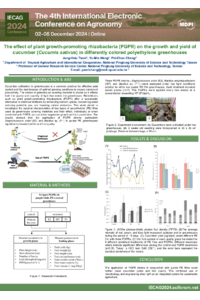
Cucumber cultivation in greenhouses is a common practice for effective pest control and the maintenance of optimal growing conditions to ensure consistent productivity. The choice of greenhouse covering material is crucial as it affects both the quality and quantity of light that enters the greenhouse. Using unsuitable materials can block essential light needed for crop growth, resulting in reduced yields. Biofertilizers such as plant growth-promoting rhizobacteria (PGPR) offer a sustainable alternative to chemical fertilizers by enhancing nutrient uptake, conserving water, reducing pesticide use, and lowering carbon emissions. This study aimed to investigate the spectral characteristics of two types of polyethylene (PE) films used as greenhouse covering materials and their effect, individually or when combined with PGPR, on cucumber vegetative growth and fruit production. The assessment of spectral properties revealed that the purple PE film provided higher light transmission, greater total photosynthetic photon flux density (PPFD), and a higher fraction of red light compared to white PE films. Growing plants in this altered lighting condition in the purple PE greenhouses gave rise to more fruits, higher yields, and a greater proportion of marketable fruits. Furthermore, the application of PGPR strains, particularly Staphylococcus sciuri (E2) and Bacillus sp. (P1), significantly boosted yields and fruit quality; this growth promotion was more effective when used in conjunction with purple PE films. The synergistic effect of combining PGPR with purple PE film demonstrated the potential of integrating biological and engineering approaches to achieve sustainable and productive cucumber cultivation.
Keywords
cucumber
polyethylene film
plant-growth promoting rhizobacteria
food production
sustainable agriculture
Poster
poster_mdpi_online(2024_12).pdf
Exploring the potential of soybean as an intercrop in maize-based cropping systems
Foliar Spraying with Tryptophan Significantly Alleviates Waterlogging Stress In Young Peach Seedlings