Event submissions
Published
This submission belongs to the session S3. Sustainable Soil Management and Farming Systems of the event The 4th International Electronic Conference on Agronomy
Published date
02 Dec, 2024
Academic Editor
'%3e%3cpath%20d='M12.6657%2010.9104C12.4185%2010.325%2012.0599%209.79327%2011.6097%209.34482C11.1609%208.89508%2010.6293%208.5365%2010.0442%208.28888C10.0389%208.28626%2010.0337%208.28495%2010.0285%208.28233C10.8446%207.69279%2011.3752%206.73249%2011.3752%205.64904C11.3752%203.8542%209.92103%202.39999%208.1262%202.39999C6.33136%202.39999%204.87715%203.8542%204.87715%205.64904C4.87715%206.73249%205.40774%207.69279%206.22393%208.28364C6.21869%208.28626%206.21345%208.28757%206.20821%208.29019C5.62129%208.5378%205.09463%208.89284%204.64265%209.34613C4.1929%209.79493%203.83432%2010.3266%203.58671%2010.9117C3.34345%2011.4845%203.21226%2012.0987%203.20023%2012.7209C3.19988%2012.7349%203.20233%2012.7488%203.20744%2012.7619C3.21255%2012.7749%203.22022%2012.7867%203.22998%2012.7968C3.23975%2012.8068%203.25142%2012.8147%203.26431%2012.8202C3.2772%2012.8256%203.29105%2012.8284%203.30504%2012.8284H4.09109C4.14874%2012.8284%204.19459%2012.7825%204.1959%2012.7262C4.2221%2011.7148%204.62823%2010.7676%205.34617%2010.0497C6.08899%209.30683%207.0755%208.89808%208.1262%208.89808C9.17689%208.89808%2010.1634%209.30683%2010.9062%2010.0497C11.6242%2010.7676%2012.0303%2011.7148%2012.0565%2012.7262C12.0578%2012.7838%2012.1037%2012.8284%2012.1613%2012.8284H12.9474C12.9613%2012.8284%2012.9752%2012.8256%2012.9881%2012.8202C13.001%2012.8147%2013.0126%2012.8068%2013.0224%2012.7968C13.0322%2012.7867%2013.0398%2012.7749%2013.0449%2012.7619C13.0501%2012.7488%2013.0525%2012.7349%2013.0522%2012.7209C13.0391%2012.0947%2012.9094%2011.4855%2012.6657%2010.9104ZM8.1262%207.9024C7.52486%207.9024%206.9589%207.6679%206.53312%207.24211C6.10733%206.81633%205.87283%206.25037%205.87283%205.64904C5.87283%205.0477%206.10733%204.48174%206.53312%204.05596C6.9589%203.63018%207.52486%203.39567%208.1262%203.39567C8.72753%203.39567%209.29349%203.63018%209.71927%204.05596C10.1451%204.48174%2010.3796%205.0477%2010.3796%205.64904C10.3796%206.25037%2010.1451%206.81633%209.71927%207.24211C9.29349%207.6679%208.72753%207.9024%208.1262%207.9024Z'%20fill='%235D1EE1'/%3e%3c/g%3e%3c/svg%3e) J.D. Flores-Félix
J.D. Flores-FélixCitation
Fadoua ELHADDAD, Julio Antonio Calero González, Sofiane Abdelhamid, Roberto Garcia-Ruiz, Hechmi Chehab, Assessing the Influence of No-Till and Cover Crop Practices on Soil Organic Carbon in a Tunisian Sandy Olive Orchard, in Proceedings of The 4th International Electronic Conference on Agronomy, 2 December–5 December 2024, MDPI: Basel, Switzerland
Share
Email
Facebook
Twitter
LinkedIn
Assessing the Influence of No-Till and Cover Crop Practices on Soil Organic Carbon in a Tunisian Sandy Olive Orchard
'%3e%3cpath%20d='M12.6647%2010.9104C12.4176%2010.325%2012.0589%209.7933%2011.6088%209.34485C11.16%208.89511%2010.6283%208.53653%2010.0432%208.28891C10.038%208.28629%2010.0327%208.28498%2010.0275%208.28236C10.8437%207.69282%2011.3743%206.73252%2011.3743%205.64907C11.3743%203.85423%209.92005%202.40002%208.12522%202.40002C6.33038%202.40002%204.87618%203.85423%204.87618%205.64907C4.87618%206.73252%205.40677%207.69282%206.22296%208.28367C6.21772%208.28629%206.21248%208.2876%206.20724%208.29022C5.62031%208.53783%205.09365%208.89287%204.64167%209.34616C4.19192%209.79496%203.83334%2010.3266%203.58573%2010.9117C3.34247%2011.4846%203.21128%2012.0987%203.19925%2012.721C3.1989%2012.735%203.20135%2012.7489%203.20646%2012.7619C3.21157%2012.7749%203.21924%2012.7868%203.22901%2012.7968C3.23877%2012.8068%203.25045%2012.8148%203.26334%2012.8202C3.27623%2012.8256%203.29007%2012.8284%203.30406%2012.8284H4.09012C4.14776%2012.8284%204.19362%2012.7825%204.19493%2012.7262C4.22113%2011.7148%204.62726%2010.7676%205.34519%2010.0497C6.08802%209.30686%207.07452%208.89811%208.12522%208.89811C9.17592%208.89811%2010.1624%209.30686%2010.9052%2010.0497C11.6232%2010.7676%2012.0293%2011.7148%2012.0555%2012.7262C12.0568%2012.7839%2012.1027%2012.8284%2012.1603%2012.8284H12.9464C12.9604%2012.8284%2012.9742%2012.8256%2012.9871%2012.8202C13%2012.8148%2013.0117%2012.8068%2013.0214%2012.7968C13.0312%2012.7868%2013.0389%2012.7749%2013.044%2012.7619C13.0491%2012.7489%2013.0515%2012.735%2013.0512%2012.721C13.0381%2012.0947%2012.9084%2011.4856%2012.6647%2010.9104ZM8.12522%207.90243C7.52388%207.90243%206.95792%207.66793%206.53214%207.24215C6.10636%206.81636%205.87185%206.2504%205.87185%205.64907C5.87185%205.04773%206.10636%204.48177%206.53214%204.05599C6.95792%203.63021%207.52388%203.3957%208.12522%203.3957C8.72655%203.3957%209.29252%203.63021%209.7183%204.05599C10.1441%204.48177%2010.3786%205.04773%2010.3786%205.64907C10.3786%206.2504%2010.1441%206.81636%209.7183%207.24215C9.29252%207.66793%208.72655%207.90243%208.12522%207.90243Z'%20fill='%235D1EE1'/%3e%3c/g%3e%3c/svg%3e)
Fadoua ELHADDAD 1,2,3

Julio Antonio Calero González 4
Sofiane Abdelhamid 1
Roberto Garcia-Ruiz 3
Hechmi Chehab 1
1. Laboratory of Sustainability of Olive and Arboriculture in Arid and Semi-Arid Environments,
Institut de l’Olivier, University of Sfax, Airport Road, Km 0.5 BP 1169, Sfax 3029, Tunisia
2. Higher Institute of Biotechnology of Monastir, University of Monastir, Street Taher Haddad,
Monastir 5000, Tunisia
3. Research Institute on Olive Groves and Olive Oils, Campus Las Lagunillas s/n, University of Jaén,
23071 Jaén, Spain
4. Department of Geology, Campus Las Lagunillas s/n, University of Jaén, 23071 Jaén, Spain
Abstract
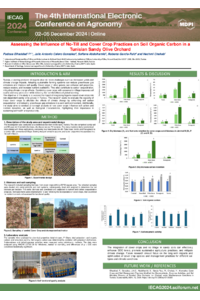
The integration of cover crops and no-tillage practices is gaining attention due to its potential to improve soil health and sustainability in agricultural systems. This study investigated the impact of cover crops and no tillage on soil organic carbon (SOC) in sandy soils, which are typically low in organic matter and prone to erosion. A field experiment was conducted over two growing seasons in a traditional olive orchard located in a semi-arid region in central eastern Tunisia. Legume-seeded (faba bean, vetch, and fenugreek) and non-tilled plots were compared with conventionally plowed plots.
The results demonstrated that cover crops and no tillage significantly increased SOC levels in the 0-30 cm soil depth and exhibited significantly higher enzymatic and microbial activity than the control plots. This increase in SOC was attributed to the aggregation of organic residues from cover crops and reduced soil disturbance, which enhanced microbial activity and carbon sequestration. Cover crops and no tillage also improved soil structure, reduced erosion, and increased water retention, contributing to overall soil health.
Consequently, the integration of cover crops and no tillage in sandy soils can effectively enhance SOC levels, promote sustainable agricultural practices, and mitigate climate change. Future research should focus on the long-term impacts and optimization of cover crop species and management practices for different soil types and climatic conditions
Keywords
Cover crops - No-tillage practices - Soil health - Soil organic carbon (SOC) - Sandy soils - Organic matter
Poster
poster mdpi agronomy conference (2).pdf
Reinforcing ecosystem health and biodiversity in smallholder farming systems through agroecological principles
In vitro growth and sporulation inhibition of the phytopathogenic fungus Cylindrocladium sp. by oregano and peppermint essential oils