Event submissions
Published
This submission belongs to the session S8. Applied Physical Science of the event The 5th International Electronic Conference on Applied Sciences
Published date
02 Dec, 2024
Academic Editor
'%3e%3cpath%20d='M12.6657%2010.9104C12.4185%2010.325%2012.0599%209.79327%2011.6097%209.34482C11.1609%208.89508%2010.6293%208.5365%2010.0442%208.28888C10.0389%208.28626%2010.0337%208.28495%2010.0285%208.28233C10.8446%207.69279%2011.3752%206.73249%2011.3752%205.64904C11.3752%203.8542%209.92103%202.39999%208.1262%202.39999C6.33136%202.39999%204.87715%203.8542%204.87715%205.64904C4.87715%206.73249%205.40774%207.69279%206.22393%208.28364C6.21869%208.28626%206.21345%208.28757%206.20821%208.29019C5.62129%208.5378%205.09463%208.89284%204.64265%209.34613C4.1929%209.79493%203.83432%2010.3266%203.58671%2010.9117C3.34345%2011.4845%203.21226%2012.0987%203.20023%2012.7209C3.19988%2012.7349%203.20233%2012.7488%203.20744%2012.7619C3.21255%2012.7749%203.22022%2012.7867%203.22998%2012.7968C3.23975%2012.8068%203.25142%2012.8147%203.26431%2012.8202C3.2772%2012.8256%203.29105%2012.8284%203.30504%2012.8284H4.09109C4.14874%2012.8284%204.19459%2012.7825%204.1959%2012.7262C4.2221%2011.7148%204.62823%2010.7676%205.34617%2010.0497C6.08899%209.30683%207.0755%208.89808%208.1262%208.89808C9.17689%208.89808%2010.1634%209.30683%2010.9062%2010.0497C11.6242%2010.7676%2012.0303%2011.7148%2012.0565%2012.7262C12.0578%2012.7838%2012.1037%2012.8284%2012.1613%2012.8284H12.9474C12.9613%2012.8284%2012.9752%2012.8256%2012.9881%2012.8202C13.001%2012.8147%2013.0126%2012.8068%2013.0224%2012.7968C13.0322%2012.7867%2013.0398%2012.7749%2013.0449%2012.7619C13.0501%2012.7488%2013.0525%2012.7349%2013.0522%2012.7209C13.0391%2012.0947%2012.9094%2011.4855%2012.6657%2010.9104ZM8.1262%207.9024C7.52486%207.9024%206.9589%207.6679%206.53312%207.24211C6.10733%206.81633%205.87283%206.25037%205.87283%205.64904C5.87283%205.0477%206.10733%204.48174%206.53312%204.05596C6.9589%203.63018%207.52486%203.39567%208.1262%203.39567C8.72753%203.39567%209.29349%203.63018%209.71927%204.05596C10.1451%204.48174%2010.3796%205.0477%2010.3796%205.64904C10.3796%206.25037%2010.1451%206.81633%209.71927%207.24211C9.29349%207.6679%208.72753%207.9024%208.1262%207.9024Z'%20fill='%235D1EE1'/%3e%3c/g%3e%3c/svg%3e) Ali Belarouci
Ali BelarouciCitation
Elias Christoforides, Athena Andreou, Unveiling the Binding Dynamics of two organic compounds with Human Serum Albumin: Integrating Computational, Spectroscopic, and Preliminary Single-Crystal X-ray Diffraction (SCXRD) Insights, in Proceedings of The 5th International Electronic Conference on Applied Sciences, 4 December–6 December 2024, MDPI: Basel, Switzerland
Share
Email
Facebook
Twitter
LinkedIn
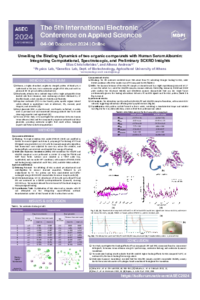
Unveiling the Binding Dynamics of two organic compounds with Human Serum Albumin: Integrating Computational, Spectroscopic, and Preliminary Single-Crystal X-ray Diffraction (SCXRD) Insights

Elias Christoforides 1
'%3e%3cpath%20d='M12.6647%2010.9104C12.4176%2010.325%2012.0589%209.7933%2011.6088%209.34485C11.16%208.89511%2010.6283%208.53653%2010.0432%208.28891C10.038%208.28629%2010.0327%208.28498%2010.0275%208.28236C10.8437%207.69282%2011.3743%206.73252%2011.3743%205.64907C11.3743%203.85423%209.92005%202.40002%208.12522%202.40002C6.33038%202.40002%204.87618%203.85423%204.87618%205.64907C4.87618%206.73252%205.40677%207.69282%206.22296%208.28367C6.21772%208.28629%206.21248%208.2876%206.20724%208.29022C5.62031%208.53783%205.09365%208.89287%204.64167%209.34616C4.19192%209.79496%203.83334%2010.3266%203.58573%2010.9117C3.34247%2011.4846%203.21128%2012.0987%203.19925%2012.721C3.1989%2012.735%203.20135%2012.7489%203.20646%2012.7619C3.21157%2012.7749%203.21924%2012.7868%203.22901%2012.7968C3.23877%2012.8068%203.25045%2012.8148%203.26334%2012.8202C3.27623%2012.8256%203.29007%2012.8284%203.30406%2012.8284H4.09012C4.14776%2012.8284%204.19362%2012.7825%204.19493%2012.7262C4.22113%2011.7148%204.62726%2010.7676%205.34519%2010.0497C6.08802%209.30686%207.07452%208.89811%208.12522%208.89811C9.17592%208.89811%2010.1624%209.30686%2010.9052%2010.0497C11.6232%2010.7676%2012.0293%2011.7148%2012.0555%2012.7262C12.0568%2012.7839%2012.1027%2012.8284%2012.1603%2012.8284H12.9464C12.9604%2012.8284%2012.9742%2012.8256%2012.9871%2012.8202C13%2012.8148%2013.0117%2012.8068%2013.0214%2012.7968C13.0312%2012.7868%2013.0389%2012.7749%2013.044%2012.7619C13.0491%2012.7489%2013.0515%2012.735%2013.0512%2012.721C13.0381%2012.0947%2012.9084%2011.4856%2012.6647%2010.9104ZM8.12522%207.90243C7.52388%207.90243%206.95792%207.66793%206.53214%207.24215C6.10636%206.81636%205.87185%206.2504%205.87185%205.64907C5.87185%205.04773%206.10636%204.48177%206.53214%204.05599C6.95792%203.63021%207.52388%203.3957%208.12522%203.3957C8.72655%203.3957%209.29252%203.63021%209.7183%204.05599C10.1441%204.48177%2010.3786%205.04773%2010.3786%205.64907C10.3786%206.2504%2010.1441%206.81636%209.7183%207.24215C9.29252%207.66793%208.72655%207.90243%208.12522%207.90243Z'%20fill='%235D1EE1'/%3e%3c/g%3e%3c/svg%3e)
Athena Andreou 2
1. Physics Laboratory, Department of Biotechnology, Agricultural University of Athens, Greece
2. Genetics Laboratory, Department of Biotechnology, Agricultural University of Athens, Greece
Abstract
This study investigates the interactions between human serum albumin (HSA) and two detergents, propylene carbonate (PC) and decyl glucoside (DG), using a combination of experimental and computational approaches. Albumin, a highly abundant and multifunctional non-glycosylated protein, plays a crucial role in various physiological processes and exhibits significant changes in plasma levels in response to inflammation. To understand the binding affinity and stability of these detergents with HSA, we employed molecular docking, molecular dynamics (MD) simulations, UV–visible spectroscopy, and preliminary single-crystal X-ray diffraction (SCXRD) analysis. Molecular docking studies revealed that DG binds more effectively to HSA than PC, as indicated by lower free energy of binding (FEB) values. MD simulations provided insights into the stability of the HSA–detergent complexes, showing that while the ligand remained relatively stable, a slight repositioning occurred during the simulation. UV–visible absorption spectroscopy confirmed the interaction of both PC and DG with HSA, evidenced by changes in the absorption spectrum, particularly around 280 nm. Preliminary SCXRD analysis of HSA crystals indicated successful crystallization, though attempts to crystallize the HSA-PC complex were unsuccessful. Overall, this study highlights the binding affinities and interaction dynamics of PC and DG with HSA, emphasizing the impact of these interactions on albumin's functionality. The integration of experimental data and computational modeling offers a comprehensive understanding of these molecular interactions, potentially guiding future research and applications in biological and industrial contexts.
Keywords
human serum albumin (HSA)
propylene carbonate (PC)
Decyl glucoside (DG)
molecular docking
molecular dynamics (MDs)
UV analysis
Poster
Andreou104268_ASEC2024.pdf
Using machine learning (ML) algorithms based on voice disorders to identify Parkinson's disease
The role of a user in a smart space: concepts, challenges, and trends