Event submissions
Published
This submission belongs to the session S3. Sustainable Soil Management and Farming Systems of the event The 4th International Electronic Conference on Agronomy
Published date
02 Dec, 2024
Academic Editor
'%3e%3cpath%20d='M12.6657%2010.9104C12.4185%2010.325%2012.0599%209.79327%2011.6097%209.34482C11.1609%208.89508%2010.6293%208.5365%2010.0442%208.28888C10.0389%208.28626%2010.0337%208.28495%2010.0285%208.28233C10.8446%207.69279%2011.3752%206.73249%2011.3752%205.64904C11.3752%203.8542%209.92103%202.39999%208.1262%202.39999C6.33136%202.39999%204.87715%203.8542%204.87715%205.64904C4.87715%206.73249%205.40774%207.69279%206.22393%208.28364C6.21869%208.28626%206.21345%208.28757%206.20821%208.29019C5.62129%208.5378%205.09463%208.89284%204.64265%209.34613C4.1929%209.79493%203.83432%2010.3266%203.58671%2010.9117C3.34345%2011.4845%203.21226%2012.0987%203.20023%2012.7209C3.19988%2012.7349%203.20233%2012.7488%203.20744%2012.7619C3.21255%2012.7749%203.22022%2012.7867%203.22998%2012.7968C3.23975%2012.8068%203.25142%2012.8147%203.26431%2012.8202C3.2772%2012.8256%203.29105%2012.8284%203.30504%2012.8284H4.09109C4.14874%2012.8284%204.19459%2012.7825%204.1959%2012.7262C4.2221%2011.7148%204.62823%2010.7676%205.34617%2010.0497C6.08899%209.30683%207.0755%208.89808%208.1262%208.89808C9.17689%208.89808%2010.1634%209.30683%2010.9062%2010.0497C11.6242%2010.7676%2012.0303%2011.7148%2012.0565%2012.7262C12.0578%2012.7838%2012.1037%2012.8284%2012.1613%2012.8284H12.9474C12.9613%2012.8284%2012.9752%2012.8256%2012.9881%2012.8202C13.001%2012.8147%2013.0126%2012.8068%2013.0224%2012.7968C13.0322%2012.7867%2013.0398%2012.7749%2013.0449%2012.7619C13.0501%2012.7488%2013.0525%2012.7349%2013.0522%2012.7209C13.0391%2012.0947%2012.9094%2011.4855%2012.6657%2010.9104ZM8.1262%207.9024C7.52486%207.9024%206.9589%207.6679%206.53312%207.24211C6.10733%206.81633%205.87283%206.25037%205.87283%205.64904C5.87283%205.0477%206.10733%204.48174%206.53312%204.05596C6.9589%203.63018%207.52486%203.39567%208.1262%203.39567C8.72753%203.39567%209.29349%203.63018%209.71927%204.05596C10.1451%204.48174%2010.3796%205.0477%2010.3796%205.64904C10.3796%206.25037%2010.1451%206.81633%209.71927%207.24211C9.29349%207.6679%208.72753%207.9024%208.1262%207.9024Z'%20fill='%235D1EE1'/%3e%3c/g%3e%3c/svg%3e) Mirza Hasanuzzaman
Mirza HasanuzzamanCitation
Syarifah Rokiah Syd Kamaruzaman, Nurul Afidah Umoruddin, Fadhilnor Abdullah, Siti Aminah Mohd Hassan, Siti Rafeeqah Romle, Badrul Hisham Johari, Evaluating the Effects of Myco-Vermicompost on the Growth Performance of Pak Choi (Brassica rapa var. chinensis), in Proceedings of The 4th International Electronic Conference on Agronomy, 2 December–5 December 2024, MDPI: Basel, Switzerland
Share
Email
Facebook
Twitter
LinkedIn
Evaluating the Effects of Myco-Vermicompost on the Growth Performance of Pak Choi (Brassica rapa var. chinensis)
'%3e%3cpath%20d='M12.6647%2010.9104C12.4176%2010.325%2012.0589%209.7933%2011.6088%209.34485C11.16%208.89511%2010.6283%208.53653%2010.0432%208.28891C10.038%208.28629%2010.0327%208.28498%2010.0275%208.28236C10.8437%207.69282%2011.3743%206.73252%2011.3743%205.64907C11.3743%203.85423%209.92005%202.40002%208.12522%202.40002C6.33038%202.40002%204.87618%203.85423%204.87618%205.64907C4.87618%206.73252%205.40677%207.69282%206.22296%208.28367C6.21772%208.28629%206.21248%208.2876%206.20724%208.29022C5.62031%208.53783%205.09365%208.89287%204.64167%209.34616C4.19192%209.79496%203.83334%2010.3266%203.58573%2010.9117C3.34247%2011.4846%203.21128%2012.0987%203.19925%2012.721C3.1989%2012.735%203.20135%2012.7489%203.20646%2012.7619C3.21157%2012.7749%203.21924%2012.7868%203.22901%2012.7968C3.23877%2012.8068%203.25045%2012.8148%203.26334%2012.8202C3.27623%2012.8256%203.29007%2012.8284%203.30406%2012.8284H4.09012C4.14776%2012.8284%204.19362%2012.7825%204.19493%2012.7262C4.22113%2011.7148%204.62726%2010.7676%205.34519%2010.0497C6.08802%209.30686%207.07452%208.89811%208.12522%208.89811C9.17592%208.89811%2010.1624%209.30686%2010.9052%2010.0497C11.6232%2010.7676%2012.0293%2011.7148%2012.0555%2012.7262C12.0568%2012.7839%2012.1027%2012.8284%2012.1603%2012.8284H12.9464C12.9604%2012.8284%2012.9742%2012.8256%2012.9871%2012.8202C13%2012.8148%2013.0117%2012.8068%2013.0214%2012.7968C13.0312%2012.7868%2013.0389%2012.7749%2013.044%2012.7619C13.0491%2012.7489%2013.0515%2012.735%2013.0512%2012.721C13.0381%2012.0947%2012.9084%2011.4856%2012.6647%2010.9104ZM8.12522%207.90243C7.52388%207.90243%206.95792%207.66793%206.53214%207.24215C6.10636%206.81636%205.87185%206.2504%205.87185%205.64907C5.87185%205.04773%206.10636%204.48177%206.53214%204.05599C6.95792%203.63021%207.52388%203.3957%208.12522%203.3957C8.72655%203.3957%209.29252%203.63021%209.7183%204.05599C10.1441%204.48177%2010.3786%205.04773%2010.3786%205.64907C10.3786%206.2504%2010.1441%206.81636%209.7183%207.24215C9.29252%207.66793%208.72655%207.90243%208.12522%207.90243Z'%20fill='%235D1EE1'/%3e%3c/g%3e%3c/svg%3e)
Syarifah Rokiah Syd Kamaruzaman 1
Nurul Afidah Umoruddin 1

Fadhilnor Abdullah 1
Siti Aminah Mohd Hassan 2
Siti Rafeeqah Romle 1
Badrul Hisham Johari 1
1. Institute Sustainable of Agrotechnology, University of Malaysia Perlis, Sg.Chucuh Campus, 02100 Padang Besar Perlis Malaysia
2. Department of Chemical Engineering Technology, Faculty of Engineering Technology, Campus Unicity Alam Sg. Chucuh, University of Malaysia Perlis, 02100 Padang Besar Perlis Malaysia
Abstract
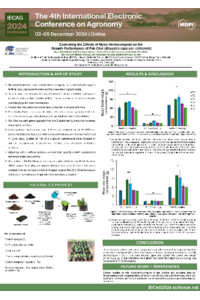
This study evaluates the effects of Myco-Vermicompost, produced by African Night Crawlers (ANCs) from mushroom waste, on the growth performance of Pak Choi (Brassica rapa var. chinensis). Myco-Vermicompost is a high-value organic fertilizer enriched with macro- and micronutrients, vitamins, enzymes, and growth hormones, offering a promising alternative to inorganic fertilizers. The experiment was designed to investigate the effects of Myco-Vermicompost in combination with biochar and topsoil on the growth and productivity of Pak Choi. The Pak Choi was planted with different growing media combinations mixed with Myco-Vermicompost approximately for six (6) treatments. Six treatments were tested, which included Myco-Vermicompost (T1), rice husk (T2), and topsoil (T3), and the combinations Myco-Vermicompost+rice husk (T4), Myco-Vermicompost+topsoil (T5), and Myco-Vermicompost+topsoil+rice husk (T6). At the end of the experimental trial, the fresh weight, the dry weight of the leaves and roots, and the total fresh and dry weight of Pak Choi were recorded to assess growth performance. The results indicated that the highest fresh weight was recorded in plants treated with T4, with values of 83.58g for leaves, 16.98g for roots, and 97.48g for total fresh weight. In contrast, the lowest fresh weight was observed in plants treated with biochar only (T2), for which we recorded 20.08g for leaves, 5.58g for roots, and 25.65g for total fresh weight. For dry weight, Pak Choi planted with topsoil (T3) showed the highest readings, with 8.54g for leaves, 1.52g for roots, and 10.06g for total weight, while the lowest was recorded in biochar treatment (T2), with 1.80g for leaves, 0.50g for roots, and 2.30g for total weight. All treatments showed significant differences (P<0.05). The findings demonstrate that using Myco-Vermicompost significantly enhances growth performance, including plant dry weight, height, and leaf area, compared to normal soil treatment. Therefore, combining Myco-Vermicompost with soil presents a significant positive impact on Pak Choi’s growth performance.
Keywords
Myco-Vermicompost
growth
Pak Choi
African Night Crawlers
Poster
IECAG-103047.pdf
Effects of Aloe Vera-Based Hydrochar on Cherry Tomato and Soil Microbial Activities: Immediate and Six-Month Aged Amendments
The Efficacy of Organic Farming Practices in Mitigating Climate Change: A Systematic Review