Event submissions
Published
This submission belongs to the session S3. Sustainable Soil Management and Farming Systems of the event The 4th International Electronic Conference on Agronomy
Published date
02 Dec, 2024
Academic Editor
'%3e%3cpath%20d='M12.6657%2010.9104C12.4185%2010.325%2012.0599%209.79327%2011.6097%209.34482C11.1609%208.89508%2010.6293%208.5365%2010.0442%208.28888C10.0389%208.28626%2010.0337%208.28495%2010.0285%208.28233C10.8446%207.69279%2011.3752%206.73249%2011.3752%205.64904C11.3752%203.8542%209.92103%202.39999%208.1262%202.39999C6.33136%202.39999%204.87715%203.8542%204.87715%205.64904C4.87715%206.73249%205.40774%207.69279%206.22393%208.28364C6.21869%208.28626%206.21345%208.28757%206.20821%208.29019C5.62129%208.5378%205.09463%208.89284%204.64265%209.34613C4.1929%209.79493%203.83432%2010.3266%203.58671%2010.9117C3.34345%2011.4845%203.21226%2012.0987%203.20023%2012.7209C3.19988%2012.7349%203.20233%2012.7488%203.20744%2012.7619C3.21255%2012.7749%203.22022%2012.7867%203.22998%2012.7968C3.23975%2012.8068%203.25142%2012.8147%203.26431%2012.8202C3.2772%2012.8256%203.29105%2012.8284%203.30504%2012.8284H4.09109C4.14874%2012.8284%204.19459%2012.7825%204.1959%2012.7262C4.2221%2011.7148%204.62823%2010.7676%205.34617%2010.0497C6.08899%209.30683%207.0755%208.89808%208.1262%208.89808C9.17689%208.89808%2010.1634%209.30683%2010.9062%2010.0497C11.6242%2010.7676%2012.0303%2011.7148%2012.0565%2012.7262C12.0578%2012.7838%2012.1037%2012.8284%2012.1613%2012.8284H12.9474C12.9613%2012.8284%2012.9752%2012.8256%2012.9881%2012.8202C13.001%2012.8147%2013.0126%2012.8068%2013.0224%2012.7968C13.0322%2012.7867%2013.0398%2012.7749%2013.0449%2012.7619C13.0501%2012.7488%2013.0525%2012.7349%2013.0522%2012.7209C13.0391%2012.0947%2012.9094%2011.4855%2012.6657%2010.9104ZM8.1262%207.9024C7.52486%207.9024%206.9589%207.6679%206.53312%207.24211C6.10733%206.81633%205.87283%206.25037%205.87283%205.64904C5.87283%205.0477%206.10733%204.48174%206.53312%204.05596C6.9589%203.63018%207.52486%203.39567%208.1262%203.39567C8.72753%203.39567%209.29349%203.63018%209.71927%204.05596C10.1451%204.48174%2010.3796%205.0477%2010.3796%205.64904C10.3796%206.25037%2010.1451%206.81633%209.71927%207.24211C9.29349%207.6679%208.72753%207.9024%208.1262%207.9024Z'%20fill='%235D1EE1'/%3e%3c/g%3e%3c/svg%3e) Mirza Hasanuzzaman
Mirza HasanuzzamanCitation
Yassine Mouniane, Amol Vibhute, Amir Souissi, Issam El-Khadir, Ahmed Chriqui, Driss Hmouni, Association cultivation of Ceratonia siliqua L. and Spergularia salina J.Presl: A sustainable strategy for mitigating salt stress in agriculture, in Proceedings of The 4th International Electronic Conference on Agronomy, 2 December–5 December 2024, MDPI: Basel, Switzerland
Share
Email
Facebook
Twitter
LinkedIn
Association cultivation of Ceratonia siliqua L. and Spergularia salina J.Presl: A sustainable strategy for mitigating salt stress in agriculture
'%3e%3cpath%20d='M12.6647%2010.9104C12.4176%2010.325%2012.0589%209.7933%2011.6088%209.34485C11.16%208.89511%2010.6283%208.53653%2010.0432%208.28891C10.038%208.28629%2010.0327%208.28498%2010.0275%208.28236C10.8437%207.69282%2011.3743%206.73252%2011.3743%205.64907C11.3743%203.85423%209.92005%202.40002%208.12522%202.40002C6.33038%202.40002%204.87618%203.85423%204.87618%205.64907C4.87618%206.73252%205.40677%207.69282%206.22296%208.28367C6.21772%208.28629%206.21248%208.2876%206.20724%208.29022C5.62031%208.53783%205.09365%208.89287%204.64167%209.34616C4.19192%209.79496%203.83334%2010.3266%203.58573%2010.9117C3.34247%2011.4846%203.21128%2012.0987%203.19925%2012.721C3.1989%2012.735%203.20135%2012.7489%203.20646%2012.7619C3.21157%2012.7749%203.21924%2012.7868%203.22901%2012.7968C3.23877%2012.8068%203.25045%2012.8148%203.26334%2012.8202C3.27623%2012.8256%203.29007%2012.8284%203.30406%2012.8284H4.09012C4.14776%2012.8284%204.19362%2012.7825%204.19493%2012.7262C4.22113%2011.7148%204.62726%2010.7676%205.34519%2010.0497C6.08802%209.30686%207.07452%208.89811%208.12522%208.89811C9.17592%208.89811%2010.1624%209.30686%2010.9052%2010.0497C11.6232%2010.7676%2012.0293%2011.7148%2012.0555%2012.7262C12.0568%2012.7839%2012.1027%2012.8284%2012.1603%2012.8284H12.9464C12.9604%2012.8284%2012.9742%2012.8256%2012.9871%2012.8202C13%2012.8148%2013.0117%2012.8068%2013.0214%2012.7968C13.0312%2012.7868%2013.0389%2012.7749%2013.044%2012.7619C13.0491%2012.7489%2013.0515%2012.735%2013.0512%2012.721C13.0381%2012.0947%2012.9084%2011.4856%2012.6647%2010.9104ZM8.12522%207.90243C7.52388%207.90243%206.95792%207.66793%206.53214%207.24215C6.10636%206.81636%205.87185%206.2504%205.87185%205.64907C5.87185%205.04773%206.10636%204.48177%206.53214%204.05599C6.95792%203.63021%207.52388%203.3957%208.12522%203.3957C8.72655%203.3957%209.29252%203.63021%209.7183%204.05599C10.1441%204.48177%2010.3786%205.04773%2010.3786%205.64907C10.3786%206.2504%2010.1441%206.81636%209.7183%207.24215C9.29252%207.66793%208.72655%207.90243%208.12522%207.90243Z'%20fill='%235D1EE1'/%3e%3c/g%3e%3c/svg%3e)
Yassine Mouniane 1
Amol Vibhute 2

Amir Souissi 3
Issam El-Khadir 4
Ahmed Chriqui 4
Driss Hmouni 4
1. Laboratory of Natural Resources and Sustainable Development, Faculty of Sciences, Ibn Tofaïl University—KENITRA-University Campus, Kenitra 14000, Morocco
2. Symbiosis Institute of Computer Studies and Research (SICSR), Symbiosis International (Deemed University), Pune-411016, MH, India.
3. Swift Current Research and Development Centre, Agriculture and Agrifood Canada, Swift Current, SK, Canada
4. Natural Resources and Sustainable Development laboratory, Faculty of Sciences, Ibn Tofail University, B.P 242, Kenitra, Morocco
Abstract
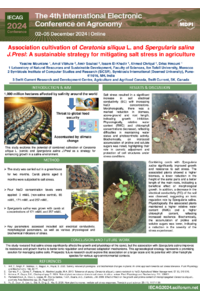
Soil salinization represents a major challenge for agriculture, severely limiting plant growth. At present, over 1,000 million hectares are threatened by this phenomenon, aggravated by climate change and human practices such as excessive irrigation. This problem leads to a drop in agricultural yields and threatens food security. It is crucial to develop sustainable agricultural strategies, including adapted management practices and innovative solutions to mitigate the effects of salinization. This study explores the potential of combined cultivation of Ceratonia siliqua L. (carob) and Spergularia salina J.Presl as a strategy for enhancing growth in a saline environment. Four levels of NaCl concentration were applied, ranging from 0 mM/L to 257 mM/L. Key parameters assessed included soil electrical conductivity, morphological parameters, as well as various physiological and biochemical indicators of stress. The results show that the combination of Ceratonia siliqua and Spergularia salina significantly improves the salt tolerance of carob plants compared with monoculture, as evidenced by the marked difference in the parameters measured. The findings of the study suggest that the associated cultivation of Ceratonia siliqua and Spergularia salina could represent a sustainable solution for maintaining agricultural productivity in saline environments. Indeed, this method not only proves to be effective in improving crop resilience to salt stress, but also offers significant benefits for sustainable soil management.
Keywords
Soil salinization
Ceratonia siliqua L.
Spergularia salina J.Presl
sustainable soil management.
Poster
sciforum-102371 pdf.pdf
Assessing the Efficacy of Citronella and Oregano Biochar for Soil Enhancement
Conservation Agriculture as Integrated and Regenerative Farming Systems for Environment Sustainability in Drylands