Event submissions
Published
This submission belongs to the session S3. Computing and Artificial Intelligence of the event The 5th International Electronic Conference on Applied Sciences
Published date
02 Dec, 2024
Academic Editor
'%3e%3cpath%20d='M12.6657%2010.9104C12.4185%2010.325%2012.0599%209.79327%2011.6097%209.34482C11.1609%208.89508%2010.6293%208.5365%2010.0442%208.28888C10.0389%208.28626%2010.0337%208.28495%2010.0285%208.28233C10.8446%207.69279%2011.3752%206.73249%2011.3752%205.64904C11.3752%203.8542%209.92103%202.39999%208.1262%202.39999C6.33136%202.39999%204.87715%203.8542%204.87715%205.64904C4.87715%206.73249%205.40774%207.69279%206.22393%208.28364C6.21869%208.28626%206.21345%208.28757%206.20821%208.29019C5.62129%208.5378%205.09463%208.89284%204.64265%209.34613C4.1929%209.79493%203.83432%2010.3266%203.58671%2010.9117C3.34345%2011.4845%203.21226%2012.0987%203.20023%2012.7209C3.19988%2012.7349%203.20233%2012.7488%203.20744%2012.7619C3.21255%2012.7749%203.22022%2012.7867%203.22998%2012.7968C3.23975%2012.8068%203.25142%2012.8147%203.26431%2012.8202C3.2772%2012.8256%203.29105%2012.8284%203.30504%2012.8284H4.09109C4.14874%2012.8284%204.19459%2012.7825%204.1959%2012.7262C4.2221%2011.7148%204.62823%2010.7676%205.34617%2010.0497C6.08899%209.30683%207.0755%208.89808%208.1262%208.89808C9.17689%208.89808%2010.1634%209.30683%2010.9062%2010.0497C11.6242%2010.7676%2012.0303%2011.7148%2012.0565%2012.7262C12.0578%2012.7838%2012.1037%2012.8284%2012.1613%2012.8284H12.9474C12.9613%2012.8284%2012.9752%2012.8256%2012.9881%2012.8202C13.001%2012.8147%2013.0126%2012.8068%2013.0224%2012.7968C13.0322%2012.7867%2013.0398%2012.7749%2013.0449%2012.7619C13.0501%2012.7488%2013.0525%2012.7349%2013.0522%2012.7209C13.0391%2012.0947%2012.9094%2011.4855%2012.6657%2010.9104ZM8.1262%207.9024C7.52486%207.9024%206.9589%207.6679%206.53312%207.24211C6.10733%206.81633%205.87283%206.25037%205.87283%205.64904C5.87283%205.0477%206.10733%204.48174%206.53312%204.05596C6.9589%203.63018%207.52486%203.39567%208.1262%203.39567C8.72753%203.39567%209.29349%203.63018%209.71927%204.05596C10.1451%204.48174%2010.3796%205.0477%2010.3796%205.64904C10.3796%206.25037%2010.1451%206.81633%209.71927%207.24211C9.29349%207.6679%208.72753%207.9024%208.1262%207.9024Z'%20fill='%235D1EE1'/%3e%3c/g%3e%3c/svg%3e) Francesco Dell'olio
Francesco Dell'olioCitation
Ahmad Abubakar Suleiman, Hanita Daud, Aliyu Ismail Ishaq, Suleiman Abubakar Suleiman, Rajalingam Sokkalingam, Ameer Hassan Abdullahi, Bashir Danladi Garba, Forecasting COVID-19 Mortality Rates: A Comparative Study of utoregressive Integrated Moving Average and Neural Network Models, in Proceedings of The 5th International Electronic Conference on Applied Sciences, 4 December–6 December 2024, MDPI: Basel, Switzerland
Share
Email
Facebook
Twitter
LinkedIn
Forecasting COVID-19 Mortality Rates: A Comparative Study of utoregressive Integrated Moving Average and Neural Network Models

Ahmad Abubakar Suleiman 1,2
'%3e%3cpath%20d='M12.6647%2010.9104C12.4176%2010.325%2012.0589%209.7933%2011.6088%209.34485C11.16%208.89511%2010.6283%208.53653%2010.0432%208.28891C10.038%208.28629%2010.0327%208.28498%2010.0275%208.28236C10.8437%207.69282%2011.3743%206.73252%2011.3743%205.64907C11.3743%203.85423%209.92005%202.40002%208.12522%202.40002C6.33038%202.40002%204.87618%203.85423%204.87618%205.64907C4.87618%206.73252%205.40677%207.69282%206.22296%208.28367C6.21772%208.28629%206.21248%208.2876%206.20724%208.29022C5.62031%208.53783%205.09365%208.89287%204.64167%209.34616C4.19192%209.79496%203.83334%2010.3266%203.58573%2010.9117C3.34247%2011.4846%203.21128%2012.0987%203.19925%2012.721C3.1989%2012.735%203.20135%2012.7489%203.20646%2012.7619C3.21157%2012.7749%203.21924%2012.7868%203.22901%2012.7968C3.23877%2012.8068%203.25045%2012.8148%203.26334%2012.8202C3.27623%2012.8256%203.29007%2012.8284%203.30406%2012.8284H4.09012C4.14776%2012.8284%204.19362%2012.7825%204.19493%2012.7262C4.22113%2011.7148%204.62726%2010.7676%205.34519%2010.0497C6.08802%209.30686%207.07452%208.89811%208.12522%208.89811C9.17592%208.89811%2010.1624%209.30686%2010.9052%2010.0497C11.6232%2010.7676%2012.0293%2011.7148%2012.0555%2012.7262C12.0568%2012.7839%2012.1027%2012.8284%2012.1603%2012.8284H12.9464C12.9604%2012.8284%2012.9742%2012.8256%2012.9871%2012.8202C13%2012.8148%2013.0117%2012.8068%2013.0214%2012.7968C13.0312%2012.7868%2013.0389%2012.7749%2013.044%2012.7619C13.0491%2012.7489%2013.0515%2012.735%2013.0512%2012.721C13.0381%2012.0947%2012.9084%2011.4856%2012.6647%2010.9104ZM8.12522%207.90243C7.52388%207.90243%206.95792%207.66793%206.53214%207.24215C6.10636%206.81636%205.87185%206.2504%205.87185%205.64907C5.87185%205.04773%206.10636%204.48177%206.53214%204.05599C6.95792%203.63021%207.52388%203.3957%208.12522%203.3957C8.72655%203.3957%209.29252%203.63021%209.7183%204.05599C10.1441%204.48177%2010.3786%205.04773%2010.3786%205.64907C10.3786%206.2504%2010.1441%206.81636%209.7183%207.24215C9.29252%207.66793%208.72655%207.90243%208.12522%207.90243Z'%20fill='%235D1EE1'/%3e%3c/g%3e%3c/svg%3e)
Hanita Daud 1
Aliyu Ismail Ishaq 3
Suleiman Abubakar Suleiman 4
Rajalingam Sokkalingam 1
Ameer Hassan Abdullahi 5
Bashir Danladi Garba 5
1. Fundamental and Applied Sciences Department, Universiti Teknologi PETRONAS, Seri Iskandar 32610, Malaysia
2. Department of Statistics, Aliko Dangote University of Science and Technology, Wudil 713281, Nigeria
3. Department of Statistics, Ahmadu Bello University, Zaria 810107, Nigeria
4. Kano State Agro - Climatic Resilience in Semi-Arid Landscapes, Kano State Ministry of Water Resources, Kano, Nigeria
5. Department of Mathematics, Aliko Dangote University of Science and Technology, Wudil 713281, Nigeria
Abstract
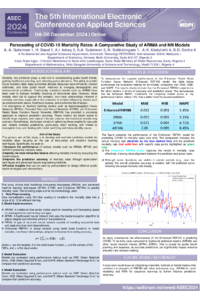
Accurate forecasting of infectious disease incidence is essential for timely intervention and effective government planning. This paper presents a comprehensive study comparing various forecasting models for daily COVID-19 mortality rates in Italy. The models evaluated include the autoregressive integrated moving average (ARIMA) model and three neural network-based models: backpropagation neural networks (BPNNs), radial basis function neural networks (RBFNNs), and Elman recurrent neural networks (ERNNs). RBFNN demonstrated superior performance with the lowest mean absolute error (MAE), mean absolute percentage error (MAPE), and mean square error (MSE), outperforming ARIMA and other neural networks by better capturing non-linear patterns in mortality data. The models’ performance ranking from best to worst was RBFNN, ERNN, BPNN, and ARIMA. These results underscore the effectiveness of neural network models, particularly RBFNN, in accurately forecasting COVID-19 mortality rates. The implications of these findings are significant for public health policy. The improved accuracy of RBFNN in short-term mortality prediction provides valuable insights for pandemic response planning, enabling health authorities to make informed decisions on resource allocation, public health advisories, and emergency preparedness. This study contributes to the literature on infectious disease modeling by demonstrating the advantages of neural networks over traditional statistical methods and offering practical guidance for selecting forecasting models in epidemic scenarios. Our evaluation of forecasting methods thus provides a critical foundation for enhancing predictive accuracy in disease incidence and supporting more responsive public health management.
Keywords
COVID-19
artificial intelligence
machine learning
forecasting
ARIMA model
neural network models
public health
Poster
sciforum-104547.pdf
Exploring the Efficacy of Various Preservative Methods in Extending the Shelf Life of Sugarcane Juice
A patent analysis on 2D-materials in active food packaging