Event submissions
Published
This submission belongs to the session S7. Food Science and Technology of the event The 5th International Electronic Conference on Applied Sciences
Published date
02 Dec, 2024
Academic Editor
'%3e%3cpath%20d='M12.6657%2010.9104C12.4185%2010.325%2012.0599%209.79327%2011.6097%209.34482C11.1609%208.89508%2010.6293%208.5365%2010.0442%208.28888C10.0389%208.28626%2010.0337%208.28495%2010.0285%208.28233C10.8446%207.69279%2011.3752%206.73249%2011.3752%205.64904C11.3752%203.8542%209.92103%202.39999%208.1262%202.39999C6.33136%202.39999%204.87715%203.8542%204.87715%205.64904C4.87715%206.73249%205.40774%207.69279%206.22393%208.28364C6.21869%208.28626%206.21345%208.28757%206.20821%208.29019C5.62129%208.5378%205.09463%208.89284%204.64265%209.34613C4.1929%209.79493%203.83432%2010.3266%203.58671%2010.9117C3.34345%2011.4845%203.21226%2012.0987%203.20023%2012.7209C3.19988%2012.7349%203.20233%2012.7488%203.20744%2012.7619C3.21255%2012.7749%203.22022%2012.7867%203.22998%2012.7968C3.23975%2012.8068%203.25142%2012.8147%203.26431%2012.8202C3.2772%2012.8256%203.29105%2012.8284%203.30504%2012.8284H4.09109C4.14874%2012.8284%204.19459%2012.7825%204.1959%2012.7262C4.2221%2011.7148%204.62823%2010.7676%205.34617%2010.0497C6.08899%209.30683%207.0755%208.89808%208.1262%208.89808C9.17689%208.89808%2010.1634%209.30683%2010.9062%2010.0497C11.6242%2010.7676%2012.0303%2011.7148%2012.0565%2012.7262C12.0578%2012.7838%2012.1037%2012.8284%2012.1613%2012.8284H12.9474C12.9613%2012.8284%2012.9752%2012.8256%2012.9881%2012.8202C13.001%2012.8147%2013.0126%2012.8068%2013.0224%2012.7968C13.0322%2012.7867%2013.0398%2012.7749%2013.0449%2012.7619C13.0501%2012.7488%2013.0525%2012.7349%2013.0522%2012.7209C13.0391%2012.0947%2012.9094%2011.4855%2012.6657%2010.9104ZM8.1262%207.9024C7.52486%207.9024%206.9589%207.6679%206.53312%207.24211C6.10733%206.81633%205.87283%206.25037%205.87283%205.64904C5.87283%205.0477%206.10733%204.48174%206.53312%204.05596C6.9589%203.63018%207.52486%203.39567%208.1262%203.39567C8.72753%203.39567%209.29349%203.63018%209.71927%204.05596C10.1451%204.48174%2010.3796%205.0477%2010.3796%205.64904C10.3796%206.25037%2010.1451%206.81633%209.71927%207.24211C9.29349%207.6679%208.72753%207.9024%208.1262%207.9024Z'%20fill='%235D1EE1'/%3e%3c/g%3e%3c/svg%3e) Antonios Koutelidakis
Antonios KoutelidakisCitation
Katerina Pyrovolou, Spyros Konteles, Eirini Strati, Panagiotis Tataridis, Maria Gouti, Martha Saroufim, Maria-Aglaia Stefani, Athanasios Karabotsos, Dimitra Houhoula, Anthimia Batrinou, Fermentation of carob syrup (Ceratonia siliqua L.) by SCOBY to produce a polyphenol-rich kombucha, in Proceedings of The 5th International Electronic Conference on Applied Sciences, 4 December–6 December 2024, MDPI: Basel, Switzerland
Share
Email
Facebook
Twitter
LinkedIn
Fermentation of carob syrup (Ceratonia siliqua L.) by SCOBY to produce a polyphenol-rich kombucha
'%3e%3cpath%20d='M12.6647%2010.9104C12.4176%2010.325%2012.0589%209.7933%2011.6088%209.34485C11.16%208.89511%2010.6283%208.53653%2010.0432%208.28891C10.038%208.28629%2010.0327%208.28498%2010.0275%208.28236C10.8437%207.69282%2011.3743%206.73252%2011.3743%205.64907C11.3743%203.85423%209.92005%202.40002%208.12522%202.40002C6.33038%202.40002%204.87618%203.85423%204.87618%205.64907C4.87618%206.73252%205.40677%207.69282%206.22296%208.28367C6.21772%208.28629%206.21248%208.2876%206.20724%208.29022C5.62031%208.53783%205.09365%208.89287%204.64167%209.34616C4.19192%209.79496%203.83334%2010.3266%203.58573%2010.9117C3.34247%2011.4846%203.21128%2012.0987%203.19925%2012.721C3.1989%2012.735%203.20135%2012.7489%203.20646%2012.7619C3.21157%2012.7749%203.21924%2012.7868%203.22901%2012.7968C3.23877%2012.8068%203.25045%2012.8148%203.26334%2012.8202C3.27623%2012.8256%203.29007%2012.8284%203.30406%2012.8284H4.09012C4.14776%2012.8284%204.19362%2012.7825%204.19493%2012.7262C4.22113%2011.7148%204.62726%2010.7676%205.34519%2010.0497C6.08802%209.30686%207.07452%208.89811%208.12522%208.89811C9.17592%208.89811%2010.1624%209.30686%2010.9052%2010.0497C11.6232%2010.7676%2012.0293%2011.7148%2012.0555%2012.7262C12.0568%2012.7839%2012.1027%2012.8284%2012.1603%2012.8284H12.9464C12.9604%2012.8284%2012.9742%2012.8256%2012.9871%2012.8202C13%2012.8148%2013.0117%2012.8068%2013.0214%2012.7968C13.0312%2012.7868%2013.0389%2012.7749%2013.044%2012.7619C13.0491%2012.7489%2013.0515%2012.735%2013.0512%2012.721C13.0381%2012.0947%2012.9084%2011.4856%2012.6647%2010.9104ZM8.12522%207.90243C7.52388%207.90243%206.95792%207.66793%206.53214%207.24215C6.10636%206.81636%205.87185%206.2504%205.87185%205.64907C5.87185%205.04773%206.10636%204.48177%206.53214%204.05599C6.95792%203.63021%207.52388%203.3957%208.12522%203.3957C8.72655%203.3957%209.29252%203.63021%209.7183%204.05599C10.1441%204.48177%2010.3786%205.04773%2010.3786%205.64907C10.3786%206.2504%2010.1441%206.81636%209.7183%207.24215C9.29252%207.66793%208.72655%207.90243%208.12522%207.90243Z'%20fill='%235D1EE1'/%3e%3c/g%3e%3c/svg%3e)
Katerina Pyrovolou 1
Spyros Konteles 1
Eirini Strati 1
Panagiotis Tataridis 2
Maria Gouti 1
Martha Saroufim 1
Maria-Aglaia Stefani 1
Athanasios Karabotsos 3
Dimitra Houhoula 1
Anthimia Batrinou 1
1. Department of Food Science and Technology, University of West Attica, Egaleo, Athens, Greece
2. Department of Wine, Vine and Beverage Sciences, University of West Attica, Egaleo, Athens, Greece
3. Department of Conservation of Antiquities and Works of Art, University of West Attica, Egaleo, Athens, Greece
Abstract
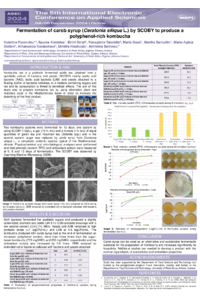
Introduction: Kombucha tea is a probiotic fermented acidic tea obtained from a symbiotic culture of bacteria and yeasts (SCOBY) mainly acetic acid bacteria (AAB), lactic acid bacteria (LAB) and yeasts attached to a floating biofilm of bacterial cellulose, in a medium containing sugars and tea and its consumption is linked to beneficial effects. The aim of this study was to prepare kombucha tea by using alternative plant raw materials used in the Mediterranean basin in order to increase the bioactivity of the final product. Methods: Two kombucha systems were fermented for 12 days, one system by using SCOBY (10g/L), sugar (10 % w/v) and a mixture (1% w/v) of equal quantities of green tea and mountain tea (Sideritis spp) and in the second system, sugar was replaced by carob syrup from Ceratonia siliqua L., a xerophytic endemic species typical of the Mediterranean climate. Physicochemical and microbiological analyses were performed and total phenolic content and antioxidant activity were measured at 0, 6 and 12 days of fermentation. The SCOBY was observed by Scanning Electron Microscopy (SEM). Results: Both systems fermented the available sugars and produced a slightly carbonated, aromatic and acidic (pH 3.12-3.39) probiotic beverage with a low alcohol content (0.5-0.7% ABV). Yeasts and AAB remained at high probiotic levels (>7 logCFU/mL) and LAB at 4-5 logCFU/mL. The kombucha produced with carob syrup had at the end of fermentation an increased polyphenol content, more than three times than the sugar-based kombucha (773 mgGAE/L and 233 mgGAE/L respectively) and the antioxidant activity was increased by 2.4 times. SEM revealed an extended net of bacterial cellulose with bacteria and yeasts attached. Conclusion: Carob syrup can be used as an alternative and sustainable fermentable substrate for the preparation of Kombucha and increases significantly its bioactivity.
Keywords
Kombucha∙Ceratonia siliqua L.∙Fermentation∙Acetic acid bacteria (AAB)∙Lactic acid bacteria (LAB)∙Yeasts
Poster
sciforum-103977.pdf
A Deep Learning-Based Framework for Enhanced Cyberattack Detection and Mitigation in Software Defined Networks
Using bioinformatic predictions to identify key bacterial strains for bioremediation of wildfire-affected soils